
随着中国在台湾问题上采取日益强硬的行动、推行"清零"政策以及一系列其他问题,中西方之间的敌意不断加剧,这促使在华经营或与中国有业务往来的外国企业重新评估其策略。详见《南希·佩洛西访台对你的中国业务实属不利》及《从中国采购产品风险骤增》。
鉴于近期种种事态发展,本所国际制造业律师团队接到大量希望撤离中国的企业来电及邮件咨询。其中多数企业都希望进一步了解墨西哥的相关情况。
我请挚友安德鲁·休珀特阐述将制造业从中国转移至墨西哥的具体流程,主要通过两国对比展开论述。选择安德鲁承担这项近乎艰巨的任务,是因为他长期深耕两国制造业体系,具备独特的内部洞察力。当本律所初涉中国法律业务时,安德鲁常驻中国并为我们提供专业咨询。 尽管安德鲁数十年来将人生与事业扎根中国,但他与我一样,是"后中国制造时代"的早期倡导者。为此他移居墨西哥,重拾西班牙语能力,开始协助企业——尤其是计划撤离中国的企业——开拓墨西哥市场。那么,还有谁比安德鲁·休珀特更适合撰写关于企业(全部或部分)撤离中国、进驻墨西哥的实践指南呢?
以下是本长期系列的第四部分。本期探讨谈判策略——安德鲁对此颇有研究,他曾在全球顶尖商学院教授多门谈判课程。
接下来请看安德鲁带来的第四部分……
有中国经验的西方管理者深知跨境谈判带来的挑战(和风险)。那些考虑进军墨西哥的人则需要适应全新的文化差异。
1. 故事终结
Chinese negotiators are known for being PATIENT PRAGMATISTS. They will wait as long as they have to for the right opportunity or resource. But when they feel a counterparty’s utility value is gone, they will turn to another opportunity -- already under development. Mexican negotiators are DECISIVE but SKEPTICAL. They will assess you, assess your offer, and assess their environment before making a decision. The suddenness of their decision-making may seem jarring to you if you are accustomed to China -- especially if the answer is a definite NO. In Mexico the ability to decide on a next step is the sign of leadership, unlike China where caution is often more highly valued.
The general vibe of the negotiating process is also different. Chinese negotiators want the process to move forward. They like negotiating -- they see it as intrinsic to their identity as managers and as a basic leadership skill. Mexican negotiators usually don’t consider deal-making to be their main job. They want the negotiation over so they can get to work.
2. 分析
让我们深入探讨一下,美国/欧洲谈判代表在与中国和墨西哥的谈判方合作时应牢记的三项关键差异。
- 文化特征:耐心与果断。
- 关系史。丑陋,却与众不同。
- 不! vs. 这很难
A. 文化概况
My main tool for analyzing cultures is "Hofstede 6 Dimension Cultural Comparison tool". There are 6 dimensions of culture. Each culture is ranked based on their position between POLAR OPPOSITES.
- 权力距离(普通人如何看待财富、权力和影响力的不平等分配?)
- 集体主义与个人主义(社会有多注重团队合作?)
- 阳刚或阴柔(为工作而活,还是为生活而工作?)
- 不确定性规避(你能接受不知道接下来会发生什么吗?)
- 传统与务实(长远导向——是抗拒未来还是顺应未来?)
- 放纵与克制(即时回报与耐心等待未来收益)
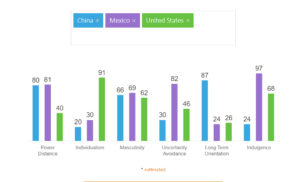
B. 墨西哥与中国之相似性
Both cultures like relationships and networks. China and Mexico both have high power distance and high collectivity scores. This means they both respect authority and are comfortable in group situations. To succeed with either culture you’ll have to work hard to build a relationship -- but once you have established a connection it is usually valuable and long-term.
两种文化的阳刚指数均略高,表明两者都具有相当的攻击性,倾向于达成交易,且存在一定程度的竞争性。这些数值都属于"正常"范畴,并未揭示任何惊天动地的发现。
C. 墨西哥与中国对比
Dimensions #4 & #6. Uncertainty Avoidance and Indulgence are keys to understanding the differences between Mexican and Chinese negotiators. Mexico scores a whopping 97 on the Indulgence dimension compared to an ultra-patient 24 for the Chinese. But wait, there’s more. Look at the Uncertainty Avoidance index to see how each culture feels about uncertainty, loose ends, and lack of clarity. Mexicans HATE this feeling and score a very high 86 here. I've been told that the reasons Mexicans are sensitive to uncertainty is that they feel they have very little control over their day-to-day life, so they are constantly afraid of new disruptions or difficulties. The Chinese side, however, is actually pretty “ok” with uncertainty. The result is that Mexican negotiators tend to be quite decisive and will make what seem like snap decisions to wrap up loose ends and “settle the matter”, even if it’s only settled briefly, and new difficulties crop up immediately. China’s default setting for relationship-building is to develop every potential relationship until there is a reason not to.
We also have to discuss the Long-Term Orientation index. LTO doesn’t mean patience or planning horizon; that’s the Indulgence index. LTO deals with how cultures relate to the past (tradition) and the future (pragmatic). Do you fight the future (“that’s not the we always did it/not the way my Dad did it/not the way God wants it done”) or try to fit in with the future (“I know we’re communists who distrust foreigners and hate landlords, but our grandchildren will be wealthier if they speak English and own property, so that’s what we'll do”). China scores an extremely pragmatic 87 on this index; they are all about preparing for the future. Mexico (along with the U.S.) comes in at the other end of the scale with a very traditional 24, meaning that Mexican negotiators may need a lot of convincing before they agree to try something new.
D. 糟糕的历史——不同的态度
欧美谈判代表在跨境谈判时乐于将历史包袱搁置一旁,而过去的商业环境中,我们的交易对手也乐于配合。请参阅《全球化2.0时代已然来临:新世界秩序的五大特征》。
然而如今,我们历史上某些棘手的元素(如"百年国耻"、入侵并吞并其半壁江山等)正频繁出现在交谈和社交媒体中。过去这些话题对我们影响不大——只要我们记得指令要说得慢、说得响,且不戏谑地威胁动用武力,一切便无大碍。 诚然,我们在中国市场的表现日渐改善,但90年代末我曾参与几次企业访问,当时双方在文化认知上的鸿沟之大令人震惊。
Now, however, the anti-western/anti-U.S. propaganda in China is official, relentless, and ultimately effective. China, as we all know, was occupied and partitioned by the West and Japan during its “century of shame” (百年国耻 Bǎinián Guóchǐ ). We were all happy enough to forget about ancient history (1839 – 1949), but now it’s trending again. Chinese nationalism has become a threat to brands marketing to Chinese consumers, who are caught between a rock and a hard place. It difficult to maintain a China-friendly brand while complying with U.S./Euro policies (i.e., Sweden's H&M boycotted in China for complying with Xinjiang cotton ban). As relations between China and the West continue to deteriorate, look for Western brands and manufacturers to suffer more.
在墨西哥,历史同样不尽如人意,但对商业的影响却截然不同。最近造访蒙特雷时,我参观了东北博物馆,了解到萨尔蒂约(墨西哥的底特律)曾是科阿韦拉-德-特哈斯州(即今得克萨斯州、亚利桑那州及加利福尼亚州大部分地区)的首府,直至1835年。 尽管达拉斯的同胞们对此未必特别兴奋,但科阿韦拉、新莱昂和塔毛利帕斯等繁荣的西北州墨西哥人,却总爱强调他们与得克萨斯州紧密相连的历史渊源。
与墨西哥方进行谈判时,谈判代表需做好充分准备。谈判桌对面的墨西哥人往往保守、虔诚(天主教徒)且注重交易实质。英语媒体(包括商业网站)对普通墨西哥人的刻画存在严重偏差。贩毒集团、难民问题和全包式度假村在墨西哥日常交谈中绝非常见话题。 墨西哥制造商视自身为美国经济体系的重要组成部分,其商业文化也尽可能与美国保持一致。在墨西哥开启对话时,若对方立即深入探讨细节,请勿感到意外。 墨西哥老板虽有意与你合作,但绝不会偏离其商业舒适区。谈判者会先评估你(及产品)的匹配度,再着手建立关系。请专注于商业实质——将那些耸人听闻的头条抛诸脑后。
E. 不!与 很难
中国谈判代表素以不愿直接说"不"而闻名,这种做法实至名归。在中文语境中,直接拒绝常被视为唐突无礼。而墨西哥人则毫不避讳地说"不"。 这恰恰是墨西哥人果断性格的弊端。他们往往对你的意图和承诺持怀疑态度,行事时更倾向于谨慎行事。在漫长的历史进程中,墨西哥人屡屡失去对自身命运的掌控。当墨西哥管理者获得决策机会时,他们会果断行动。若墨西哥合作方对你的提案存疑,他们更可能在早期就予以拒绝,而非冒险探索渺茫的可能性。
这与中国谈判者的做法形成鲜明对比,后者更重视人际关系和社交网络。中国谈判者对自己参与的交易往往表现出极大的耐心,同时他们也意识到你可能对他们社交网络中的其他成员具有价值,因此值得维系这种关系。正因如此,在中国谈判中常会听到诸如"情况比较困难"或"时机尚未成熟,但可能会有变化"之类的表述。 在中国谈判时,明确时间框架和截止期限至关重要。墨西哥的风险在于对方可能迅速拒绝,而在中国则需警惕无休止的沉默。
3. 结论
The biggest differences between Chinese and Mexican negotiators relate to timing and transparency. In China, it’s easy to start a relationship, but it may end up costing you considerable time and energy and yield nothing. In Mexico, your counterparty will qualify you and your deal quickly to decide if you are a legitimate counterparty in terms of your specifics AND their broader business environment. If the answer is NO, you’ll hear it early and definitively. If your deal makes sense and you seem like a committed partner, then the relationship-building process can begin. Both Mexican and Chinese negotiators want to end up in the same place -- a cordial, profitable, long-term business relationship -- but they take different (almost opposite) routes to get there. When approaching Mexico, do your research, show up with good questions, and take the initiative to talk up your commitment to the deal.
安德鲁·休珀特常驻墨西哥,致力于协助国际企业掌控其供应链。在亚洲(上海、台北、香港、西贡)工作逾二十年后,安德鲁决定遵循自身建议,将业务重心移回本土。如今他立足于科阿韦拉州的萨尔蒂约——这座被誉为"墨西哥底特律"的城市,指导企业如何拓展或调整2023年及未来的供应链布局。 他将新事业精炼为一句箴言:"无法掌控供应链与采购的老板,等于无法掌控自己的企业。"欲探讨供应链未来发展,请联系安德鲁·休珀特:Andrew@JLAsociados.com.mx或通过领英建立联系。