NDAs Do NOT Work for China but NNN Agreements Do
Companies preparing to show a Chinese manufacturer a new product often ask our China lawyers whether they can just use the NDA they already have. Usually they cannot, though not because China lacks confidentiality or trade secret laws. A standard Western NDA is aimed at the wrong risk.
An NDA is primarily about disclosure: you give someone confidential information and that person agrees not to reveal it to anyone else. When you give product information to a Chinese manufacturer, though, disclosure to some unrelated third party is often not your biggest concern. Your bigger concern is that the manufacturer will use the information itself. It may use your drawings to make the same product for another customer, or make a slightly different version and sell it under another name. It may pass your information to an affiliate that does the same thing. Or, after learning who your customers are and what they pay, it may go directly to those customers and offer them your product for less. None of that requires the factory to publish a word of your confidential information.
This is why our China manufacturing lawyers generally use an NNN Agreement (non-disclosure, non-use and non-circumvention) rather than a conventional Western NDA. For our full discussion of these agreements, see China NNN Agreements: What They Do, What They Don't, and How to Get Them Right.
The Problem With a Standard NDA
There is nothing inherently wrong with an NDA. If two companies are discussing a possible transaction and their main concern is keeping information confidential, a properly drafted NDA may be exactly what they need. The mistake is assuming that every business relationship involving confidential information carries the same risks. Manufacturing relationships often present different ones.
Suppose you spend two years developing a consumer product. You send a Chinese factory your CAD drawings, specifications, bill of materials and prototype so it can tell you whether it can manufacture the product and at what price, and the factory signs your standard NDA. It never posts your drawings online, never gives them to one of your competitors, and never publicly reveals anything about your product. Six months later, you discover the factory selling a nearly identical product to someone else. Nothing was disclosed. Your information was used, and that distinction is the heart of the difference between a conventional NDA and a China NNN Agreement.
Non-Use Is Often the Most Important Protection
When you give a manufacturer your information, you are permitting it to use that information for a limited purpose. It may need your drawings to quote the job, its engineers may need them to determine whether the product can be made, and if you hire the factory it will obviously use your specifications to make the product for you. Nothing in that arrangement gives the factory permission to use the same information to compete with you.
A strong non-use provision draws that line. The manufacturer may use your information to perform the work you authorized, but it may not use your design, know-how, specifications or drawings to make competing products for itself or for anyone else. Many conventional NDAs never say this clearly because they were written with disclosure in mind rather than competitive use, and a factory can keep your information completely confidential while still using it against you. This is also why translating your American NDA into Chinese usually does not solve the problem. Translation changes the language of the document without changing what the document was designed to do.
Non-Circumvention Protects Against Going Around You
Now suppose the factory has been making your product for a year. It knows what the product costs to make and roughly what you sell it for. It may know who your largest customers are, which markets buy the most product, and what those customers want changed. Then one of your customers gets an email from the factory offering to sell directly at a lower price. Again, the factory may not have disclosed anything. It has gone around you.
A non-circumvention provision is designed to address exactly this. A properly tailored one prevents the manufacturer from using the customers, distributors, suppliers or business opportunities it learned about through you to cut you out of the transaction. For companies whose value lies in product development, branding, sourcing, distribution or customer relationships, this risk can be every bit as serious as disclosure, and a traditional NDA often does little about it.
Non-Disclosure Still Matters
Confidentiality remains important, but a manufacturing relationship requires you to think about where your information will actually travel. Your factory may send a drawing to a component supplier or have a related engineering company work on your design. A mold maker may receive your CAD files, a coating company may see your specifications, and a packaging supplier may see your product months before launch. A standard NDA drafted for two companies exchanging confidential documents may not account for that network. A China NNN Agreement should account for that network by addressing who may receive your information, why they may receive it, and who bears responsibility if it is misused. Telling the factory to keep a secret is the easy part. The real work is controlling how your information is disclosed and used throughout the relationship.
Putting "NNN" on the Cover Does Not Fix a Bad Agreement
There is nothing magical about the letters NNN. A document titled "Non-Disclosure Agreement" could contain excellent non-use and non-circumvention protections, and a document titled "NNN Agreement" can be nearly worthless. We regularly review supposedly China-specific NNN Agreements that identify the Chinese company only by an English name, bind a trading company instead of the mainland factory, define the protected information too narrowly, or leave the factory plenty of room to use the client's work. What matters is what the agreement says, not what it is called.
This is also why pulling an NDA off your company's server, adding the words "non-use" and "non-circumvention," and translating it into Chinese will not necessarily produce a useful China NNN Agreement. The agreement has to fit the deal. That means knowing who will receive your information and who will actually use it, whether affiliates or subcontractors will see it, which uses are permitted and which competitive uses must be prohibited, which customer or business relationships need protection, and which Chinese company is actually agreeing to all of these restrictions.
Getting that last point wrong can make everything else academic. We constantly see agreements signed by a Hong Kong trading company while the mainland factory holding the client's drawings has signed nothing. For more on this problem, see The RedNote Contract Lesson for Companies Doing Business in China.
When an NDA May Be Enough
Sometimes an ordinary confidentiality agreement is enough. If the relationship truly involves little more than an exchange of confidential business information, and there is no realistic concern that the recipient will use that information to compete with you or go around you, you may not need an NNN structure. The important thing is to start with the risk rather than with the form sitting on your server, by asking what the Chinese company could actually do that would hurt you. If the only answer is that it might tell someone else your confidential information, an NDA may address the problem. If the answer includes making your product for somebody else, creating a competing version, giving your designs to an affiliate, or going directly to your customers, an ordinary NDA probably does not do enough.
An NNN Agreement Does Not Replace Your Other China Contracts
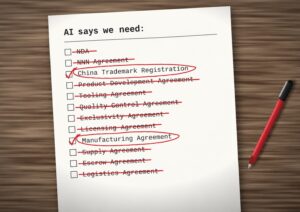
An NNN Agreement has a limited job. It does not register your trademark, establish product specifications or quality standards, determine who owns newly developed technology or your molds and tooling, or govern everything that happens once full-scale manufacturing begins. Those issues require other protections. If you are deciding between an NNN and a manufacturing agreement, see Do I Need a China NNN Agreement or a China Manufacturing Agreement? Usually Both. If you are deciding whether to prioritize an NNN or a China trademark registration, see China NNN Agreement or Trademark Registration? You Usually Need Both.
The Question to Ask
When companies ask whether they can use their standard NDA with a Chinese manufacturer, the better question is what are you trying to prevent? If your only worry is disclosure, an NDA may be enough. Most companies sending valuable product information to a Chinese manufacturer worry about much more: the manufacturer using their information, making their product for someone else, creating a competing product, passing their information through its manufacturing network, or selling directly to their customers. Those are different risks, and your agreement should address them before the manufacturer ever sees your information. The real test is whether your agreement stops the Chinese company from doing the things that could actually hurt you, and a standard NDA rarely does.