China NNN Agreement or Trademark Registration? Usually Both
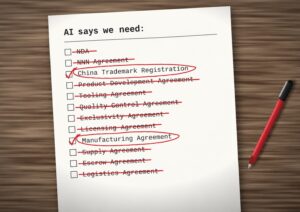
Do you need a China NNN Agreement or a China trademark registration before approaching a Chinese manufacturer? Most branded products custom-manufactured in China need both. A trademark gives you a property right in the brand that you can enforce against third parties. An NNN Agreement controls what its signers can do with the information you give them.
The deadlines differ. File the trademark application as soon as you settle on the brand and clear it for registration. Get an NNN Agreement signed before sending a prospective manufacturer anything worth protecting. These steps often proceed at the same time.
Manufacturing in China Exposes Your Brand
Companies often assume they don’t need a China trademark because they sell in the United States, Canada, or Europe rather than China. But if your name or logo appears on the product or packaging, it becomes visible in China before the goods reach your customers. The factory, sourcing agent, packaging vendor, and freight forwarder can all see it, and any one of them can apply to register it.
A Canadian outerwear company came to us after China Customs detained an important shipment. The Canadian company had used its brand for years, but someone else had registered the name in China and asserted the registration against its goods. With the delay threatening to cost more than a settlement, the company paid six figures to acquire the mark. Filing at the outset would have cost thousands. We discuss that company and similar matters in China Trademark Registration: How to Stop Squatters from Stealing Your Brand. China awards priority to the first applicant, subject to limited exceptions for prior rights and bad-faith filings. An existing business relationship with the applicant can help establish bad faith, as can evidence that the applicant knew of your mark. Prior use outside China does not give an earlier Chinese filing date, and even a strong challenge takes time and money.
A China Trademark Protects You Against More Than Your Factory
A mainland China registration can be enforced against people who never signed a contract with you, including competitors, counterfeiters, online sellers, and distributors. Under China’s Trademark Law, unauthorized use of an identical mark on identical goods infringes the registered right. For similar marks or goods, the law asks whether confusion is likely. Trademark rights are territorial. A registration in the United States, Canada, the European Union, or Australia creates no rights in mainland China. A mainland registration does not cover Hong Kong, Macao, or Taiwan; each has its own trademark system.
File in the name of the entity that should own the brand. Factories and sourcing agents sometimes offer to handle the filing, only for the application to name them as owner. Recovering the mark then requires a transfer, an opposition or invalidation proceeding, or a settlement with the party whose leverage you just increased.
Companies can file directly in China or designate China under the Madrid System. Madrid can be efficient for a larger international portfolio, but it gives counsel less control over China’s subclasses because CNIPA assigns the international goods specification to them. A direct application can be drafted around those subclasses from the start, so we generally prefer that route when China matters to the business. Registration is not the end of the work. Important brands should be monitored for conflicting applications, and companies concerned about counterfeit exports should consider recording their registrations with China Customs.
Filing Well Takes More Than a Name and a Class Number
One client had registered its trademark in China for “gloves.” The Chinese lawyer handling the application placed the mark in Class 25, which covers gloves worn as clothing. The client sold protective work gloves in Class 9. A competitor registered the same mark for those goods and used its registration against one of our client’s shipments. Nobody had asked what kind of gloves the client sold. China uses the international Nice Classification’s 45 classes but divides them into its own subclasses. Those subclasses heavily influence which goods CNIPA treats as similar. A respectable-looking certificate can leave the products that generate the company’s revenue exposed.
Your China trademark lawyer needs to understand what your business sells, identify the proper owner, select the right goods and subclasses, and account for the way the mark appears on your product and its packaging. In the glove matter, filing instructions took the place of trademark strategy. China Trademark Registration: Why U.S. Companies Need More Than a Filing Agent discusses that case, Madrid filings, and other common failures.
A word mark and a logo are separate marks and ordinarily require separate applications. If the words have value apart from the design, the word mark usually deserves priority: it survives a logo redesign and offers more flexible protection. Companies selling to Chinese consumers should also consider registering an official Chinese-character name before the market creates one for them.
Filing establishes an application date, but the exclusive registered right comes later. If the application succeeds, its filing date generally gives it priority over later applications for the same or similar marks on the same or similar goods. Under the Trademark Law that takes effect January 1, 2027, CNIPA has nine months to examine an application. Preliminary approval is followed by a two-month opposition period. Allow about a year for an uncomplicated application and longer for a refusal or opposition. The revised law preserves China’s first-to-file system but tightens the treatment of unused and excessive registrations. CNIPA can initiate cancellation when a mark has become generic or has gone unused for three consecutive years without justification, although the details await implementing rules.
The law also denies damages when a registrant, faced with a nonuse defense, cannot prove use during the preceding three years or another loss. Keep the contracts, invoices, labels, and shipping records that document legitimate use. Five Practical Steps Foreign Brands Should Take to Prepare for China’s New Trademark Law covers the revisions, and the official CNIPA text is available in Chinese.
A well-drafted NNN Agreement prohibits its signers from registering your marks and related names. A breach gives you a contract claim, but the clause reserves nothing at CNIPA and binds no unrelated applicant. You still need to file the trademark application.
The NNN Protects What You Hand Over
A China trademark registration protects your brand, but it does not protect the drawings, formulas, specifications, manufacturing methods, pricing, customer information, or other valuable information you give a prospective manufacturer. That is the role of the NNN Agreement. Non-disclosure restricts sharing. Non-use restricts the recipient from exploiting your information for itself or someone else. Non-circumvention restricts the recipient from using the relationships and opportunities it learns through you to go around you.
An NNN is contractual protection. It binds the companies that sign it; a trademark registration reaches parties that never signed anything with you. For the full discussion of when you need an NNN, who should sign it, and how it should be structured, see China NNN Agreements: What They Do, What They Don't, and How to Get Them Right.
When the Budget Does Not Cover Both
For a branded product with a settled name, the trademark application ordinarily comes first. It reaches beyond your factories, and someone else can take the earlier filing date while you are deciding what to do. Treat the filing as an early supply-chain expense. If the brand has not been chosen and the company must disclose a proprietary design or process to obtain a quote, the NNN comes first. Trademark work begins once there is a settled mark. Some projects need only one. A buyer purchasing unbranded, off-the-shelf components has little confidential information to protect with an NNN. A company developing an unbranded industrial component cares more about its engineering, tooling, and customer relationships than a product name. The facts determine where the money belongs.
Act Before You Lose the Leverage
Outsiders control the trademark deadline. Another party can file tomorrow, and proof that you used the brand elsewhere will not restore the earlier Chinese filing date. Clear the mark, choose the owner, and file before manufacturing makes it visible. The NNN deadline is your first sensitive disclosure. Screen candidates using public information, then obtain signatures before sending the material needed for a quote.
Once you choose the manufacturer, put a comprehensive manufacturing agreement in place before production or any substantial payment. It should cover the production relationship and preserve or deliberately replace the NNN obligations so they don’t disappear by accident. Our earlier post explains why an NNN Agreement and a Manufacturing Agreement perform different jobs. Waiting until the factory has your drawings, tooling, purchase order, and brand means negotiating after your leverage is gone. Our international manufacturing and trademark lawyers can help you put each protection in place while it still works.