
Arlo Kipfer

Arlo is based in Bogotá, where he advises clients on Latin America and China business issues. In addition, Arlo has advised clients on the establishment of several independent and joint venture international schools and he is a frequent speaker at international school conferences.

A person stands on a beach at sunset under a swirling, vibrant sky of red, orange, and blue. Waves approach the shore as houses and a church are visible in the distance.

Your China Employee Signed the Vacation Policy. You Can Still Lose.

Your China Employee Signed the Vacation Policy. You Can Still Lose. Every year, foreign employers in China face the same claim. Their handbook says unused vacation expires at year-end, every employee signed an acknowledgment, HR sent the reminders, and payroll kept a leave spreadsheet. Then an employee resigns or is terminated and demands compensation for

A man pushes a large boulder up a steep, rocky hill under a bright, partly cloudy sky, evoking a struggle or challenge.

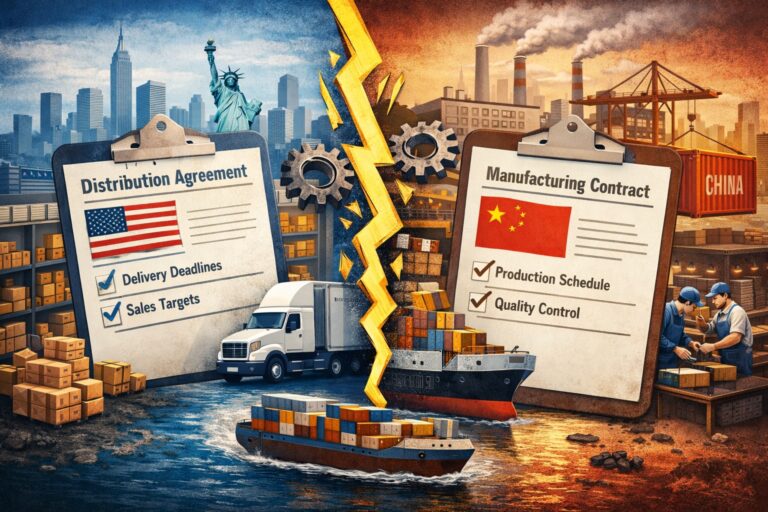
The RedNote Contract Lesson for Companies Doing Business in China

Your China contract may look comprehensive and still bind the wrong company. This article uses the RedNote dispute and two real manufacturing matters to show why contracts must reach the entities that actually control the factory, tooling, technical information, and money, and what can happen when they do not.

Image of a document labeled "NNN Agreement" with a red seal, a padlock featuring the Chinese flag, and a backdrop of shipping cranes and the Great Wall, symbolizing the importance of China NNN Agreements in international business.

China NNN Agreements: The Hard Truth

China NNN Agreements work when they deter Chinese companies from misusing your IP. Here is when they help, when they do not, and how to draft one that will actually work.

A yellow book titled "China Employee Terminations" next to a cutout of China with scales of justice and a judge's gavel on a wooden surface.

China Employment Termination Today: Reinstatement Risk and What Employers Should Do

China Employment Termination Today: Reinstatement Risk and What Employers Should Do A Supreme People’s Court judicial interpretation effective September 1, 2025, has shifted the risk profile of China employment termination disputes. Employers that have treated unlawful termination claims as a predictable, mostly financial exposure should reassess that assumption, because it is now harder to avoid

An illustration of a concerned office worker at a laptop, with a prohibition sign and a map of China in the background, highlighting China's crackdown on excessive working hours.

China Employment Law 2025: 996 Is No Longer Okay

China Employment Law 2025: Working Hours Compliance Guide for Foreign Companies Could a Single Employee Complaint Derail Your China Operations? Imagine this: your Shanghai HR manager picks up the phone. A local employment bureau officer is on the line. Within days, inspectors arrive at your offices, your company name is in the Chinese press, and

Illustration showing a hand pointing at a computer and a phone displaying an "AI generated" label, with a Chinese flag and a padlock in the background. Text reads: "China’s new AI labeling rules.

China’s New AI Labeling Rules: What Every China Business Needs to Know

China’s New AI Labeling Rules: What Every China Business Needs to Know Is Your China Content Strategy About to Break? China is tightening its grip on digital business practices, especially those tied to social trust and content authenticity. If your company still treats China AI compliance as optional, you’re setting yourself up for major problems.

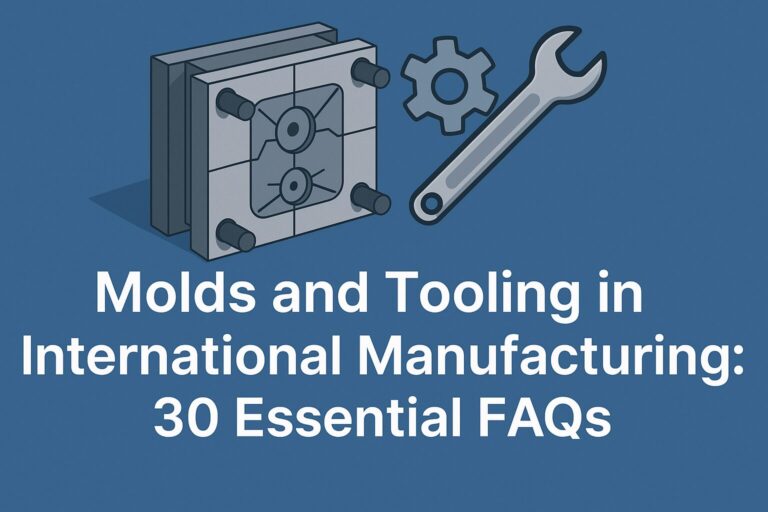
Illustration of a mold, gear, and wrench above the text "Molds and Tooling in International Manufacturing: 30 Essential FAQs" on a blue background.

Molds and Tooling in International Manufacturing: The 30 Essential FAQs

Molds and Tooling in International Manufacturing: 30 Essential FAQs On May 25, we published The Guide to Molds and Tooling in International Manufacturing, laying out just about everything we thought you need to know about molds, tooling, and the contracts that protect them—along with practical steps to secure your supply chain. The response was immediate.