Do I Need a China NNN Agreement or a China Manufacturing Agreement? Usually Both.
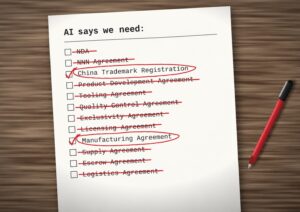
Most companies manufacturing custom products in China need both a China NNN Agreement and a China Manufacturing Agreement, at different points in the project. The NNN Agreement goes in place before you disclose anything sensitive to the factories you are evaluating. The Manufacturing Agreement goes in place after you select your factory and before you pay for tooling, wire a deposit, or start production. Two situations change that answer. If you have already chosen your factory and can sign a comprehensive Manufacturing Agreement before disclosing anything sensitive, that agreement should carry the non-disclosure, non-use, and non-circumvention protections that would otherwise sit in a separate NNN, and the separate NNN becomes unnecessary. If you are buying a small quantity of ordinary off-the-shelf goods and disclosing nothing of value, neither agreement may be worth its cost.
Start by Identifying the Chinese Company That Will Be Bound
Before worrying about the wording of any agreement, identify the company that needs to be bound by it. Foreign buyers routinely get this wrong. They deal with an English-speaking salesperson, a sourcing agent, a Hong Kong company, or a trading company and assume that entity is the factory. The mainland company receiving the drawings and running the production line is often a different legal entity, and it has signed nothing.
We recently wrote about an American buyer whose agreement was with a Hong Kong company while a separate mainland factory made the goods. When the relationship deteriorated, the buyer had a contract with one company and needed rights against another. The same problem arises when one company signs the contract but another holds the molds, the CAD files, or the other assets the buyer needs to move production elsewhere. The RedNote Contract Lesson for Companies Doing Business in China describes two real matters built around this problem.
Identify the mainland company by its exact registered Chinese name and registration information, including its Unified Social Credit Code. The English name on an invoice, a website, an Alibaba page, or an email signature does not necessarily identify the legal entity operating the factory, and often does not. Everything you sign afterward depends on getting this right.
Downloaded forms fail here more than anywhere else. An English-language NDA pulled off the internet and governed by California or New York law can look respectable while binding the wrong company, omitting non-use and non-circumvention protections, and sending disputes to a forum with no practical connection to the factory or its assets. Templates Are Not Contracts: They're Landmines explains why changing the names on a form is not the same as drafting the right agreement.
Get the Company Chop
For mainland Chinese counterparties, we want the verified company to affix its official company chop to the agreement, and we confirm that the Chinese name on the chop matches the company we verified. Getting the verified company to chop the agreement provides the beest evidence that the company itself agreed to the deal, and it eliminates an argument you do not want to be litigating two years later.
Watch how the factory responds to all of this. A factory that wants to negotiate the damages figure or narrow a restriction is bargaining, which is ordinary. A factory that will not disclose its registered Chinese identity, or will not explain why the company making the product cannot execute the contract, is doing something else. Investigate before sending sensitive information or money.
Use the NNN Agreement While You Are Choosing the Factory
Companies evaluating Chinese manufacturers must usually disclose enough for each factory to determine whether it can make the product and what it will charge. That can include drawings, specifications, prototypes, formulas, software, customer lists, or anything else you do not want the factory using for itself or handing to someone else. The NNN Agreement exists because you have to give this material to companies you have not chosen and may never choose.
The three N's are non-disclosure, non-use, and non-circumvention. Non-disclosure keeps the factory from passing your information to others. Non-use keeps it from taking what you provided and competing with you. Non-circumvention keeps it from using what it learns about your customers to sell around you. A conventional NDA falls short in a China manufacturing relationship because the factory does not need to publish your CAD files to hurt you. It can build your design itself, move the project to an affiliate or a subcontractor, or approach a customer it learned about from you. China NNN Agreements: The Hard Truth discusses these differences in more detail.
Sequence your disclosures to limit exposure. If you can screen factories without revealing what makes your product distinctive, do that first, narrow the field, then put NNN Agreements in place with the finalists before giving them anything that matters. Negotiating several full Manufacturing Agreements to obtain preliminary quotes wastes time and money on factories you will not use. Adding manufacturers to an NNN Agreement costs a fraction of the first one and adds no time, so covering every finalist is rarely the expensive choice. Roughly half the time a company comes to us for an NNN Agreement we convince them that they simply do not need one.
China Trade Secret Law Helps, But the Contract Does More
Chinese law protects trade secrets, and that protection depends in part on the owner having taken appropriate steps to keep the information secret. China's revised Anti-Unfair Competition Law, effective October 15, 2025, defines a trade secret as commercial information that is not publicly known, has commercial value, and is subject to appropriate confidentiality measures. The State Administration for Market Regulation's 2026 Provisions on Trade Secret Protection (《商业秘密保护规定》), effective June 1, 2026, make the point clearer still. Article 9 specifically identifies a signed confidentiality agreement or confidentiality obligations within a contract as an appropriate confidentiality measure.
Those rules strengthen trade secret protection and give you a reason to have the contract in the first place. Article 15 also confirms that analyzing a product obtained through public channels is generally lawful, so trade secret protection thins considerably once your product reaches the market, while a contractual non-use obligation binds your factory either way. A well-drafted NNN Agreement goes further by prohibiting conduct you do not want to leave to a later fight over whether particular information qualifies as a trade secret at all. It can restrict disclosure to affiliates and subcontractors, prohibit circumvention, and set consequences for conduct the parties defined in advance, none of which requires you to prove the information met a statutory definition. For more on the new rules, see China's New Trade Secret Rules Do Not Replace China NNN Agreements.
Agreed Damages Give the Agreement Teeth
A China NNN Agreement should attach a credible monetary consequence to specified breaches, because an obligation with no defined consequence invites a fight about the size of your loss at the worst possible moment. China's Civil Code allows the parties to agree in advance on damages for breach, and Article 585 permits a court or arbitration tribunal, on request, to increase an agreed amount that falls below the actual loss or reduce one that is excessively high.
A massive damages number does not make an agreement stronger, and the factory’s chop does not bind a Chinese court to enforce that number as written. The amount should be defensible in light of the likely breach and resulting harm. A properly drafted agreed-damages clause sets a financial consequence in advance, gives the factory something concrete to weigh before misusing your information, and strengthens your position if you need court relief. Our manufacturing lawyers consider many factors in setting that amount. Clients often want a much larger number than the facts support, and we regularly must explain why a lower, defensible number provides better protection.
Once You Choose the Factory, You Need the Manufacturing Agreement
After you select the manufacturer, confidentiality becomes only part of your problem. The factory must make the right product, meet the required quality standards, deliver on time, use the agreed components and processes, and take responsibility when the goods are defective. An NNN Agreement addresses none of that, which is why it cannot serve as your production contract no matter how well it is drafted.
The Manufacturing Agreement turns those expectations into measurable obligations. Specifications and approved samples define what the factory must make. Inspection provisions establish when the goods can be inspected, by whom, and what happens after a failed inspection. Provisions on pricing, delivery, subcontracting, IP ownership, tooling, defect remedies, warranties, and termination address the problems that surface once real money and real production are involved. China Manufacturing Contracts: Why Your Draft Does Not Work goes deeper into those provisions. It will tell your factory which component your product must use, whether a shipment with a 4 percent defect rate is acceptable, whether an unapproved subcontractor may make the goods, or when seasonal inventory must leave the plant.
When a China Manufacturing Agreement Is Worth Its Cost
It always makes sense to weigh the contract you are considering against what is at risk rather than against nothing. A single injection mold routinely costs more than the agreement. A production deposit on a first order usually costs several times more. A season of inventory that arrives defective, arrives late, or arrives at a competitor's warehouse costs more than all of it together.
The calculation runs the other way for a small one-time purchase of ordinary goods, where a full Manufacturing Agreement can cost more than the transaction warrants, and we will tell you so. Once the product is custom or branded, requires tooling, involves a significant deposit, or will be produced repeatedly, the contract is what stands between you and a supplier holding your money, your molds, and your design.
Settle Mold and Tooling Ownership Before Production
Tooling shows why an NNN Agreement cannot do the work of a Manufacturing Agreement, because paying for a mold settles almost nothing. It does not resolve who owns the mold, who may possess it, where it may be used, whether it may be used for other customers, or when the factory must release it. Your Manufacturing Agreement should answer those questions before the factory has the tooling in its building and the relationship has soured. A factory holding your molds has enormous leverage and knows it.
The same principle applies to engineering changes and improvements. If the factory modifies your design, develops a manufacturing solution, or creates other technical work during production, your agreement should establish who owns that work and whether you can take it to another manufacturer. Our guide to molds and tooling in international manufacturing covers these issues in greater detail.
Make the Two Agreements Fit Together
Once the Manufacturing Agreement is signed, it becomes the principal contract. We nearly always fold the NNN protections into it so that one agreement governs the relationship. The Manufacturing Agreement should expressly preserve claims arising from disclosures or breaches that occurred before it was signed. Otherwise, a boilerplate entire-agreement clause can create an argument that the NNN Agreement was superseded, including for the period when the factory was evaluating your product and receiving your drawings. That is often when the most sensitive information changes hands.
If the two agreements remain separate, the Manufacturing Agreement should state that the NNN Agreement remains in force and specify which agreement controls if their terms conflict.
The NNN Agreements signed by the manufacturers you did not select remain your only contractual protection against those companies. Your Manufacturing Agreement with the selected factory does not affect them.
Draft the Contract for Where You Expect to Enforce It
Forum, governing law, and contract language should be selected with enforcement in mind. For most mainland manufacturing relationships, we draft China dispute resolution clauses that provide for Chinese law and litigation before a Chinese court with jurisdiction over the manufacturer. The factory, its bank accounts, its equipment, and the conduct you may need to stop are all in China. A Chinese court can reach those assets directly and, when the legal requirements are met, order preservation measures. A judgment from your home court, however satisfying to obtain, may reach nothing at all.
Arbitration is preferable in some cross-border deals, particularly when the parties or their assets span several jurisdictions. It can also make sense when a state-owned Chinese company refuses to submit to litigation in a local Chinese court but will accept arbitration. The right forum depends on the transaction and the enforcement objective. The foreign buyer’s instinct to keep any future dispute close to home should not decide the issue.
When we expect to enforce an agreement in a mainland Chinese court, we generally make Chinese the controlling language. The Civil Procedure Law requires Chinese courts to conduct proceedings in Chinese and foreign-language documentary evidence to be accompanied by a Chinese translation. A carefully drafted controlling Chinese version keeps the contract’s operative language in the hands of the lawyers who drafted it. If the agreement exists only in English, someone must translate the disputed provisions after the fight has begun, when every word is already being contested. We always prepare an English version as well so our client can review every term before signing, and have it on hand for the duration of the manufacting relationship.
Chinese law does not require Chinese to control every manufacturing contract. We make it controlling because the expected enforcement forum calls for it.
An NNN Agreement Does Not Register Your IP
An NNN Agreement binds the companies that signed it but does nothing to the rest of China. It does not create trademark rights against third parties or replace patent and design filings where those protections make sense.
This distinction matters because China is fundamentally a first-to-file trademark system. A company can hold a strong NNN Agreement with its factory and still face serious problems if it fails to register the trademark appearing on its products or packaging. The agreement can prohibit the factory from filing for your trademark. It cannot bind an unrelated trading company, competitor, or trademark squatter that files first and then uses the registration to interfere with your manufacturing or exports. Registration gives you rights against companies that never signed your contract.
The NNN Agreement, the Manufacturing Agreement, trademark registration, and any appropriate patent or design filings each address a separate risk. The NNN Agreement governs what potential and actual manufacturers can do with the information you disclose. The Manufacturing Agreement governs the production relationship. IP registrations create rights against third parties. Leaving one out does not make the others broader; it leaves that category of risk uncovered.
The Practical Sequence
For most custom manufacturing projects, disclose only what potential factories need to provide a preliminary quote and demonstrate their capabilities. Verify each candidate using its registered Chinese name and registration information. Before revealing what makes your product valuable, have the correct Chinese legal entity properly sign and chop the NNN Agreement. Continue the rest of your supplier due diligence while evaluating the factory. Once you select the manufacturer, sign the Manufacturing Agreement before making substantial tooling payments or deposits and before beginning commercial production. Start the China trademark filing on a separate track as early as possible instead of treating it as the final step.
Sequence is most of the game. Sending drawings before securing protection, paying for molds before settling ownership, or putting only an English trade name in the contract gives away leverage that no later document can fully restore. Resolve these issues while the factory still wants your business and before your money, IP, and production depend on its cooperation.
Frequently Asked Questions
Is a standard NDA good enough for a Chinese factory?
No. A conventional NDA focuses on disclosure and leaves unauthorized use and circumvention largely unaddressed, and those are the two things a factory is most likely to do to you. Standard NDAs also tend to select a US or European court. Chinese courts are under no obligation to enforce a US judgment and generally will not, which leaves you holding a judgment you cannot collect against assets that never leave China.
Can I skip the NNN Agreement and go straight to the Manufacturing Agreement?
Yes, if you have already chosen your factory and can get the Manufacturing Agreement signed before you disclose anything sensitive. Our China Manufacturing Agreements include full non-disclosure, non-use, and non-circumvention provisions, so clients in that position need one contract rather than two. The mistake is assuming you will get there in time and sending drawings during the negotiation.
Does the Manufacturing Agreement replace the NNN Agreement?
Only if it says so deliberately and correctly. Claims for breaches that occurred before the Manufacturing Agreement was signed survive only if the later contract preserves them, and a generic entire-agreement clause can wipe them out along with everything else. Your NNN Agreements with the finalists you did not select are unaffected and remain in force on their own terms.
Will a Chinese court enforce an NNN Agreement?
Chinese courts do enforce contractual obligations of this kind, but the outcome in any case depends on the agreement, the contracting parties, jurisdiction, the evidence, and the relief sought. Two practical features often favor a Chinese forum. Chinese courts can order asset preservation early in a case when the legal requirements are satisfied, and Chinese litigation can reach judgment far faster than comparable US litigation. Neither advantage helps if the company named in your contract is a Hong Kong shell with no assets and the mainland factory never signed.
The greater value of a well-drafted China NNN Agreement, however, is deterrence. A defensible agreed-damages provision gives the factory a concrete financial consequence to consider before it misuses your information, circumvents you, or discloses your product to someone else. The agreement does its best work by preventing the breach from occurring.
What if the factory refuses to sign?
The reason for the refusal is what matters. Negotiating the agreed-damages amount or the scope of a restriction is normal commercial behavior, and legitimate Chinese manufacturers routinely sign NNN Agreements. A factory that refuses to identify the actual manufacturing entity, or that will chop an NNN Agreement but resists a Manufacturing Agreement covering quality, subcontracting, and tooling, is telling you how it intends to run the relationship. Resolve the issue before disclosing information you cannot claw back.
When we first began drafting China NNN Agreements, legitimate factories sometimes flatly refused to sign any written agreement. That changed well before COVID. Since then, we have not had a legitimate Chinese factory refuse to sign a reasonable NNN Agreement.
Does an NNN Agreement protect my China trademark?
No. It restricts the companies bound by it and creates no rights against anyone else in China. Because China awards trademarks to the first party to file, your filing date establishes priority, and registration typically follows within about a year. File before your brand appears on anything you send to a factory.
Does my China Manufacturing Agreement need to be in Chinese?
Usually, yes. When a contract is designed for enforcement in a mainland Chinese court, we generally make Chinese the controlling language and provide an English version so our client can review every term. If the transaction calls for arbitration or enforcement outside China, English may instead be controlling, with Chinese provided as a reference translation. The language follows the enforcement plan.
How long does each agreement take to put in place?
We have drafted thousands of China manufacturing contracts, and we maintain a library of provisions drawn from what actually goes wrong at each stage of a manufacturing relationship. That experience is why we can usually complete an NNN Agreement in two to three days and a Manufacturing Agreement in four to five. This includes our onfirming that your factory exists, is authorized to manufacture your product, and will sign under its exact registered Chinese name.
If you are deciding how to structure a China manufacturing relationship, Harris Sliwoski’s China manufacturing lawyers can identify the protections you need, put them in the proper sequence, and draft the agreements for where they will need to be enforced.