














Get in Touch with Our China Team
Get started by filling out the form, or call 1-888-330-0010 to schedule a free initial consultation.
"*" indicates required fields


We are leading authorities on China’s legal system and business environment.
Contact UsAnd use our deep knowledge of China's laws and business culture to stay there.
Our lawyers have earned international acclaim for providing cutting-edge legal solutions to companies doing business in or with China. Our vast experience handling China-specific entity formation, contracts, intellectual property matters, and dispute resolution gives our clients the security of knowing they have a truly seasoned legal team behind them.
Between our acclaimed China legal team, our on-the-ground China connections, and our budget-conscious approach, it’s clear why companies around the world choose Harris Sliwoski to help them optimize their China operations.


There is no substitute for been there, done that and can do it again.
Do you need help understanding the law in China? We're here to resolve these FAQs on China's law.
China's legal system is a socialist system with codified statutes to ensure equal law application to all members of society. The country characterizes it as "The Socialist Legal System of Laws with Chinese Characteristics."
While China has courts, they do not directly hear constitutional claims. Laws become effective by presidential order and originate with the National People's Congress and its associated standing committee. The Standing Council of the National People's Congress also interprets the law.
Registering a business in China demands a registered address, a business scope that meets China's industrial policies, a Chinese business name and a feasibility study. You also need to register sufficient capital to cover expenses and provide identity documents for all foreign investors. Other requirements may depend on your business's industry and location.
China subscribes to territoriality principles, meaning intellectual protection is only valid in the country or territory of registration. It is a member state of the World Intellectual Property Organization (WIPO) and part of various international treaties to protect IP rights globally.
Key labor laws in China include mandatory written contracts, mandatory social insurance, overtime for working hours beyond the 40-hour workweek and anti-discrimination laws. These laws are complex and designed to ensure employee safety.
China has a comprehensive range of compliance requirements, including labor compliance, taxation compliance and even social responsibility compliance. Please contact us to help you navigate the complexities of Chinese business compliance.
In China, most foreign-owned companies are subject to a standard 25% tax requirement unless their country of origin has a tax treaty with China. Taxation is based on net profits and may also differ by sector or industry. Other taxes, incentives or treaties may apply.
China has three legal umbrellas covering these aspects — the Personal Information Protection Law (PIPL), Data Security Law (DSL) and Cybersecurity Law (CSL). Implementation of these laws in an evolving landscape is more complex.
Due to the complexities of its legal structures, China has limited ability to practice judicial review. Legislative and executive reviews are more common.
Chinese criminal law applies to all citizens and foreign visitors equally. If you break the law in China, they may arrest and detain you for an allowable period before prosecuting you. You'll be subject to the same penalties and punishments as a Chinese citizen if found guilty.
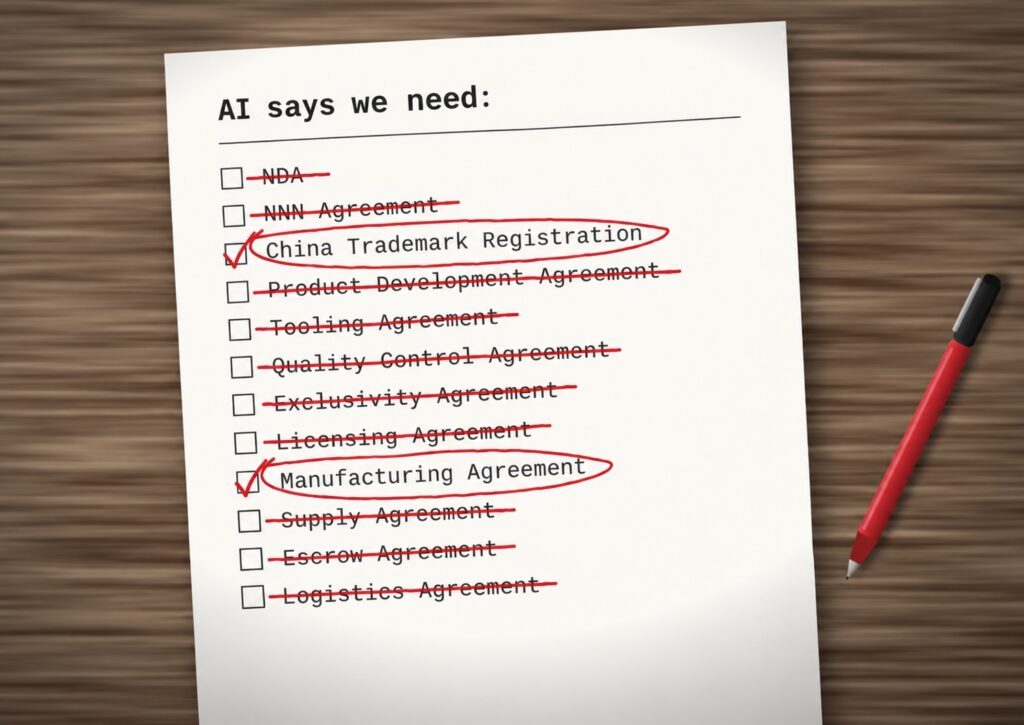
Most companies that come to us with a China question buy from China, and for them the legal work follows a set order. Confirm the Chinese company is who it claims to be, protect your intellectual property before you disclose it, register your trademark in China, and sign a manufacturing agreement that can be enforced there. The costly mistakes nearly always happen at the start, when a company wires a deposit or sends design files before any of this is in place. Companies selling into China, licensing technology to Chinese companies, or setting up operations in China face different issues, including entity formation, regulatory approvals, and employment and tax compliance.
You need a China NNN Agreement. A U.S.-style NDA protects confidentiality, but a Chinese manufacturer rarely needs to leak your information to hurt you. It can use your design to make and sell the product itself, or go around you to sell to your customers. An NNN Agreement covers all three risks: non-disclosure, non-use, and non-circumvention. To be worth anything, it must hold up where the factory and its assets are, which means it must be written in Chinese with the Chinese version controlling, governed by Chinese law, enforceable in a Chinese court, signed and sealed with the official company chop, with the factory identified by its registered Chinese name, and backed by a liquidated damages provision that sets the price of a breach in advance. Sign it before you share anything sensitive. If your design will emerge from work with the factory rather than arrive finished, an NNN is the wrong tool by itself, and you also need a product development agreement that settles who owns what gets created.
Yes. China is a first-to-file country, so the first party to file for your brand there usually gets it, and taking it back is slow, expensive, and uncertain. A factory, distributor, or squatter that registers your name can record it with Chinese customs and have your own products stopped at export, and buying the mark back costs far more than filing would have. Registration takes roughly six to eight months, so file before production starts. File in the right subclasses, not just the right classes, because China's subclasses are narrower than most companies expect and a filing in the correct Nice class can still leave some of your products exposed. Unless you plan to sell in China, you can probably skip registering the Chinese-character version of your brand.
Before you send money or sign anything, confirm the company exists and get its registered Chinese name. The English name a Chinese company puts on its website, business cards, and invoices has no legal standing, and relying on it can leave you unable to prove which company you contracted with. Confirm who owns the company, who its legal representative is, and whether its registered business scope covers what you are buying. Find out whether you are dealing with the factory itself or with a trading company, often in Hong Kong, that stands between you and the factory. For larger deals, check litigation, enforcement, and sanctions records; our Company Reputational Report draws on Chinese public records and on records open only to lawyers licensed in China. When you do pay, pay only into an account in the registered company's name, and treat any request to pay a different account as fraud until proven otherwise.
A good one does far more than tell the factory to make your product. It names the factory by its registered Chinese name, sets specifications and quality standards specific enough to inspect against, and resolves the issues behind most of the disputes we see: who owns the molds and tooling, whether the factory may subcontract your work, what happens when products fail inspection, and what the factory pays when it ships late or ships defective goods. It needs liquidated damages, because proving actual damages in a Chinese court is hard, and it needs the same foundation as an NNN Agreement, with the Chinese version controlling, the company chop, and a dispute mechanism designed around where the factory's assets are. Contracts the factory hands you are written to protect the factory. Contracts copied from U.S. templates, and a growing number drafted with AI, fail for a different reason, which is that nobody built them to be enforced in China. We draft the dispute resolution clause last, because the right forum and governing law depend on everything else in the deal.
Both, and in most cases with the Chinese version controlling. We have drafted thousands of China contracts, nearly all of them bilingual so both sides could read them. Not one said both languages control, because that invites a fight over which version means what, and a Chinese court will read the Chinese anyway. If you might ever need to enforce the contract in China, Chinese should usually govern, and you must know exactly what the Chinese says before you sign. With an English-only contract, the Chinese text the court relies on gets produced for the first time after the dispute starts, when the other side has every reason to fight over it.
Start with the contract. Whether it is in Chinese, which law governs, where disputes go, and whether it names the right Chinese company will determine most of your options. Then look at the money. Below roughly $250,000, litigation or arbitration in China rarely makes sense, because legal costs consume much of any realistic recovery. A U.S. court judgment against a Chinese company with no U.S. assets is usually worth little, because the company and its money are in China. The cases worth bringing almost always share the same features: a Chinese-language contract, sealed with the company chop, naming the company by its registered Chinese name, with a liquidated damages provision. Where those features are missing, negotiation, leverage over future orders, or pursuing the company's assets outside China may accomplish more than a lawsuit. When you do sue in China, ask the court at the outset to freeze the company's assets, because Chinese companies move money fast. A liquidated damages provision helps here too, because it gives the court a fixed sum to freeze against.
Sinosure is China's state-owned export credit insurer. When a foreign buyer does not pay a Chinese exporter, the exporter can file a claim, and Sinosure can pay it and then pursue the buyer through U.S. collection agencies and lawsuits, through proceedings in China, or by blacklisting the buyer so Chinese factories stop selling to it. Across the more than 100 Sinosure matters we have handled, the same rules hold. Suppliers threaten Sinosure far more often than claims materialize, but the period between a threat and a claim is the most useful window you will get, because almost none of the work that protects your business can be done after a claim lands. Do not contact Sinosure yourself, since reaching out signals that you believe the claim is good and that you have assets worth pursuing. Keep owners and key employees out of mainland China until the matter is resolved, because a Chinese company that believes it is owed money can have your people held there until it is paid, through an exit ban or by less formal means.
Dan Harris is a leading authority on China’s legal system and business environment. In addition to making frequent media appearances to speak on Chinese legal issues, they co-author the China Law Blog, which consistently ranks as one of the top English-language legal blogs in the world.
The ABA (American Bar Association) Journal named the China Law Blog as one of the 20 best legal blogs of all time, and for five years in a row the Journal’s readers voted it the best in its category. The China Law Blog offers readers a wealth of information about the types of clients we serve and the legal challenges we help them solve every day.
View BlogGet started by filling out the form, or call 1-888-330-0010 to schedule a free initial consultation.
"*" indicates required fields

“Harris Sliwoski expertly guided us through the formation of our company. They continue to assist with necessary registrations and compliance with numerous regulations. They were able to promptly answer all our many questions and provide understandable options, explanations and practical advice. We expect to continue to use Harris Sliwoski on a regular basis as our company expands. They were also able to introduce us other professional experts. We would not hesitate to recommend Harris Sliwoski to any companies in need of legal advice.”
 Three Continents Foods LLC
This law firm was a huge help as our company went through the process of commercial licensing in the California cannabis industry. They have helped us with a variety of legal issues in a timely fashion, while clearly communicating with us throughout the process. Everyone we’ve worked with at Harris Sliwoski is an expert in their field and we have always felt that we were in good hands through our legal representation.
Wil Crummer, CEO PRO Farms
Legal stuff is always scary. And I've had to play offense a couple times, begrudgingly. To have Harris Sliwoski have my back? It made things a lot less prickly. They quickly walked me through my options, and were refreshingly consistent in their communications, timing and billing. I've been lucky to stay out of the legal side of things my whole career, thankfully. When things went a little wrong, Harris Sliwoski quickly made things right.
Aaron Draplin, Founder Draplin Design Co.
I am impressed with this law firm. They answered all my questions regarding cannabis businesses and the California cannabis framework, and they have helped me with a variety of legal issues in a timely fashion, while always clearly communicating with us throughout the process. They also redirected me to other quality people for my business needs. Everyone I worked with at Harris Sliwoski is an expert in their field, and I was in good hands throughout my legal representation.
Corey T., CEO Thinc Cubed, LLC
I have been working with the lawyers at Harris Sliwoski for more than 20 years both as a business owner and as an executive at a large east-coast health system and that is because they have always efficiently provided high level and clear international law advice. Most recently, Harris Sliwoski provided legal support on many matters related to procuring medical products worldwide. Their support was particularly helpful to during the onset of COVID, when there was a big need for securing PPE quickly, all while navigating complicated international and domestic legal requirements. Harris Sliwoski’s team of international lawyers helped by conducting rapid-fire due diligence on potential suppliers, navigating the legal logistics for getting product from overseas and through U.S. customs, and drafting contracts to protect against various sorts of horribles. They did this by essentially providing what amounted to 24/7 service. I cannot recommend them highly enough.
Dan Pak Hospital Supply Chain Executive
Harris Sliwoski has represented our company in the legal cannabis industry for years. Harris Sliwoski has advised us in a wide variety of legal matters, and they are truly experts in their field. I would highly recommend Harris Sliwoski to anyone with questions about cannabis law, or any legal matters. They have been great for our Company, and will continue to guide us as our industry evolves
Matt Hurt, COO Cannabis Nation
You won't find a better partner than Harris Sliwoski when trying to navigate the complex world of healthcare regulations. They not only give sound and reliable legal advice, but they are also very responsive and are able to guide you in a way that helps you reach your business objectives as well.
Joseph Axelrod, General Counsel Irwin Naturals
When we started the process of building a 'seed to sale' cannabis company in Oregon, we saw the need for expert legal counsel. The cannabis sector is fraught with potential peril at every turn, and we wanted the best legal advice we could find. After talking to several firms and individuals, we feel extremely fortunate to have chosen Harris Sliwoski as our legal counsel.
Tony Theiss, CEO and Co-Founder Redbarn Cannabis
We use Harris Sliwoski on all our international legal matters, including on our international litigation matters. We have over the last few years been involved in a couple big international legal disputes and Harris Sliwoski’s international dispute resolution team provided us with expert legal assistance on both matters. They were always very careful to explain to us what they were doing and why and what their actions would likely cost us in legal fees. Most importantly, we did extremely well on both cases and I have no doubt Harris Sliwoski was a big factor in that.
Kevin English, CEO We Are Camp
We have used Harris Sliwoski for legal help related to our international manufacturing. The lawyers with whom I worked had extensive familiarity with the international legal issues involved in our various projects and offered us key insights. I particularly appreciated how they always quickly and efficiently do what they say they will do and always within their cost estimates.
Andrea Barona Valladolid, Senior Legal Counsel Fairphone