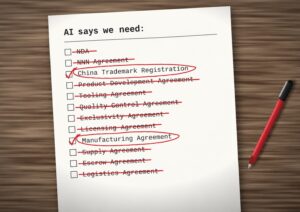
NDAs Do NOT Work for China but NNN Agreements Do

China NNN Agreements: Why a Western NDA Is Usually the Wrong Tool

A conventional Western NDA is usually the wrong agreement for a China manufacturing disclosure. The problem is not that China lacks trade-secret protection. China has strengthened that protection, most recently through new trade-secret regulations that took effect on June 1, 2026. The problem is that trade-secret law and an ordinary confidentiality clause do not necessarily address the business risks that matter most when you give a manufacturer your designs, specifications, pricing, customer information, prototypes, or know-how.

Your factory does not need to publish your drawings on the internet to hurt you. It can use what it learns to make a competing product, pass your information to an affiliate or subcontractor, or approach your customers directly. A properly drafted China NNN Agreement deals with those risks before you disclose the information. NNN stands for non-use, non-disclosure, and non-circumvention.

China’s New Trade-Secret Rules Help, but They Do Not Replace an NNN Agreement

China’s 2026 trade-secret regulations strengthen an already substantial legal framework. They describe the technical and business information that can qualify as trade secrets, spell out reasonable confidentiality measures, and prohibit improper acquisition, disclosure, and use. The regulations recognize confidentiality agreements as one form of protection. They also recognize access controls, encryption, restrictions on copying and storage, data classification, activity logs, and other measures appropriate to the information involved. That is good news for companies doing business in China, but it does not make an NNN Agreement obsolete.

Trade-secret law still requires the information at issue to qualify as a trade secret. The regulations also recognize independent development and lawful reverse engineering. Those limitations make sense, but they show why contract protection remains important.Suppose your manufacturer learns enough from your specifications, samples, pricing, testing history, customer relationships, packaging, and product-development work to build a competing product. You do not want your first legal question to be whether each piece of information the factory used satisfies every element of a trade-secret claim. You want the contract to say what the factory can use, why it can use it, who else can receive it, and what the factory cannot do with it. That is the core of an NNN Agreement.

Why an Ordinary NDA Often Misses the Real Risk

A typical NDA starts with confidentiality. It defines confidential information, prohibits disclosure, creates exceptions for information already known or independently developed, sets a term, and chooses a governing law and forum. There is nothing inherently wrong with that structure. In the right transaction, a good NDA does exactly what it should.

The trouble starts when a company assumes confidentiality is the main risk in a China manufacturing relationship. We once heard from a company that had followed what seemed like a sensible path. It obtained a sample from a Chinese manufacturer, improved the product, hired a U.S. patent lawyer, had the factory sign an NDA, and sent the factory its revised design. The factory delayed the project. It later showed the company a product containing essentially the same improvements and claimed it had developed the product before receiving the customer’s design.

The dispute was no longer simply about disclosure. The important questions were whether the factory could use what it had received, whether it could make a competing product, and how the company could prove what had happened. A well-drafted NNN Agreement would not necessarily have prevented the dispute. No contract can guarantee that. It would have put much clearer rules in place before the factory received the design.

Non-Use: What Can the Factory Do With Your Information?

Non-use is often the most important part of a China NNN Agreement. Your counterparty receives information for a defined purpose and agrees not to use it for itself or anyone else outside that purpose. If you are evaluating a manufacturer, for example, the factory can use your drawings, samples, specifications, and related materials to determine whether it can make your product and on what terms. It cannot use those materials to develop its own competing product or manufacture one for somebody else. The drafting requires more care than saying, “Do not copy our product.”

Products change. Dimensions move. Components are substituted. Features are added or removed. If the contract protects only an exact design, the factory can argue that a modified version falls outside the restriction. Go too far in the other direction and the agreement becomes an open-ended ban on competition. That creates a different problem. The better approach is to identify the information and project being protected, state what uses are permitted, and prohibit competitive use without pretending the factory can never work on another product in the same industry.

This is one place where contract rights and intellectual-property rights do different work. A non-use obligation can restrict agreed conduct without requiring every later claim to fit neatly into patent, copyright, trademark, or trade-secret law.

Non-Disclosure Has to Reflect How Information Actually Moves

Non-disclosure still matters. It just needs to match the way manufacturing relationships work. Factories do not receive important information in a tidy stack of documents stamped “CONFIDENTIAL.” Engineers exchange CAD files. Specifications change in emails and WeChat messages. Pricing moves through spreadsheets. Drawings sit in shared folders. Testing companies receive samples. Suppliers see bills of materials. Technical problems get solved in conversations that nobody thinks to memorialize as formal disclosures. A contract that ignores how information actually moves can leave gaps precisely where the important information is moving.

The “Marked Confidential” Trap

A common mistake is to protect information only if someone specifically marks it “Confidential.” That can work in transactions built around controlled document exchanges. It is risky when hundreds of pieces of technical and commercial information move through informal channels over months. Your protection should not disappear because an engineer sent a revised CAD file without a confidentiality legend or because a product defect was discussed over WeChat rather than in a formally marked memorandum.

China’s 2026 regulations reinforce the point. Marking information is one recognized confidentiality measure, but it is only one. The regulations also recognize confidentiality agreements, access restrictions, encryption, permission controls, data-management measures, and other reasonable safeguards. The contract should protect the information that matters without making protection depend on perfect administrative behavior every time someone sends a file.

Calling Everything Confidential Forever Creates a Different Problem

The opposite mistake is defining every email, conversation, document, fact, idea, and scrap of information exchanged between the parties as confidential forever. That sounds protective. It often creates arguments that a better-drafted agreement would avoid.

Some information was already known to the recipient. Some becomes public. Some is independently developed. Routine commercial information does not deserve the same treatment as an unreleased design, proprietary formula, customer list, or source file. Overbreadth creates disputes about what the clause really covers and whether the parties could realistically comply with it. It can also make a serious commercial agreement look like an attempt to claim everything. Good drafting protects what needs protection through the channels the parties actually use, while dealing sensibly with public information, prior knowledge, independent development, and legitimate third-party sources.

Make Sure the Right Companies Are Bound

Another common failure has little to do with confidentiality language. The wrong companies are bound. Manufacturers use subcontractors. Outside engineers work on products. Design houses modify files. Testing laboratories receive prototypes. Affiliates handle tooling or components. Sourcing agents coordinate suppliers. If another legal entity will receive your information, decide before disclosure how that entity will be covered.

Sometimes the additional company should sign its own agreement. In other cases, the primary counterparty can be made responsible for what specified recipients do with the information. The right structure depends on who will receive the information and what role each company will play. What does not work is assuming Company B is bound because Company A signed the contract and the two share owners, employees, offices, or a factory network. Separate legal entities remain separate legal entities.

The same care is required when identifying the original counterparty. The agreement should use the company’s correct registered Chinese name. An English trade name, a salesperson’s email signature, or the name on an Alibaba page is not enough. Before worrying about the finer points of an NNN clause, make sure you are binding the company that will actually receive and use the information.

Non-Circumvention: Protecting the Business Relationship

Non-circumvention addresses a risk most NDAs barely touch. Suppose you buy a product from a Chinese factory for $40 and sell it abroad for $80. Through the relationship, the factory learns who your customers are, what they buy, how much they order, how much they pay, and how to reach them. The factory then offers substantially the same product directly to those customers for $55. It has not necessarily disclosed your confidential information to the public. It has used the commercial relationship to remove you from the transaction. That is what a non-circumvention clause must be designed to prevent.

The provision still needs boundaries. It should not casually prohibit a manufacturer from selling anything to anyone in an entire industry. It should protect the customers, opportunities, sales channels, or other commercial relationships the factory learns about through its work with you. For companies whose value lies in developing products, finding suppliers, building markets, or controlling customer relationships, circumvention can cause more damage than disclosure.

The Contract Should Work Where the Problem Is

A strong non-use clause does little good if the rest of the contract makes enforcement unnecessarily difficult. For most mainland China manufacturing relationships, the factory, its bank accounts, its equipment, its employees, and the conduct you may need to stop are in China. That often argues for Chinese law, a carefully selected Chinese court, and Chinese as the controlling contract language. Older discussions of China contracts, including some of ours, sometimes said foreign judgments generally were not enforced in China. That formulation is no longer accurate.

China’s amended Civil Procedure Law now provides an express framework for recognizing and enforcing foreign judgments, subject to statutory requirements and grounds for refusal. Recognition can still be difficult, expensive, fact-dependent, and commercially pointless in some cases. But saying China simply does not enforce foreign judgments overstates the law. The practical question remains more useful than the categorical one: if the defendant, its assets, and the conduct you need to address are in China, why obtain a judgment somewhere else and then begin a second proceeding in China? For many NNN Agreements, going directly to the appropriate Chinese court offers the cleaner route. There are transactions where another forum makes more sense, but the choice should follow the parties, assets, likely breach, and remedy rather than one side’s familiarity with its home courts.

Arbitration Is a Real Option, but It Is Not Always the Best One

The same correction is needed for arbitration. It is no longer fair to describe China’s record on foreign arbitral awards as “spotty.” China is a party to the New York Convention, and Chinese courts regularly recognize and enforce foreign arbitral awards. The Supreme People’s Court reported that Chinese courts decided 42 applications involving recognition and enforcement of foreign arbitral awards in 2024 without refusing recognition or enforcement in any of them. That does not make foreign arbitration the automatic choice for an NNN Agreement.

If the immediate problem is unauthorized use in China, preservation of China-based assets, or conduct you need stopped quickly, beginning with an overseas arbitration can add procedural steps before you reach the Chinese court whose assistance you need. Arbitration makes sense in many cross-border transactions, particularly where the parties or assets span several jurisdictions. For a straightforward NNN with a mainland manufacturer, a Chinese court often gives the foreign company a more direct route to the defendant and its assets.

Choose the forum with the likely dispute in mind.

Contract Damages Need to Be Credible

A China NNN Agreement should also address damages with care. Article 585 of China’s Civil Code permits parties to agree on an amount payable for breach or a method for calculating damages. It also allows a court or arbitral tribunal to adjust that amount when it is too low or excessively high compared with the loss. That is why bigger is not always better.

A damages figure should be large enough to matter and defensible enough to survive scrutiny. Unauthorized production, customer circumvention, and misuse of technical information often produce losses that are difficult to prove after the fact. An agreed amount gives the parties a measure of those consequences before the breach occurs. It can also help frame the monetary claim in a property-preservation application, though the damages clause does not by itself entitle anyone to an asset freeze. The normal evidentiary and procedural requirements still apply. We discuss the subject in more detail in China Contract Damages: How Liquidated Damages Give Your Contract Real Teeth. The drafting principle is straightforward: the number should have a commercial rationale. A provision designed to compensate for a plausible loss is much easier to defend than a number chosen simply because it looks frightening.

When a “Mutual NNN” Is Not Enough

Clients sometimes ask us to make an NNN Agreement mutual because both sides will disclose information. If two companies are exchanging confidential information while deciding whether to do business together, mutual obligations can make sense. But that is rarely the case in a manufacturer/product purchaser relationship

The analysis changes when both sides contribute meaningful technology, engineering, software, designs, formulas, or know-how to create something new. Confidentiality is then only part of the problem. Someone needs to own the resulting product and the intellectual property created during development. The parties also need rules for improvements, derivative works, drawings, source files, prototypes, molds, testing results, licensing, commercialization, and what happens if the development project fails. A “mutual NNN” does not answer those questions simply because both parties sign it. When the parties are actually developing a product together, they usually need a Product Development Agreement that allocates those rights from the beginning.

An NNN Agreement Is an Early-Stage Contract

An NNN Agreement is also not a substitute for a Manufacturing Agreement. Its natural place is early in the relationship, while you are evaluating factories and before you disclose information that would hurt you if misused. Once you select the manufacturer, the business relationship becomes much broader. Now you need specifications, quality standards, pricing, delivery requirements, inspection rights, tooling provisions, ownership rules, warranties, restrictions on subcontracting, defect remedies, termination rights, and a workable way to move production if the relationship fails. Those subjects belong in the Manufacturing Agreement.

If you have already selected the manufacturer and can sign a comprehensive Manufacturing Agreement before disclosing anything sensitive, you may not need a separate NNN at all. The Manufacturing Agreement can include the same non-use, non-disclosure, and non-circumvention protections. But more contracts do not automatically mean more protection. The right contract depends on where you are in the relationship. For a broader look at how NNN Agreements, Product Development Agreements, Manufacturing Agreements, and tooling agreements fit together, see China Manufacturing Contracts: When One Agreement Is Not Enough.

An NNN Agreement Does Not Replace China IP Registration

Contract rights and intellectual-property rights solve different problems. An NNN Agreement binds the companies covered by the contract. A China trademark registration, patent, copyright, or other IP right can give you rights against parties that never signed anything with you. That distinction matters especially for trademarks. An NNN Agreement with your factory does not prevent an unrelated third party from filing for your brand in China, nor does it turn a contractual promise into a China trademark registration.

For manufacturers, protection is usually layered. Register the IP worth registering, control sensitive pre-production disclosures by contract, and use the right manufacturing or development agreement once the relationship progresses. We discuss the trademark piece separately in Manufacturing in China: China Trademark Registration Should Be the First Thing You Do.

Not Every China Manufacturing Deal Needs an NNN

NNN Agreements are useful. They are not mandatory paperwork for every transaction involving China. If you are buying an ordinary off-the-shelf product, disclosing nothing commercially important, and giving the supplier no information it can use against you, an NNN may solve a problem you do not have. The same can be true if you have already chosen your manufacturer and can get a complete Manufacturing Agreement signed before any sensitive disclosure.

In other cases, the biggest immediate risk is not confidentiality. It can be your trademark, your tooling, ownership of a jointly developed product, or the financial condition and identity of the company you are about to pay. Start with the risk. Then choose the document.

What a Good China NNN Agreement Actually Does

A useful NNN Agreement requires considerably more than three prohibitions. It identifies the right Chinese legal entity, defines the protected information and permitted uses without swallowing the entire business relationship, and deals with the third parties that will actually receive the information. It anticipates how engineers and factories communicate instead of relying on perfect confidentiality markings.

Its governing law, language, forum, and remedies fit the place where a dispute is most likely to occur. Any agreed damages amount has a commercial basis rather than being plucked from the air. Most important, the agreement is signed before the sensitive information goes out the door. Once the factory has your drawings, prototype, source files, pricing, or customer information, no later contract can recreate the leverage you had before disclosure.

Why China NNN Agreements Still Matter

NNN Agreements matter because trade-secret law and ordinary confidentiality clauses do not answer every commercial question that arises when a manufacturer receives information it can use against you. A well-drafted contract establishes the rules for competitive use, disclosure to others, circumvention, and remedies before those questions turn into a dispute. The time to establish those rules is while you still control the information.

Check Out Our China Law Services

Leave a comment

Your email address will not be published. Required fields are marked *