China Trademark Registration: Why U.S. Companies Need More Than a Filing Agent
A company that makes protective work gloves came to us after China Customs seized one of its shipments. A direct competitor held the China registration covering exactly the gloves our client sold, and China Customs had stopped the shipment based on that registration. Our client had registered its own mark in China years earlier through a lawyer in China who did exactly what he had been asked to do: register the mark for gloves.
The application went into Class 25, which covers gloves worn as clothing. Our client sells protective work gloves, which belong in Class 9. Its registration covered goods it did not sell, while the class covering its protective gloves remained open long enough for a competitor to register the mark and use it against our client at the border.
The client asked for gloves and got gloves. Nobody asked the question that mattered: What kind of gloves?
We see versions of this story regularly. A U.S. company finds an inexpensive China trademark filing service, tells the service what to register, and assumes the job is done. Months or years later, it learns that someone else registered its product name, logo, Chinese name, or the same mark in the class or subclass covering what it sells. The original filing was cheap. Correcting the problem can run into six figures, and sometimes there is no practical remedy.
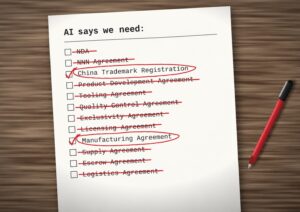
We see the same assumption in companies that otherwise take their China legal risks seriously. A company hires us to investigate its Chinese manufacturer, prepare an NNN Agreement and Product Development Agreement, and later draft its China Manufacturing Agreement. Then it tells us it is sending the China trademark “filing” to a Chinese law firm because that firm charges less.
The terminology is revealing. The company sees its manufacturing contracts as legal work and its trademark application as a form to be filed. Submitting the application is usually straightforward. Deciding what belongs in it is where the legal judgment comes in.
Those contracts do not replace trademark registration. A China trademark and an NNN Agreement protect different assets against different parties, and most branded manufacturing projects need both.
For a direct China trademark application, a foreign company without a business domicile in China generally cannot apply on its own. CNIPA requires the company to use a legally established Chinese trademark agency. Many low-cost online filing services are intermediaries that pass their customers’ instructions to one of those agencies. The business selling the filing service may not be the agency that submits the application.
If a company already knows which marks need protection, which classes and subclasses cover its business, who should own the registrations, and what form each application should take, a good Chinese trademark agent can execute those instructions for less than U.S. counsel. The hard part is knowing whether the instructions are right.
We learned that distinction the slow way. When we began handling China trademark work in earnest about 25 years ago, we went through several agents before finding the one we have now used for more than 15 years. We changed agents because we kept catching errors. Language was rarely the problem. Our lawyers could read the Chinese-language filings, and the agents understood our instructions. Problems arose when an agent did not understand what the American client sold, how its business worked, or why a seemingly small distinction mattered.
Some mistakes were almost comically basic. At least twice, despite precise instructions and arrows showing which way was up, an agent filed a client’s logo upside down. When an agent we selected made an error requiring a new application, we paid to correct it rather than sending the client another bill.
Our China trademark lawyers now handle the trademark strategy, while our Chinese agent handles the filing itself. She is precise and exceptionally good at what we ask her to do. We do not ask her to make the strategic decisions.
File Your China Trademark Before Someone Else Does
China generally gives trademark priority to the first applicant. A U.S. trademark registration does not by itself give its owner trademark rights in China. Prior use ordinarily does not give a company the nationwide exclusive rights that come with registration, though Chinese law recognizes limited prior-use and other exceptions. A company that waits can discover that a manufacturer, distributor, competitor, professional squatter, or complete stranger has filed first.
Getting a mark back can be slow and uncertain. One practical route in the right case is cancellation for non-use, but a registered China trademark generally must go unused for three consecutive years before it becomes vulnerable on that ground. That remedy does little against a mark registered last year.
Filing quickly matters only if the application covers the right marks and goods or services. If nobody asks what the company sells today, how customers encounter its brands, and what it plans to sell next, the application will reflect the list the filing service received rather than the business the trademark is supposed to protect.
Decide What You Need to Register in China
U.S. companies often come to us asking to register their company name in China when the more valuable mark is a product name or another brand customers see. One client had registered its corporate brand and nothing else. Once we understood how the company sold its products, we saw that its flagship product carried a completely different name, displayed far more prominently on the packaging. Nobody had registered that name in China, and nobody else had taken it. We filed before someone did.
The same analysis applies to logos. A combined word-and-logo registration costs less than two separate filings, but the protection attaches to the composite mark as filed. A company that routinely uses its word mark without the logo, or expects to redesign the logo, often gains more flexibility from separate registrations than it saves by combining them.
Protect the Chinese Version of Your Brand -- Sometimes
Registering a Latin-letter mark does not automatically protect a separate Chinese-language version of the brand. Foreign brands often acquire Chinese names whether they plan for one or not. Customers, distributors, manufacturers, and social-media users need something they can pronounce and remember, so a Chinese name begins circulating. If the trademark owner does not choose and register one, someone else can.
Choosing a Chinese mark involves far more than translation. A company can translate the meaning of its original mark, transliterate its sound, invent a different Chinese-character name, or combine those approaches. Chinese characters carry meanings and associations of their own, and a name that sounds close to the English brand can say something the company never intended.
Chinese fluency matters for another reason. We have caught filing and terminology errors because our lawyers read the Chinese application itself rather than relying on an English summary. A client that cannot read the filing cannot independently check what was submitted in its name.
Clear the Brand at Home Before You Build Around It in China
A Chinese filing agent ordinarily is not retained to determine whether a brand is safe to use in the United States. For a U.S. company, that question can matter far more than anything in the China application.
Years ago, a company asked us to register the name of a new product in China. We recognized the name because a large, well-known international company already used it for services in the same broad industry. We told the client the name presented a serious problem and declined to file. The client took the work to another China agent, obtained its China registration, and began selling in the United States under the new name. Within weeks, a cease-and-desist letter arrived from the larger company's U.S. counsel. The client called and asked what would happen if it kept using the name. We explained that litigation was a real risk and defending it would be expensive.
The client rebranded rather than fight. The cost of rebranding and the resulting market disruption were severe enough that the business failed. The China registration did its job, but the company could not use the brand at home.
For a U.S. company planning to use one brand in both countries, the U.S. and China questions need to be considered together. A well-executed China application does not rescue a brand that creates an unacceptable infringement risk in the United States.
File in the Right Class and the Right Subclass
China uses the international Nice Classification system and then divides many classes into subclasses. Goods in different subclasses within the same broad class can be treated as dissimilar, so those subclasses often determine the practical scope of a China trademark registration. A registration in the correct class can leave the company's products exposed if the application lands in the wrong subclass.
Companies also make the opposite mistake by buying far more protection than they need. We once saw an industrial equipment company that had properly protected its mark for its machinery and then filed in seven unrelated classes, including clothing, because somebody had recommended a sweeping defensive strategy. Another client came to us after buying 11 China trademark applications from an online service when one would have covered its real exposure. A provider paid per application has little economic incentive to tell a customer that 10 of the 11 proposed filings are unnecessary.
Broad defensive filings make sense for some companies. A famous consumer brand selling throughout China has a different risk profile from a specialized equipment company manufacturing in China solely for export. The filing strategy should reflect the business rather than a template.
Weigh Madrid Against a National China Trademark Filing
The Madrid System allows companies to seek trademark protection in multiple jurisdictions through an international registration. For some businesses, it is a sensible way to include China in a broader international portfolio. It is not automatically the best route for every China filing. We usually prefer a national China application filed through a Chinese trademark agent because it gives us more control over China's subclass structure. With a Madrid designation, Chinese authorities fit the international specification into China's classification system. With a national application, counsel can draft the goods and services with China's subclasses specifically in mind.
Madrid also carries a five-year dependency period. As WIPO's Guide to the Madrid System explains, an international registration remains dependent on its underlying basic application or registration for five years. If the basic mark ceases to have effect during that period, the international registration can be affected to the same extent.
The Madrid Protocol provides a transformation procedure that can preserve the international registration's filing date, but it requires national or regional applications to be filed within the prescribed period. A Madrid designation for an English-language mark also does not itself protect a separate Chinese-character mark. Madrid can be the right answer, particularly for a company seeking protection in many countries at once. The decision should follow from the company's portfolio and China strategy rather than an assumption that Madrid is always cheaper or easier.
Put the China Trademark in the Right Company
Who owns the application affects far more than the filing itself.
One company properly registered its China trademarks and lost them anyway. Its factory obtained a Chinese judgment against it and seized the registrations to satisfy the judgment. The filings were correct, but the registrations were China assets exposed to enforcement of the factory's judgment. Companies regularly tell us they have no assets in China, and then we find China trademarks, tooling, molds, deposits, inventory, or other property there. A China trademark is an asset in China, its ownership is publicly recorded, and China trademarks can become part of creditor and enforcement proceedings.
Ownership also affects licensing, enforcement, corporate transactions, and what a buyer receives when a business or its intellectual property is sold. In one matter, an employee of a client's China subsidiary handled the filing, and the subsidiary ended up owning the trademark. Nobody noticed for years. During an acquisition, the buyer expected a clean global IP portfolio and discovered that an important China trademark sat in the wrong entity. Closing was delayed while the assignment was recorded, at our client's expense.
Corporate structure, creditor exposure, and litigation risk ordinarily fall outside a filing agent's assignment. Those questions should be addressed before filing, when the company decides whether its China trademarks belong in an operating company, importing company, parent company, or separate IP holding company.
Know Who Is Handling Your China Trademark Filing
Before a China trademark application is filed, the company has disclosed exactly which valuable trademark rights remain unclaimed. Companies have come to us after hiring a Chinese company, a purported law firm, or online service to register a mark, only to be told shortly afterward that someone else had filed the identical mark. The service then explains that the new owner will sell the trademark to the American company for $10,000, $25,000, or whatever amount it believes the company will pay.
In several of these matters, the sequence of events and ownership records pointed to a more troubling explanation. The American company disclosed an unprotected mark to the filing service, and someone connected with the service filed it in the name of a Chinese individual or another straw owner before the client's application went in. The people hired to protect the trademark later returned with the news that a stranger had beaten the client to it, along with an offer to negotiate its return.
The client had disclosed both the identity of an important asset and the fact that it remained unprotected. We have seen enough variations of this pattern that we do not treat it as theoretical, and similar schemes appear in other China legal-service contexts. We have used the same Chinese trademark agent for more than a decade and we know she can be trusted. The point is narrower: know who is receiving the information before sending it. A low filing fee becomes much less attractive when the provider receiving the trademark strategy is an unknown intermediary.
Control What You Send to China
Though Chinese lawyers have some confidentiality obligations, their obligations are not even close to the sorts of protections that come with a U.S. attorney-client privilege. China's Civil Procedure Law gives courts broad authority to collect evidence and it imposes obligations concerning evidence and testimony on organizations and individuals with knowledge of a case. U.S. companies should not assume that the U.S.-style evidentiary privilege they associate with lawyer communications follows those communications into China. Our longer discussion of attorney-client confidentiality in China addresses the distinction in more detail.
Chinese lawyers also practice within a professional system that expressly includes political obligations. Article 2 of the Ministry of Justice's Measures for the Administration of Lawyers' Practice states that lawyers must treat support for Communist Party leadership and socialist rule of law as basic professional requirements. The lawyer oath required of newly licensed or relicensed lawyers likewise includes support for Communist Party leadership and socialist rule of law.
China's national-security laws add another consideration. Article 7 of the National Intelligence Law requires organizations and citizens to support, assist, and cooperate with national intelligence work. Article 16 authorizes intelligence personnel, subject to applicable procedures, to inspect or obtain files, materials, and other items.
None of this means U.S. companies should stop using Chinese lawyers or trademark agents. We use them constantly, and a routine trademark filing rarely requires much commercially sensitive information. The agent needs the mark, the goods or services, the owner, and the required supporting documents. but the analysis changes when the work touches sensitive technology, a planned restructuring, threatened litigation, trade secrets, regulated information, or other material the company would not want circulating beyond a small group. Once sensitive information becomes accessible to Chinese government authorities, a company also has to account for the risk that it reaches state-linked entities or commercial competitors.
The practical rule is simple: decide before sending anything what China needs to see, who needs to see it, and what should remain with U.S. counsel. A trademark agent ordinarily is not retained to make that information-control decision. Make it before the information leaves the United States.
Keep the Registration Alive and Put It to Work
Getting the registration certificate does not end the work. The company still has to deal with any opposition or related proceedings, decide whether Customs recordation makes sense, keep ownership records current, record assignments, and docket renewals. After registration, the company should consider whether to record the trademark with China Customs. Customs recordation can turn the registration into a practical border-enforcement tool against counterfeit or otherwise infringing goods.
A U.S. trademark registration can also be recorded with U.S. Customs and Border Protection. CBP's e-Recordation system allows qualifying trademark owners to work with Customs on border enforcement, and companies exposed to counterfeiting can use China and U.S. Customs recordation as parts of the same enforcement strategy.
The records themselves have to stay accurate. Assignments must be recorded, corporate name and address changes handled, and renewals docketed. A China trademark registration lasts 10 years. By renewal time, the employee who ordered the filing may be gone, the company may have moved, and the email address associated with the matter may no longer work. We have seen assignments where the documents were signed and everyone assumed the transfer was complete, only to discover years later that the official trademark record still showed the former owner because nobody followed the process through.
Where the Money Gets Lost
A Chinese trademark agent usually costs less than experienced U.S. counsel because the assignment is narrower. If a company already knows precisely what it wants filed, in what form, in which classes and subclasses, and in whose name, paying a good Chinese agent to execute those instructions can make perfect sense.
The expensive mistakes usually happen before the filing or outside it. We have seen companies buy 11 applications when one would cover the risk, put an important China trademark in a subsidiary and discover the problem during an acquisition, and pay for a registration covering goods they did not sell while leaving the goods they did sell exposed. Those are strategic mistakes, not filing mistakes.
The lawyer responsible for the strategy needs to understand the client's business and U.S. trademark issues, know how China's classes and subclasses work, recognize when a Chinese-character mark or different ownership structure is needed, and be able to read the Chinese application for which that lawyer is responsible. That is why we decide what the business needs before we tell our Chinese agent what to file. The protective-glove company was not defrauded. It asked someone to register a trademark for gloves, and that is what it got. The mistake was treating filing instructions as a trademark strategy. A Chinese trademark agent can handle the application, but someone still has to make sure the application protects the business.