Your China Contract May Bind the Wrong Company
Xiaohongshu, known outside China as RedNote, has denied reports that a former employee’s complaint delayed a possible Hong Kong IPO. The underlying dispute is real, and it turns on a problem we see constantly in China matters: The company that signs an agreement is not always the company that controls the factory, tooling, money, or employment decision.
Chen Hao’s employment agreement was with a mainland Xiaohongshu company, while his stock options came from an offshore entity. When the relationship ended, the separation between those companies became central to the dispute and later to Chen’s complaint to Hong Kong regulators.
The account here is based on published reports; we have not reviewed the complete court record. Caixin Global reported that Chen argued the positions taken by Xiaohongshu-related entities during the litigation raised disclosure and compliance questions for any future listing.
Chen’s argument does not make the mainland employer responsible for every obligation of the offshore option grantor. Commercial ties between affiliated companies do not automatically make one company liable for another’s debts. But it does raise a practical question every international business should ask: Does the company named in the contract control what the contract is supposed to protect?
The Wrong-Party Problem
Multi-entity structures are standard in international business. An offshore parent raises capital, a Hong Kong affiliate handles invoicing, a U.S. company owns the brand, a mainland subsidiary employs local personnel, and a separate Chinese factory makes the product. Trouble starts when the contracts follow the payment trail or organizational chart instead of the business itself.
Too often, the company issuing the invoice does not control the factory, and the offshore entity signing the NDA never sees the technical information. A contract protects you only if it binds a company that can perform the obligation, prevent the harm, return the asset, or pay a judgment. The name on the invoice may not be that company. For more on verifying and binding the correct legal entity, see China Manufacturing Contracts: Why Your Draft Does Not Work.
The Mold Was “Ours” Until It Wasn’t
We once represented a California company that had purchased a molded plastic product from what it believed was a single Guangdong manufacturer for nearly two years. Every document ran through a Hong Kong company. It sent quotations, issued invoices, accepted payment, and called the mainland factory “our production facility.” Our client understood that it was dealing with one manufacturing operation. Everything about the relationship reinforced that impression.
The client eventually found a less expensive supplier and decided to move production. It asked for its molds back. The Hong Kong company then explained, politely and for the first time, that it did not own the factory and had no molds to return. The mainland factory was a separate company with which our client had never contracted. That factory claimed the molds as its own because it had paid the toolmaker to cut them.
Our client had spent substantial money on tooling it could not prove it owned, because it didn't. The company holding the molds had signed nothing; the company that signed the contract held nothing our client needed. The companies were connected when they wanted the purchase order and separate when the buyer wanted a remedy.
An agreement with the intermediary does not bind a mainland factory simply because the intermediary calls it “our factory.” Hong Kong intermediaries often do real work, including sales, export logistics, and payment collection. An agreement with the intermediary does not bind a mainland factory simply because the intermediary calls it “our factory.” We examine this structure in greater detail in The Hong Kong Intermediary Trap: Do Not Bind the Wrong China Company.
The right structure depends on the transaction. It might require a direct agreement with the factory, a three-party contract, a related-company guarantee, or separate agreements allocating responsibility among the companies involved.
At a minimum, the manufacturing agreement should establish who owns the tooling, where it may be used, and when it must be returned. It should also let the buyer inspect production, control subcontracting, stop unauthorized runs, and move production elsewhere. Length and detail cannot compensate for binding the wrong company. For a detailed discussion of ownership, marking, inspection, use restrictions, and return rights, see THE Guide to Molds and Tooling in International Manufacturing.
The Contract Package Should Follow the Deal
A manufacturing relationship changes over time, and the legal documents should change with it.
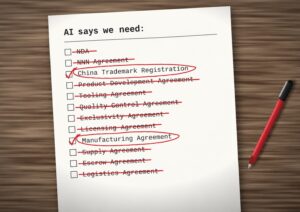
Protecting technical information before sending it usually starts with a China-specific NNN agreement. If the supplier will help develop the product, add a development agreement covering ownership, milestones, and the transfer of technical work. The manufacturing agreement comes next, before commercial production begins, and should address specifications, quality, delivery, warranties, termination, and transition. As we explain in China Manufacturing Contracts: When One Agreement Is Not Enough, the contract package should follow the commercial relationship.
Tooling often requires separate attention, especially when the molds are expensive or necessary to move production. A defensive China trademark strategy should usually be in place before a supplier, distributor, or sourcing company gains leverage over the brand. The point is not to bury the transaction under a pile of paper. It is to bind the company that controls each stage of the deal.
One company may receive the technical information, another may develop the product, and a third may manufacture it. Each important obligation should bind the company capable of causing or preventing the harm.
The NDA That Bound the Wrong Company
The agreement was with a Hong Kong sourcing company. Hong Kong law governed it, and disputes went to Hong Kong arbitration. The mainland factory that made the product, held the CAD files, and opened a second production line for the competitor had never signed anything.
Suing the sourcing company for a leak it did not commit would not have stopped the factory or solved the client’s immediate problem. The mainland factory was the only company capable of stopping the unauthorized production, yet it had never signed the document meant to prevent it. The client had paid for the appearance of protection without the substance. We see this surprisingly often. When we ask why a company relied on such a weak agreement, the answer is usually some version of: “We thought it would be better than nothing.”
A bad agreement has greater potential to be worse than no agreement at all. It may bind the wrong company, require litigation in an ineffective forum, limit useful remedies, or create the false impression that the real risk has been addressed. Without a written agreement, a claim may be difficult and expensive. With the wrong agreement, the company may have signed away useful options without gaining meaningful protection.
A standard Western NDA often fails in China manufacturing because disclosure is only one concern. A supplier may also use the information to make a competing product, sell directly to the buyer’s customers, or manufacture through an affiliate.
A properly drafted China-focused NNN agreement should bind the mainland factory and every other company that receives or can use the information. It should prohibit unauthorized use and circumvention, not merely disclosure. An agreement binding only the offshore sourcing or sales company may never reach the party creating the risk.
The IP You Think You Own
Product development rarely stays within one company. A local engineering team may modify the design, the factory may adapt it for production, and a tooling shop may create the manufacturing drawings. Unless the agreements address those contributions, the buyer may discover that its ownership is incomplete or difficult to prove. The contracts should identify who owns factory-created improvements, production drawings, and tooling designs. They should also ensure that the buyer can take the complete technical package to a replacement manufacturer when the relationship ends.
Possession matters nearly as much as ownership. A factory holding the CAD files, tooling drawings, and product specifications has enormous practical leverage, even when the buyer owns the underlying IP. The NNN agreement, product development agreement, manufacturing contract, tooling provisions, and trademark registrations should reinforce one another. A gap between those documents gives the supplier or an affiliate room to claim rights the buyer assumed it already owned.
When Salary and Equity Come from Different Companies
The RedNote dispute shows how the same problem arises in employment. In a common structure, a mainland company signs the employment agreement and pays the salary, an offshore company grants the stock options, and another affiliate claims ownership of the employee’s inventions.
That arrangement can work, but the documents must explain how the pieces fit together. If managers recruit an employee by presenting salary, bonuses, and offshore equity as one compensation package, the company should identify which entity made each promise and who controls the conditions attached to it. The documents should also explain how termination affects vesting and what happens if the termination is later found unlawful. The offer letter, employment contract, bonus plan, option agreement, and invention assignment do not need identical wording, but they cannot describe incompatible relationships.
Published reports state that a Guangzhou court awarded Chen RMB 190,600 after finding his termination unlawful. His option claim was resolved separately through a mediated payment of RMB 661,500. The result was not a sweeping judgment that disregarded corporate boundaries. The case shows why cross-border offer letters, local employment agreements, and offshore equity plans for China employees must be coordinated. The documents should identify which entity made each promise, who controls vesting, and what happens to the equity if the employee resigns, is terminated, or successfully challenges the termination.
Compliance Claims Without Supply-Chain Control
The same gap undermines compliance claims. A company that tells customers or customs authorities its products meet particular sourcing or country-of-origin rules will struggle to support that claim if it cannot identify the factory, inspect its records, or verify its subcontractors. A promise to comply with “all applicable laws” is not control. Control means having the contractual right to inspect, approve subcontractors, and demand traceability from the company making the goods.
Map the Business as It Really Runs
Start with how the business runs, not the organizational chart. Identify the company controlling each important function and determine who holds the tooling, technical files, inventory, and records. Confirm that those companies have signed enforceable agreements and have assets where enforcement is realistic. Then compare that operational map with the contracts, employment documents, compliance statements, and investor materials.
The goal is not to ignore legitimate corporate boundaries. It is to prevent the legal documents from describing a business that does not exist. Make sure your contracts bind the companies that control the factory, tooling, information, and money.
A dispute is the worst time to discover that they do not.