China NNN Agreements: What They Do, What They Don't, and How to Get Them Right
If you are about to show a Chinese company a new product, design, formula, manufacturing process or customer list, you need more than an NDA. For decades, companies doing international business have reached for a non-disclosure agreement whenever confidential information is about to change hands. But with Chinese manufacturers, NDAs do not work. Chief among the reasons an NDA does not work for China is because a Chinese factory handing your drawings to some unrelated third party is rarely the problem. What we see far more often is a Chinese factory that uses your information itself, passes it to an affiliate or subcontractor that uses it, makes your product for another buyer, develops a competing version, or goes straight to your customers and sells them the same product for less.
A traditional NDA does little about any of that, which is why our China lawyers use an NNN Agreement (non-disclosure, non-use and non-circumvention) when a client needs contractual protection before revealing valuable information to a Chinese company. For a focused comparison, see NDAs Do NOT Work for China but NNN Agreements Do. An NNN is one tool among several, and not every company doing business in China needs one. Sometimes a China trademark registration matters more. Sometimes the right answer is a product development agreement or a manufacturing agreement. And sometimes the best protection is a supply chain structured so that no supplier ever learns enough to copy you.
What the Three Ns Do
Each of the three Ns addresses a different risk. Most companies focus almost entirely on the first, even though unauthorized use of information usually poses a much greater commercial threat than unauthorized disclosure. Suppose you give a Chinese manufacturer the specifications for a new consumer product. The factory never publishes them and never sends them to your competitors, so in the narrow sense they stay confidential. Then it starts making a nearly identical product under another brand. Nothing was disclosed, and you still have a serious problem. NNN Agreements exist to close that gap.
Non-Disclosure
The first N most resembles a traditional NDA. It bars the Chinese company from revealing your designs, specifications, drawings, formulas, customer information, pricing or other protected material to unauthorized third parties. Even this familiar obligation has to be drafted for how Chinese manufacturing works. The main disclosure risk is your information moving through the manufacturer's own network of affiliates, sister companies, family-owned companies, component suppliers, subcontractors, mold makers and packaging companies. The manufacturer may not think of sharing within that network as disclosure at all, but you probably do.
A China NNN therefore needs to say who may receive your information, for what purpose, and who is responsible if an affiliate, subcontractor or employee misuses it. Making your contracting party responsible for an affiliate's misuse does not make the affiliate a party to the contract. If another company will receive especially sensitive information, perform essential engineering work or hold your tooling, consider having that company sign as well. We regularly see agreements that bind a Hong Kong sourcing company while the mainland factory holding the client's CAD files has signed nothing.
When that factory later produces for a competitor, the client has contract rights against the company standing next to the problem and none against the company causing it. Our post The RedNote Contract Lesson for Companies Doing Business in China looks more closely at this wrong-party problem.
Our China lawyers address this risk with research. We check official Chinese government databases to confirm that the counterparty actually exists, that it is authorized to engage in the business covered by the contract, and that we have its exact registered Chinese character name in the agreement. We have drafted thousands of contracts with Chinese companies, and we have done this work on every one. If you get the entity, its authority, or its legal name wrong, you can end up with a contract that is difficult or impossible to enforce against the company you thought you were binding.
Non-Use
For many companies, non-use is the most important of the three. You give the Chinese company your information for a specific commercial reason, usually to quote, develop or manufacture a product for you. That is not permission to use the same information for itself or anyone else, and a strong non-use provision draws that line. The manufacturer may use your information to do authorized work for you. It may not use your design, know-how, specifications or drawings to make competing products for itself or another customer.
This matters most when conventional intellectual property law does not fully protect the product. You may have no patent, your application may still be pending, or key elements of the product may not be patentable at all. Your competitive advantage may come from a combination of ordinary components, manufacturing knowledge, sourcing, tolerances and design choices that is valuable as a package even though no single piece qualifies for strong standalone protection. In those circumstances the contract carries most of the weight. It should define what the recipient may and may not do with what you provide, so you are not left arguing later about whether each piece of information qualifies as a trade secret.
A non-use provision also needs boundaries in both directions. If it prohibits only exact copies, the factory can change a dimension, modify a feature and call the result a different product. If it bars the factory from making anything resembling your product, it becomes an industry-wide non-compete and invites a fight over enforceability. The better approach identifies the project and the information being protected, defines what the Chinese company may do with that information, and prohibits competitive use arising from what you disclosed. That stops the manufacturer from exploiting your work while leaving it free to serve the rest of its market.
Chinese counterparties sometimes propose narrowing protection for "confidential information" to protection only for "trade secrets." Resist that change, because it can gut the agreement. A trade secret claim depends on proving that the information meets the legal definition of a trade secret. A contractual non-use claim asks a simpler question: did we give you this information for a limited purpose, and did you use it for something else? If your NNN protects only information that independently qualifies as a trade secret, the eventual dispute will turn on whether your information meets that definition rather than on whether the factory broke its promise.
China's trade secret regime has grown stronger. The State Administration for Market Regulation adopted new Provisions on the Protection of Trade Secrets on February 24, 2026, and they took effect on June 1, 2026, replacing rules dating from 1995. They give rights holders an administrative enforcement route alongside civil litigation and criminal prosecution, and they list confidentiality agreements among the measures that count as reasonable steps to protect secrecy. All of this helps, but none of it makes an NNN Agreement obsolete. Trade secret law still asks whether particular information qualifies, and it still recognizes defenses such as independent development and lawful reverse engineering. An NNN answers a different question: what did this particular company promise not to do with the information and opportunities you gave it?
Non-Circumvention
The third N addresses a risk NDAs usually ignore entirely. After two years of making your product, a factory knows what it costs to make and what you charge for it. It knows who buys it, how it is packaged, which markets and distributors move the most volume, and what changes your customers want. Then one of your customers gets a message from the factory offering to sell directly at 30 percent less than you charge. A confidentiality clause does not necessarily prevent that. A properly tailored non-circumvention provision does, because it bars the Chinese company from using the relationships and information it acquired through you to go around you.
This protection counts most for companies whose worth lies in product development, branding, sourcing, distribution or customer relationships rather than patented technology. Like non-use, it needs sensible limits. The goal is to protect the customers, distributors, suppliers and opportunities the Chinese company learned about through its dealings with you. It should not bar the company from doing business with everyone in your industry forever. Draft the provision too narrowly and you leave an obvious route around it. Draft it too broadly and you create enforceability problems of your own.
Why a Western NDA or a Template Usually Fails in China
There is nothing magic about the letters NNN, and nothing inherently defective about a document titled NDA. What matters is the substance. The NDA sitting on the server of an American, Canadian, British, Australian or European company was drafted for a different legal system and a different commercial relationship, and the same problems show up in these documents again and again. Most prohibit disclosure but say nothing about competitive use or circumvention.
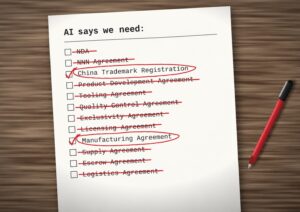
They ignore affiliates and subcontractors, define protected information too narrowly, and lean on common-law trade secret concepts. They identify the Chinese company only by an English name, bind the wrong entity, or send disputes to a forum with little practical connection to the defendant or its assets. Many were drafted for a different transaction and simply recycled. And now we are seeing the same problems in AI-drafted contracts. As we explain in Your AI-Drafted China Contract Says It Needs a Lawyer. Listen to It., a contract can look polished while leaving the provisions that determine whether it can actually be enforced unresolved or badly handled.
More than half of the China NNN Agreements clients send us to review are worse than having no agreement at all. And roughly as often, once we understand the transaction, we conclude that the client did not need an NNN Agreement in the first place. And virtually none of the agreements we review provide all of the protection the client thinks it has. Most leave at least one important gap involving the party bound, the information covered, non-use, non-circumvention, contract damages, enforcement, or the relationship between the NNN and the client's other China contracts.
Dispute resolution is another recurring problem. Most of these agreements get some combination of governing law, forum, venue, service, controlling language, or enforcement wrong. AI-generated contracts have made this problem easier to spot, but not easier to solve. We now see AI-drafted China contracts that expressly leave those very issues blank and instruct the user to have qualified China counsel fill them in later. Those are not peripheral details. They often determine whether the rest of the agreement will be useful when something actually goes wrong.
Templates fail for a related reason. Someone finds an NDA online, gets one from another company, pulls one from an old deal, or has AI generate one, and then asks whether they can just use it. The document usually looks good, with proper headings, numbered sections, confidentiality language and a few intimidating remedies, and that appearance is the danger. A contract can be well drafted for somebody else and terrible for you. A form built for two U.S. technology companies does little for a U.S. company sending CAD drawings to a mainland factory. An NDA designed for an acquisition data room fails when engineers are trading drawings, test results and manufacturing instructions over email, WeChat, WhatsApp and shared cloud folders. A template strips out the context of your deal, and in China that context decides whether the contract works. When a lawyer tells you a template is well drafted, the real question is whether it is well drafted for this transaction, against this company and for these risks, with an enforcement structure that works if things go wrong.
Lawyers from common law countries sometimes find our China contracts surprisingly short and ask where the representations, warranties, notice provisions, integration clause and pages of other familiar boilerplate went. Some of those provisions belong in a given agreement, and many do not. A China NNN exists to impose clear, enforceable obligations on the Chinese company concerning disclosure, use and circumvention. Every other provision should have to justify its presence, and page count proves nothing.
Drafting the NNN Agreement Around Your Deal
What your NNN agreement should cover depends on your transaction. Protected information can include product concepts, drawings and CAD files, prototypes, specifications, formulas, manufacturing methods, software and firmware, component selections and bills of materials. It can also include pricing and sourcing information, packaging, customer and distributor identities, marketing plans, test and quality data, and engineering revisions. The agreement should not contain the confidential information itself. It should describe the protected project and information clearly enough to make the obligations enforceable without embedding your most valuable material in a document that will circulate through the factory.
How the information arrives matters as much as what it is. Older NDAs assume confidential information comes as a formal document stamped CONFIDENTIAL, but manufacturing relationships do not work that way. The commercially important material may be a SolidWorks model, a bill of materials, a WeChat exchange, a photo of a prototype, packaging die lines, a tolerance change, or a string of minor revisions scattered across months of email. A contract that protects only marked documents misses much of what matters. At the other extreme, declaring everything the parties exchange confidential forever creates an obligation nobody can follow and a court may not take seriously.
Many American NDAs include a detailed Purpose clause, and importing one automatically can create a loophole. If the agreement says information is disclosed solely to evaluate Product X for potential manufacture, the factory may later argue that anything disclosed during redesign, costing, sourcing or testing fell outside that purpose. Defining the project helps in some deals and hurts in others, and the drafting should turn on which is true for yours.
Duration deserves the same care. Some information warrants a defined term. For other information, the commercial expectation is that the Chinese company should never become free to use it on its own. The answer depends on what you are disclosing, how quickly the technology changes, and how you expect the relationship to evolve. When disclosures will continue over years, pay attention to when the clock starts, because a five-year term running from signing differs from one running from the last protected disclosure. Rather than importing a one- or two-year term from a domestic NDA, ask when, if ever, this company should become entitled to use this information for itself, and draft around the answer.
Our starting point is that an NNN should not be mutual. If our client is disclosing valuable information to a Chinese factory, the agreement exists to protect our client, and making every obligation run both ways weakens and complicates it. Some relationships do involve real two-way technology exchange or joint development, and mutual obligations can make sense there. Once both sides contribute technology, though, you quickly face questions about who owns existing technology, jointly developed technology, and the resulting drawings, software and tooling, and about who may use improvements. At that point you likely have a product development agreement problem, not an NNN problem.
Be wary when a Chinese company responds to your proposed NNN with its own mutual NNN Agreement. The two are not interchangeable. A mutual NNN often protects both sides against classic disclosure while weakening or omitting the non-use, non-circumvention, affiliate-liability, damages, and forum provisions that matter most to our client.
Much of the time, the Chinese manufacturer appears to be proposing a mutual NNN because AI or a template told it to do so, without any clear understanding of why it needs one. In those cases, we explain in Chinese why we do not believe mutual protection is necessary and ask the Chinese manufacturer to identify the confidential information or IP it wants protected.
Roughly 90 percent of the time, the manufacturer drops the request. About five percent of the time, it identifies a legitimate need for protection, and we use two separate NNN Agreements: one protecting the Chinese manufacturer and one protecting our client. For various reasons, this usually makes better sense for both parties than a mutual NNN Agreement.
The remaining cases are the troubling ones. If the manufacturer cannot identify a legitimate need for its own protection but still insists on a mutual agreement that would weaken our client's NNN, we treat that as a serious warning sign. At that point, the issue is no longer mutual confidentiality. The agreement the Chinese manufacturer is proposing would undermine the protections our client needs, and much of the time, there are additional indicators that this is the goal of the Chinese manufacturer. In those situations, we generally advise the client to find a different manufacturer, rather than entrust valuable IP to a company that insists on being free to take our client's IP.
Making the NNN Agreement Enforceable
Enforceability starts with the Chinese company's legal identity. That sounds elementary, but many of the contracts we review identify the Chinese company only by an English trade name, which is virtually meaningless in China, especially when there might be hundreds of companies with the same trade name. You need the Chinese company's registered Chinese legal name and its registered address. You also need to know whether the company you are talking to is the manufacturer. The self-described factory is often a trading company, a sourcing agent, a Hong Kong intermediary or a related entity, while a different mainland company makes the product. Salespeople sometimes use company names with only a loose connection to the entity that owns the factory and its assets. An excellent contract against the wrong company is likely to be a worthless contract. Before disclosing anything valuable, determine who will receive the information, who will use it, who will manufacture the product, and which of those entities must sign your NNN Agreement. See The RedNote Contract Lesson for Companies Doing Business in China for real-world examples.
Execution matters for the same reason. The agreement should bear the Chinese company's official chop, be signed by someone with authority, and match the company's registered information. Proper execution builds the evidence you will need if the relationship fails. For more on this, see China Contracts That Work: Get the Company Chop Right and The Essential Checklist for Signing Contracts with Chinese Companies.
We prepare our China NNN Agreements in Chinese and English, with the Chinese version controlling. Our firm has drafted thousands of China contracts, nearly all of them bilingual, and not one provided that both languages would control in a dispute. One language must govern, and both sides must know which before they sign. The English version lets our clients understand exactly what they are signing.
Chinese usually (but not always) controls because a Chinese court presented with an English-controlling contract will work from a translation. You do not want the meaning of your non-use clause to turn on a translation you did not draft and first see only after a dispute has begun. For a deeper discussion on these issues, see Why Your China Manufacturing Agreements Should Almost ALWAYS Be in Chinese. Translating an American NDA into Chinese does not turn it into a Chinese contract, any more than translating a Chinese employment contract into English makes it suitable for California. See Translating Contracts into Chinese Does Not a China Contract Make.
A good China NNN agreement will usually include a contract damages provision, meaning an agreed amount or formula for damages on breach. The provision tells the Chinese company that violating the agreement carries an immediate economic cost. It also spares you from proving from scratch every dollar of harm caused by the misuse of information that is inherently difficult to value. Chinese law allows parties to agree on damages in advance and lets courts adjust amounts that are excessive or inadequate, so the number has to be commercially and legally defensible. An astronomical figure can weaken the provision rather than strengthen it.
A damages clause does not, on its own, freeze a bank account or seize anything. On application, Chinese courts can freeze or seize assets and can order a party to stop specified conduct while a case proceeds. Both remedies are discretionary, and the court may require you to post security. For an NNN breach, an order stopping the factory from making or selling your product is often worth more than a frozen account, which is one more reason the forum, the damages clause and the counterparty's identity have to be designed together. It is critical that the contract-damages provision be calibrated to what a Chinese court is likely to regard as commercially reasonable. That judgment depends on the facts, including the nature of the breach, the value of the transaction, the size of the parties, and the court or arbitral forum likely to hear the dispute.
We draft the governing law and forum clause last. The choice turns on who the parties are, where the Chinese company's assets sit, what remedies you will need and how a breach is most likely to occur, and on harder deals two to five of our lawyers meet to decide it. If the Chinese company, its factory, its bank accounts and its other assets are all in mainland China, there are strong practical reasons to choose Chinese law and a forum that can grant relief where the assets and the conduct are. Foreign judgments can sometimes be recognized and enforced in China, but relying on one adds a separate recognition proceeding in China, with its own cost, delay and uncertainty. Your hometown courthouse is rarely the answer. See Choosing the Jurisdiction for Your China Contract Disputes.
Timing, Disclosure and Records
Sign the NNN before you disclose anything important. Do not wait until after three months of product discussions, after you have sent a prototype, after you have received a quotation built on your drawings, or after the factory's engineers have begun studying your design. Signing first does not mean disclosing everything once you have signed. If you can screen ten possible manufacturers with information that does not reveal what makes your product valuable, do that. Then bind the serious candidates and give them only what they need to quote or build. An NNN protects against misuse; it is not a substitute for controlling who learns what. If you have already disclosed information, all is not lost. An agreement can cover previously disclosed material, and it helps to identify in writing what has already been provided. The problem is that Chinese companies that are asked to sign an NNN agreement after they have your information will often seek to leverage your information for better terms.
Records are the part almost everyone neglects. If you ever have to enforce the agreement, you will need to prove what you gave the factory and when. Keep a dated log of every drawing, file, sample and specification you send and whom you sent it to. Mark drawings with the recipient's name, and preserve the WeChat and email threads where engineering decisions are made. These habits also matter under the new trade secret rules. Whether information qualifies as a trade secret depends on concrete, specific confidentiality measures, and courts may reject claims that rest on a broadly drafted confidentiality agreement and nothing more. The NNN gives you the claim, and disciplined records give you the proof, both for the contract claim and for any trade secret claim.
Negotiation as Due Diligence
When a Chinese company objects to your NNN, treat the objection as information, but do not assume it means the company plans to steal your IP. Your agreement may be too broad, the damages figure may be excessive, or the restrictions may conflict with how the project has to work. Legitimate manufacturers tend to ask practical questions. They want to know whether their coating or plating subcontractor can see a drawing, whether an engineering subsidiary can work on the project, and whether they can keep the archival copies their quality system requires. Sensible exceptions solve those.
Other responses tell you much more about the relationship you are about to enter. A factory that insists on the right to use your designs for other customers is demanding the very right your NNN exists to deny it. Be equally wary of a refusal to take responsibility for affiliates, a refusal to use the company's registered Chinese name, insistence on a forum that makes enforcement impractical, or a claim that the mainland factory cannot sign and only its Hong Kong trading company will. None of these automatically means you should walk away, but each requires an explanation before you disclose anything valuable. Sometimes the most useful thing an NNN does is expose a problem while it is still cheap to leave.
Our China NNN lawyers actually prefer a manufacturer that proposes one or two sensible changes over one that signs immediately without comment. A company that takes the agreement seriously enough to make sure it can live with its obligations is often more likely to honor them.
Next come the companies that simply sign. After that come the companies that demand changes they cannot explain, often because someone told them to ask for those changes without understanding what they mean. At the bottom are the companies whose proposed revisions would preserve their ability to use our client's IP, sell around our client, or otherwise hollow out the protections the NNN is supposed to provide. At that point, the negotiation is no longer about drafting preferences. It is telling you something important—and unfavorable—about the company on the other side.
What an NNN Agreement Does Not Do
An NNN Agreement governs how a Chinese company may treat your information and business opportunities. It does not register your brand, govern your production, allocate ownership of new technology or establish who controls your tooling. Each of those needs its own protection, which is why the strongest position usually rests on several documents working together. For an overview of how these protections fit together, see Protecting Your Product From China: The 101.
It Is Not a Trademark
China is a first-to-file trademark country, so if your brand name or logo matters, register it separately and early. This applies even if you never plan to sell in China, because manufacturing there exposes your brand to your factory, its suppliers, your packaging printer and everyone else in the supply chain. A good NNN prohibits the Chinese company from registering your trademarks, brand names and related names, but that gives you only a contract claim against the signer. It reserves nothing at China's trademark office and does nothing to stop an unrelated third party from filing first. For more on why these protections are complementary, see China NNN Agreement or Trademark Registration? Usually Both.
If you cannot do both the NNN and the trademark right away, prioritize the deadline you do not control. Once your brand is settled, anyone can file for it at any time, so the application should begin promptly. If the brand is still undecided but you must disclose proprietary designs to get a quote, get the NNN signed before that disclosure.
It Is Not a Manufacturing Agreement
An NNN is an early-stage agreement meant to protect you while you evaluate and negotiate with a Chinese company. Once you choose a factory and production begins, you need a manufacturing agreement. That agreement covers specifications, quality standards, inspections, defects, pricing and payment, delivery and late delivery, packaging and warranties. It also covers intellectual property, molds and tooling, subcontracting, product changes, termination and remedies. Stretching an NNN to cover production leaves large gaps. See Do I Need a China NNN Agreement or a China Manufacturing Agreement? Usually Both.
The transition from one agreement to the other needs to be deliberate. The manufacturing agreement usually becomes the principal contract and should carry forward the non-disclosure, non-use, non-circumvention and IP protections. It should also preserve claims arising from disclosures and breaches that occurred before it was signed. The risk is greatest when the manufacturing agreement contains an integration or entire-agreement clause, since boilerplate in the later contract can support an argument that your rights covering earlier disclosures disappeared. If the two contracts will remain independently effective, they should say so. If the manufacturing agreement supersedes the NNN going forward, it should say what happens to rights that have already accrued and which agreement controls any conflict.
Then there are the manufacturers you rejected. You may have disclosed sensitive information to three or four factories while collecting quotes and then chosen one. The factory you chose signs your manufacturing agreement, and the others never will, so their NNNs remain your only protection long after production begins elsewhere. Those agreements should require the rejected factories to return or destroy your information when talks end and to confirm in writing that they have done so, and you should enforce that requirement.
It Is Not a Product Development Agreement
If the Chinese company will perform engineering, design or prototyping work, an NNN is often not enough. When you provide a concept and the factory turns it into a manufacturable product, you need to settle who owns the resulting design, the CAD drawings, the improvements and the tooling. You also need to settle whether the factory may use the engineering knowledge on other projects and whether you may take the finished design to another manufacturer. These questions usually go far beyond nondisclosure and even beyond the scope of most well-crafted NNN Agreements. When the Chinese side will create new intellectual property, address ownership of that work directly in a product development agreement rather than hoping the NNN will resolve it. See The 101 on China Product Development Agreements.
It Does Not Establish Ownership of Your Molds and Tooling
Suppose you pay $75,000 for molds. Your NNN can stop the factory from misusing the drawings and specifications behind them. It does not settle who legally owns the molds, where they must be stored, or whether the factory can run them for another customer. Nor does it settle whether you can inspect them or move them to another factory, or what happens when the relationship ends or the factory refuses to return them. Those issues belong in a manufacturing agreement or a tooling agreement that addresses the physical assets directly. Information protection and asset ownership overlap, but they are separate legal problems, and companies routinely spend a fortune on excellent tooling before discovering that their contracts never established who controls it. For a detailed treatment, see THE Guide to Molds and Tooling in International Manufacturing.
When You Don't Need an NNN Agreement
Many of the companies that ask us for an NNN Agreement (or already have one) turn out not to need one. Consider a company that buys five ordinary components from five unrelated Chinese suppliers and assembles its proprietary product in the United States. Its safest strategy may be to make sure none of the five ever learns what the final product is, and handing each supplier an agreement that describes the overall project would reveal more than necessary. More common is the company that worries that a Chinese factory will copy its design when its real exposure is an unregistered brand. A third may already be deep into collaborative engineering with a Chinese company and need a product development agreement rather than a preliminary NNN. Legal documents are tools, and the right one depends on what can actually hurt you.
My law firm has been drafting China NNN Agreements for roughly 25 years, and this blog was writing about them long before they became common. Unfortunately, once NNN Agreements became widely known, they also became a business opportunity for fake lawyers, cut-rate online providers, and others who had no business drafting China contracts.
We regularly see the fallout. Some of these providers simply produce bad agreements. Others produce documents that are much more troubling: contracts that look polished, use the right terminology, and appear protective, but are structured in ways that favor the Chinese manufacturer. In The High Cost of China Contract Mistakes, I wrote about a U.S. company that hired a supposed “Chinese lawyer” through a well-known online services marketplace to draft an NNN Agreement at an unusually low price. When we reviewed it, virtually every important provision favored the Chinese manufacturer and made enforcement by the U.S. company harder and more expensive. The drafter had also been paid by the Chinese manufacturer.
We see variations of this problem with disturbing regularity. The agreement binds the wrong entity. It sends disputes to a forum that is practically useless. It weakens the non-use or non-circumvention provisions. It leaves affiliates or subcontractors outside the contract. It uses language that sounds protective but quietly preserves the manufacturer's ability to do exactly what the NNN is supposed to prevent. That is what makes these agreements dangerous. A plainly amateurish contract is easy to distrust. The real risk is the contract that looks sophisticated enough to inspire confidence while being drafted against your interests.
What Our Lawyers Ask Before We Draft
A properly drafted NNN reflects the deal, so our first questions are about the deal. We need your company's full legal name, jurisdiction and address, the name and title of the person signing, and any Chinese name your company uses. We need the Chinese company's registered Chinese name and registered address. We also need to know whether it is the factory, a trading company, an affiliate, a Hong Kong intermediary or something else. If companies outside mainland China are involved, whether in Hong Kong, Macau, Taiwan, Singapore or Vietnam, the agreement may need to be different, because a different entity in a different jurisdiction often calls for a different contract.
Then we ask what the two companies will be doing together, whether that means requesting quotes, sending prototypes, developing a new product, providing complete production specifications or engineering jointly. We need to know whether the project covers one product or several and one factory or several, because each factory needs its own agreement. We want to know exactly what you will disclose, since telling a factory you want a stainless steel fire pit of roughly a certain size is a different matter from sending complete CAD drawings, tolerances, packaging designs, customer information and cost targets. And we ask how the information will move, whether by email, WeChat, WhatsApp, a shared cloud folder or a product lifecycle management system, as physical prototypes, or in video calls where factory engineers make design changes in real time.
We also ask whether the Chinese side will do design or engineering work, which can call for a product development agreement. We ask what intellectual property you already hold, from patents and pending applications to trademarks, copyrights, tooling and software. If the factory will learn who your customers and distributors are, that shapes the non-circumvention provision. If subcontractors will be involved, the agreement has to account for them. A flat ban on disclosure to subcontractors makes no sense when everyone knows the product must go to a specialist coating shop, and a subcontractor receiving your most important information may need to sign on its own. Some technology or components warrant tighter restrictions or a different supply chain. Finally, we ask what happens if the Chinese company wins the production order, so the handoff to a manufacturing agreement is planned from the start.
Before You Disclose
Companies often contact our China lawyers saying they need an NNN Agreement. A better conversation begins with what you are afraid the Chinese company will do. It may copy your product, file your trademark, sell to your customers, pass your drawings to another factory, claim the design it developed for you, hold your molds hostage or sell overruns online. Once the real risk is clear, the right legal tools usually are too.
For companies that need one, a China-specific NNN Agreement drafted for the actual deal can restrict disclosure, prohibit unauthorized use and block circumvention. It can also strengthen your enforcement position and expose a dangerous counterparty before it has your most valuable information. A downloaded template, a translated American NDA, an AI-generated draft, or an NNN copied from someone else's transaction usually provides little more than false confidence, and false confidence is sometimes worse than having no agreement at all. If you are preparing to send a prototype, CAD file, formula, specification or customer list to China, contact our China lawyers before you send it.