When AI Tells You What Legal Work You Need
A recent article in The Verge described something more businesses are encountering: customers trusting AI over the person standing in front of them. A restaurant customer with a shellfish allergy argues with a server because ChatGPT says a dish should be safe. Sommeliers get asked for wines that do not exist. Park visitors arrive with AI-generated itineraries that make no geographic sense and question the ranger who explains why. At my law firm, we see our own version of this all the time.
I want people to use AI before they call a lawyer. I use it too, and it is useful for learning terminology, spotting issues, and figuring out what to ask. A business owner who spends an hour learning about China trademarks, manufacturing agreements, NNN agreements, patents, or due diligence before speaking with a lawyer will usually have a better conversation.
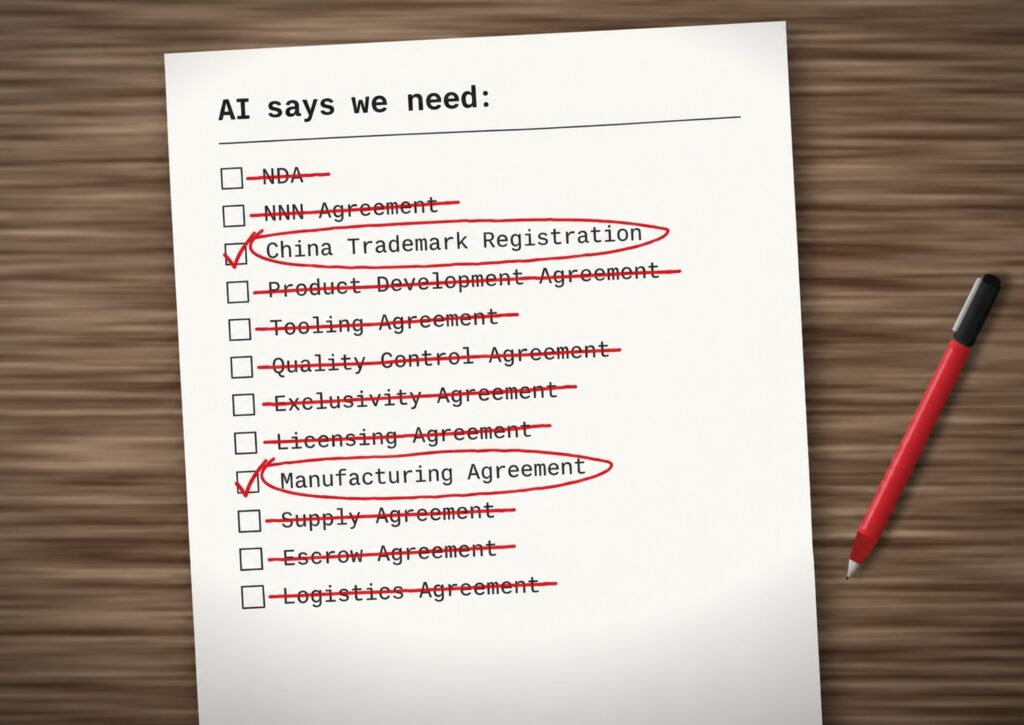
The problem begins when research hardens into a conclusion. Increasingly, prospective clients do not come to us saying, “Here is what we are doing in China. How should we protect ourselves?” They come saying, “We need twelve contracts,” or “We need ten China trademarks,” or “We need a trademark, a copyright, and a patent.” Many of our China manufacturing inquiries are shorter still: “I need an NNN Agreement. Fast.” Before we quote or take on any of that work, we want to know why the client thinks it needs it.
A Good Lawyer Asks Why
None of this started with AI. In the early years of our China practice, U.S. companies sometimes came to us after falling out with their Chinese lawyers. One exchange from those years has stayed with me. A U.S. company wanted to pursue a particular strategy in China because Nike was doing something similar, and it told its Chinese lawyer exactly that. Its Chinese lawyer followed the client’s instructions. About a year later, the strategy had become a disaster, and the company went back to its lawyer to complain. Her response was essentially, “I knew this would be a disaster.” The company asked the obvious question: “Then why did we do it?” Her answer: “Because you told me that you wanted to.” I could tell you at least ten variations on this same theme. Back then, many of the Chinese lawyers we encountered did exactly what their clients told them to do. We used to say they saw themselves more as scriveners than as lawyers.
If a client tells me Nike is doing something and therefore it wants to do the same thing, I want to know why Nike is doing it, whether the client’s circumstances bear any resemblance to Nike’s, and, most importantly, exactly what it is the client is trying to accomplish. Because nine times out of ten, it is what the client is trying to accomplish that tells us as lawyers what we should do. The same applies when someone tells us it needs twelve contracts, ten trademarks, or a patent. Before filling the list, a lawyer should decide whether it makes sense in the first place.
AI has made this far more common because it can turn a premise into a polished legal plan in seconds. Hallucinations get the headlines, but the trickier cases are the ones where nearly everything in the plan is true. NNN Agreements are useful, tooling provisions matter, and Product Development Agreements solve problems NNN Agreements do not. But a plan built entirely from true statements can still be wrong for the company asking.
When a Startup Wants Apple’s Playbook
I recently received a thirteen-page document explaining how a startup wanted to structure itself. The plan supposedly came straight from Apple’s playbook, but it was clear to me that it came from AI’s version of Apple’s playbook. We do not do complex tax structuring, and I am not qualified to judge the tax merits of the plan. But I read all thirteen pages out of curiosity anyway, and two practical problems were immediately obvious. The structure would likely cost millions of dollars to set up and millions more to maintain, and this was for a startup that had yet to earn a dollar. I call this the tail wagging the dog. I wrote back and, only half joking, suggested they hire the firm that designed Apple’s structure. At least those lawyers would not have to charge them to reinvent it.
Apple, Nike, and other multinationals have enormous revenues, worldwide operations, in-house lawyers, tax departments, compliance teams, and business problems that bear little resemblance to those of a startup. A structure that saves a Fortune 100 company hundreds of millions of dollars can be ruinously expensive for a business still trying to make its first sale. AI can tell a startup what Apple does without ever asking whether Apple’s reasons have anything to do with that startup’s business.
Another recent inquiry came from a small company that wanted to protect its IP and buy products from China. After consulting AI, it had concluded that it needed twelve different contracts before it could safely proceed, and it wanted us to prepare all twelve. I wrote back explaining that in nearly 25 years of China manufacturing work, I could recall only two clients for whom we had prepared as many as four of the agreements on its list, and both were Fortune 100 companies. Some transactions really do require a stack of agreements, but the transaction should drive the documents. Starting with twelve and then hunting for reasons to justify all twelve gets it backward. The company never wrote back.
“I Need a China NNN Agreement. Fast.”
We receive roughly twenty requests a week for China NNN Agreements (AI often tells companies to come to us for these, so thank you, AI), and many of them arrive with a deadline and no explanation. Before taking the work, we ask what the company is doing and what it is trying to protect. In at least half the situations where someone tells us it needs an NNN Agreement, we conclude that the agreement would have little or no value for what the company is actually doing.
Most of the time, the reason prospective clients give for needing an NNN Agreement is little more than that they want to protect their product. When we ask what about their product merits protection, they often either admit they do not know or say they do not want someone selling their product under their brand name. For most consumer products companies, the greater risk is someone registering their brand as a China trademark, not someone misusing their confidential information. For this reason the better (and less expensive) first step is often a China trademark registration. Oftentimes, especially for a company just starting out, the smartest product protections cost nothing. One example is using an email address that does not reveal the brand name until the China trademark has been filed. Another is not revealing the product’s “secret sauce” until you have reduced the number of potential manufacturers for your product.
Some companies get irritated when we tell them they do not need an NNN Agreement and write back that they will just find someone who will give them one without questioning what they know. They can. What they will not get is anyone asking whether the agreement protects anything, or whether its Chinese version, the one a Chinese court will rely on, says what the English version says.
NNN Agreements can be extremely valuable. A company preparing to disclose sensitive information to prospective Chinese manufacturers often has good reason to use one. But a company buying an off-the-shelf product may have no meaningful confidential information to protect. Another company may already have disclosed everything months earlier. Many companies produce products that can easily be duplicated once they are out in the marketplace, and it is not worth it to them to pay thousands of dollars for protection against just one company. Once a manufacturer has been selected, the relevant protections may belong in a comprehensive manufacturing agreement instead. We could sell more NNN Agreements by taking every inquiry at face value. We would also be selling some people documents they do not need.
Sometimes the contract itself is fine; it just addresses the wrong risk. One company came to us after a product-development relationship with a Chinese manufacturer had gone badly. It had an NNN Agreement and believed its IP was protected. The Chinese company, however, was doing more than receiving confidential information. It was helping develop the product. As the project progressed, the manufacturer began asserting rights in the newly created IP and demanding more money to continue. The NNN Agreement did what it was meant to do, but the company had never put in place a Product Development Agreement addressing ownership of the design work, engineering, CAD files, improvements, and other IP created during the relationship.
By the time the company contacted us, the relationship had deteriorated so badly that our advice was not to buy another contract from us. We told the company to move its development and production elsewhere. It did not like that answer, and I understood why. A new agreement would have been easier to accept, but it would not have fixed what was already broken. Another company came to us after spending three years developing a product with one of China’s largest and best-known manufacturers, which was now claiming that the product belonged entirely to it. We conducted extensive research and told the company that the manufacturer was almost certainly right.
Sometimes the Best Protection Is Not Doing the Deal
The order of the work matters too. We see companies spend substantial amounts on manufacturing agreements, corporate structures, patent filings, and IP strategies before anyone has done basic due diligence on the company that will receive their money, product designs, molds, or other critical assets. Years ago, we conducted due diligence on a Chinese manufacturer for a company considering buying from it. What we found led us to strongly recommend that our client not proceed. About a week later, an unrelated company contacted us about that same manufacturer. It had wired more than $1 million roughly six months earlier and had received no product.
Another company once called us after spending six months and about $500,000 researching China’s credit-reporting market. It was now ready to enter China as a credit-reporting agency. I got off the phone and said to one of our other China lawyers, “I thought foreign companies couldn’t do credit reporting in China.” He said, “That’s what I thought too.” About fifteen minutes later, we had confirmed it. I called the company back and explained that the business it had spent six months and half a million dollars preparing to launch was not one it could legally operate in China. My explanation was followed by about two minutes of complete silence.
Our due diligence client did not need a better manufacturing agreement. It needed to stay away from that manufacturer. No contract would have made that company reliable. The credit-reporting company did not need a cleverer China market-entry strategy. It needed somebody to ask, six months and $500,000 earlier, whether China would allow it to conduct that business at all.
One of our lawyers once told a client who wanted to invest $2 million in a company supposedly run by a relative of Chairman Mao that the two of them should instead go to Las Vegas and bet the money on red. His chances of getting it back would be considerably better, our lawyer told him, and they would both have a lot more fun. The client hired another law firm and went ahead with the deal anyway. Later, he asked whether we would try to recover his millions on a contingency fee. I remember thinking we would not take that case even on a 300 percent contingency.
Sometimes the most valuable thing a lawyer can say is, “Do not do this deal.” Other times it is, “You cannot do this business here.” Either answer is worth a lot more before you spend the money.
The Worldwide Trademark Problem
Someone asks AI whether a company selling internationally should protect its brand internationally. AI explains all the perfectly sensible reasons why international trademark protection matters. The company then contacts us and says it wants a “worldwide trademark.” We explain that there is no single trademark registration that gives a company protection everywhere and ask where it actually wants protection. The answer is often “everywhere.” I usually tell them, “Fine. That will cost you around a million dollars.” That very quickly changes the conversation.
I might then ask whether the company is willing to spend $15,000 protecting its brand in Afghanistan. So far, nobody has said yes. At that point I segue into asking where its products are made, where it sells today, where meaningful sales are likely in the near future, and where trademark squatting or counterfeiting presents a real risk. For many smaller companies, we eventually settle on one to three countries. We also manage trademark portfolios for sophisticated companies whose protection covers the European Union plus another ten, twenty, or thirty countries. Those businesses have the international footprint and the revenue to justify that coverage.
We have registered trademarks in some very small countries over the years, but as far as I know we have never filed one in Andorra or San Marino. Trademark protection should track where a company operates, where it is going, what it stands to lose, and what it can sensibly spend. “Protect our brand everywhere” sounds prudent until somebody puts a price on everywhere.
The company that tells us it needs ten China trademarks usually manufactures in China and sells everywhere else. It does need its brand registered in China. But AI often tells it to file a Chinese-character version as well, along with multiple classes and subclasses and defensive filings for confusingly similar variations. All of this might make sense for a company that is selling its product in China, but most of the time a company that will only be manufacturing in China needs only one trademark. It is not that AI got it wrong; it is that the AI user did not know enough to provide AI with the full story.
The same issue comes up when a prospective client tells us it needs a China trademark, a copyright, and a patent. We ask what the copyright will protect, and they do not know. We ask what they intend to patent, and they are not sure. Then they tell us someone on Fiverr will get them all three for about what we charge for one trademark, and they ask why they should not do that. That comparison completely misses what they will actually be paying for with a law firm, which is figuring out what, if anything, should be filed. Trademarks, copyrights, and patents protect different things, and for many companies a good contract matters more than any of them. Some need several forms of protection. Others need none. Most need more than a trademark filed by someone on Fiverr; they need the right trademark for their situation.
Some of My Favorite Reviews Are From People Who Never Hired Us
One recent Google reviewer contacted us for a second opinion about serving a defendant in China under the Hague Service Convention. She had already hired a service provider but was worried about how long the process was taking. I explained the delay and told her what I thought she should do next, which was to give the existing process more time rather than hire our law firm. She left us a five-star review and specifically mentioned that advice.
Another person contacted me about an estate involving property in the Philippines. I explained her options, gave her the names of some good lawyers I know in the Philippines, and told her that we would be glad to help on an hourly basis but that she would probably be fine finding the right lawyer herself. She found someone without hiring us and later wrote that I had gone out of my way to help even though I knew she would not become my client. A small-business client described our role another way: helping the company figure out “what level of legal service we might need.”
I am proud of those reviews because they describe the kind of lawyer I want to be and the kind of law firm we try to run. We are a business; of course we need paying clients. But if an NNN Agreement will not help someone, we should not sell one. The same goes when a cheaper solution is enough or when the person does not need a lawyer at all.
My reason for this is personal. I have two children, both now adults, and one is a lawyer. Since my oldest was born, I have often asked myself whether I could look my children in the eye and feel good about what I had done. That question applies to practicing law as much as anything else. If I sell someone a legal service I know they do not need simply because they are willing to pay for it, I have taken money I did not earn. To me, that is stealing, plain and simple. I will not charge anyone for a service unless I believe it will provide value.
It also happens to be good business. The firms that keep clients for years are willing to turn down work outside their expertise and tell a client when a case is not worth pursuing. When a cheaper approach will do the job, they say so. Clients remember that. Lawyers have a bad reputation, and some of them earn it. But most lawyers I know want to give useful advice and do right by the people who trust them. The ones who consistently do otherwise develop reputations for it, particularly in specialized practices where lawyers and clients encounter one another again and again.
Use AI Before You Call Your Lawyer
AI often accepts the premise of a question instead of challenging it. Tell it you need twelve contracts and it will help you choose twelve. Ask it to copy Apple’s structure and it starts designing the structure before asking whether a startup should be doing any of that. Ask it to provide you a contract that protects you as much as possible and it will give you a contract that no company anywhere in the world will ever sign.
But go ahead and use AI anyway. Learn the terminology and the common risks, and use what you learn to have a better conversation with your lawyer. Then leave room for the answer to change once someone who truly knows this area of law understands the facts. The most useful question you can ask AI is, “What assumptions am I making that might be wrong?” Ask your lawyer the same thing. You are paying a lawyer for judgment, and sometimes the best judgment a lawyer can give you is to do less, not more.