







How to Sue a Chinese Company
One of our clients had a manufacturing agreement that clearly gave it ownership of the molds sitting in its Chinese factory. When the factory refused to return them, we had a Chinese litigation lawyer file suit. Within about five days, the court froze the factory's bank accounts. The next day, the factory released the molds. That kind of speed is unusual. It happened because three things lined up: the client had a contract written to be enforced in China, the defendant had money a Chinese court could reach, and the remedy was aimed directly at that money. Before I recommend suing anywhere, I want to know whether a case has those same fundamentals.
You can sue a Chinese company in a Chinese court or, if jurisdiction exists, in a U.S. court or another court outside China. If the parties agreed to arbitrate, the dispute usually belongs in arbitration instead. Because most Chinese companies keep most of their assets in China, the shortest path to getting paid usually runs through a Chinese court. A Hong Kong-seated arbitration can also provide access to mainland courts for interim relief, but only when both the seat and administering institution qualify. A U.S. judgment can now be enforced in China, though doing so requires a separate proceeding there.
This guide covers commercial disputes with companies in mainland China. Hong Kong, Macau, and Taiwan have their own legal systems. Hong Kong comes up repeatedly because so many China transactions run through it.
Who Exactly Are You Suing, and What Do They Own?
We get some version of this call constantly. A buyer negotiates with a salesperson using an English company name. It receives an invoice from a Hong Kong trading company and wires the money to a third entity. The products come from a mainland factory. When the goods prove defective, the factory denies signing the contract and the trading company says it merely arranged the transaction. Before suing anybody, the buyer needs to untangle those relationships and determine which company actually took on the obligation that was breached.
Get the mainland company's registered Chinese name and Unified Social Credit Code. Then compare its registration records with the contract, company chop, invoices, and payment instructions. Confirm its current operating address as well as its registered address. English trading names and website branding tell you remarkably little about the legal entity with which you contracted. Our guide to China due diligence explains which records to pull and what warning signs to look for. We have also written specifically about why the correct Chinese company name on a contract matters.
Make sure you are suing as the right company, too. A parent that negotiated the deal, a subsidiary that signed it, and an affiliate that paid the invoices are three different parties. You need to know which entity owns the claim and be able to explain any mismatch before filing. The same discipline applies to the defendant's side. Common ownership does not automatically make every company in a supplier's group liable. A claim against an affiliate or owner needs its own legal basis: a guarantee, that party's own wrongful conduct, or facts sufficient to disregard the corporate form under the applicable law. A wealthy founder is not a collection plan.
When a Hong Kong trading company sits in the middle of the deal, establish early what each company agreed to do and which one owns the assets that matter. If the Hong Kong company signed the contract and received the money, it may be the proper defendant even though it never made anything. Hong Kong's common-law courts will also feel familiar to American lawyers. The problem is that many intermediary companies own little beyond a bank account that can be emptied when trouble begins. A Hong Kong judgment against a thinly capitalized trading company may leave you with nothing to collect. The mainland factory is often the company whose assets you really need to reach, but its role in manufacturing your product does not make it liable under somebody else's contract. You still need a legal basis for suing it. The Hong Kong Intermediary Trap explains how to structure these relationships before anything goes wrong.
Finding Reachable Assets
An asset investigation should tell you what the defendant owns and who else may have claims against it. An impressive factory building means little if the company leases the building, its equipment is pledged to a bank, and its customers pay an affiliate. Find out whether the defendant owns its equipment, receives customer payments directly, or holds receivables worth collecting. Look for existing enforcement proceedings and signs that operations are being moved to another entity. Registered capital is a number in a company registration. It tells you little by itself about what is available to creditors. No preliminary investigation will find every bank account, but a good one tells you whether continued spending makes sense. Our Company Reputational Report draws on Chinese public records and records available only to Chinese-licensed lawyers.
If the defendant appears insolvent, work out before filing how insolvency proceedings, secured creditors, and transfers to related companies affect the chance of recovery. As I explain in International Litigation: Winning the Lawsuit Is Often the Easy Part, collection strategy belongs at the beginning of the case, not the end. Reachable assets should influence the forum you choose, the provisional relief you seek, and the settlement terms you are prepared to accept.
What Should You Do Before Escalating the Dispute?
Preserving Evidence
Preserve the complete transaction record, including the documents that hurt you. Keep the signed agreements and amendments, specifications, approved samples, inspection reports, payment records, and correspondence showing what each side agreed to do. Suspend routine deletion of email and messaging records. Make sure a departing employee does not walk out with the only usable copy of important evidence. For WeChat and other electronic communications, preserve the original records together with enough surrounding material to establish who was communicating and what the exchange meant. A handful of screenshots invites an argument over authenticity and context.
For a product-defect claim, preserve representative samples, packaging, and shipping records. Before destructive testing, repair, or disposal, ask your lawyer what needs to be kept and whether the supplier should first receive notice. Document customer complaints and what you did to mitigate your losses. Evidence in China presents another issue. Preserve it, but do not assume that records stored there can lawfully be sent abroad. China restricts the transfer of some information for use in foreign proceedings, as discussed in the discovery section below. Look outside China as well. Inspection companies, testing laboratories, freight forwarders, and customers often have records that explain a failure better than anything the supplier will volunteer. Identify those sources early. The defendant is unlikely to hand you the evidence that sinks its case.
Notice Requirements and Limitation Periods
The statute of limitations is only one deadline that matters. Contracts often require prompt notice of defects, give the supplier a chance to cure, or require negotiation or mediation before suit. Insurance policies and marketplace dispute procedures have their own deadlines. Separate notices that must go out immediately from demands that should wait until your asset-preservation strategy is ready. Do not sacrifice a contractual, insurance, or statutory deadline just because you would prefer not to alert the supplier.
International sales also raise the United Nations Convention on Contracts for the International Sale of Goods, commonly called the CISG. China and the United States are both parties, so the CISG governs many sales between companies in the two countries unless the contract excludes it. When the CISG applies, Article 39 requires a buyer to give notice specifying the nature of a defect within a reasonable time after discovering it, or after it should have discovered it. A buyer that fails to give timely notice generally loses the right to rely on the nonconformity, subject to limited exceptions.
Article 39 also establishes an outer limit of two years from the date the goods were actually handed over, unless that deadline conflicts with a contractual guarantee period. Do not mistake those two years for the ordinary notice period. A buyer that waits anywhere close to two years has usually missed Article 39(1)'s reasonable-time requirement long before then. Article 40 prevents a seller from relying on those notice rules when the nonconformity concerns facts it knew, or could not have been unaware of, and failed to disclose. Article 44 creates another, narrower exception: a buyer with a reasonable excuse for failing to comply with Article 39(1) can still seek a price reduction or damages other than lost profits. Article 44 does not override Article 39(2)'s two-year limit.
Read the contract and the CISG before assuming you have years to deal with a quality complaint. Where Chinese limitation rules apply, Article 188 of China's Civil Code generally gives three years to bring a civil claim. Article 594 provides four years for litigation or arbitration involving international sale-of-goods contracts and technology import and export contracts.
Which period applies, when it began to run, and whether something interrupted or suspended it depend on the particular claim. Calendar the deadline now. Do not assume negotiations keep your claim alive. Under Article 195, a demand for performance or the other party's agreement to perform can interrupt the limitation period and start it running again. Have Chinese counsel evaluate the communications and preserve evidence of any interruption. The two-year period for enforcing a judgment, discussed below, is a different deadline.
Demand Letters
A demand letter can secure an admission, satisfy a notice requirement, or start a useful negotiation. It can also tell a supplier to move its money, hold onto your tooling, or stop cooperating before you are ready to act. Send one because it fits the legal and commercial strategy, not because somebody is angry. Why Demand Letters to China Suppliers Often Backfire explains why we are often reluctant to send them prematurely.
Withholding Payment and Sinosure
Review your own obligations before withholding payment, canceling orders, or announcing termination. Before we recommend suing, we want to know about unpaid invoices, missed commitments, specification changes, and anything else that gives the supplier a defense or counterclaim. Withholding payment also carries a risk that many foreign buyers never see coming. Many Chinese exporters carry Sinosure credit insurance, and an unpaid invoice can quickly become a Sinosure claim against the buyer. We have handled more than 100 Sinosure matters. The fastest we have seen a supplier's threat turn into a Sinosure demand is 24 hours. We have also seen Sinosure move against a buyer's Chinese assets, including trademarks, before the buyer knew a claim existed.
Read our Sinosure guide before you stop paying a Chinese supplier.
Travel to China
We tell clients not to send owners, officers, or key employees to mainland China while a serious dispute is live. Exit bans get most of the attention, and they are real. We have dealt with them for years. But another risk is a factory or creditor arranging to keep someone in China until it gets what it wants. If one of your people is in China when a dispute turns hostile, the priority is getting that person out. Our current guide to China exit bans and commercial disputes explains why these disputes can become personal very quickly. Plan the case on the assumption that nobody from your company will travel to mainland China until it is over.
Is Your Case Worth Bringing?
Below roughly $350,000, we generally do not recommend litigation or arbitration in China. Legal costs consume too much of a realistic recovery. Above that amount, the cases we like best usually rest on a contract written to be enforced in China. That generally means a contract that:
- is written in Chinese;
- bears the supplier's company chop;
- identifies the supplier by its registered Chinese name; and
- contains a sensible liquidated damages provision.
Each point reduces what you need to prove and makes the claim easier to value. A buyer with all four negotiates from a much stronger position. A buyer missing one or more of them can still have a good case. But a company with none of them usually needs to look hard at the alternatives discussed below. The value of recovering critical tooling or stopping misuse of intellectual property can also justify action even when the cash claim by itself falls below our usual threshold.
The company chop deserves particular attention. Western companies regularly assume the signature block is enough and never verify the seal used by the Chinese company. Our article on getting the Chinese company chop right explains why that can become important when enforcement begins.
Claims Without a Signed Contract
No signed contract does not necessarily mean no case. Accepted purchase orders, correspondence, invoices, and performance can establish a contractual relationship. Article 469 of the Civil Code recognizes retrievable electronic data as a written form. Article 490 recognizes a contract where one side has performed its principal obligation and the other accepts that performance.
A missing company chop is not automatically fatal either. Chinese courts enforce plenty of contracts without a chop or a Chinese-language version. Both simply make proof and enforcement easier. But without a clear signed agreement much more of the lawsuit becomes a fight over who promised what. The documents must establish the obligation and connect it to the defendant. When the company name appearing on those documents is imprecise, investigate before assuming you know which entity is bound.
When Is a Lawsuit the Wrong Response?
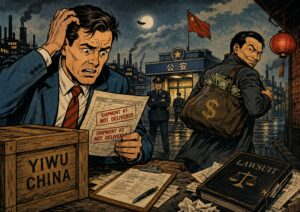
Some disputes call for a different first move. A buyer came to us about a Yiwu intermediary that had taken payment for goods that mostly never shipped. According to the buyer, only a small part of the money reached the actual manufacturer, while the intermediary continued giving assurances about production and shipment. The reported facts looked more like intentional fraud than an ordinary performance dispute. We recommended that Chinese lawyers experienced in economic-crime matters evaluate whether the evidence should be taken to the police. We describe that matter in China Supplier Fraud in Yiwu: Why We Recommended the Police, Not a Lawsuit.
A police complaint is not a collection device for an ordinary disputed debt, and threatening criminal action merely to force payment creates problems of its own. Where a criminal referral does make sense, counsel should work out how it affects the civil claim and its deadlines. For smaller disputes, look quickly at marketplace procedures, insurance, and whatever remedy your bank or payment provider offers. Sometimes a negotiated inventory return or partial refund is the best result available. Below our normal litigation threshold, these alternatives are often where the economics point.
Where Can You Sue a Chinese Company?
Reading the Dispute Resolution Provisions
Start with the contract. Read the master agreement together with purchase orders, amendments, guarantees, and any separate tooling, manufacturing, or confidentiality agreements. Different documents sometimes name different parties or prescribe different forums. A lawsuit filed before those conflicts are sorted out can turn into an expensive fight over where the underlying dispute belongs.
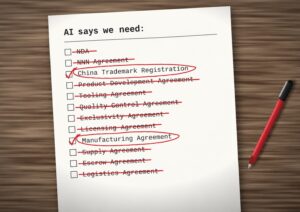
We have also started seeing AI-drafted China contracts that leave the most important question open. One provision we have now seen repeatedly says that governing law and forum “shall be selected by qualified counsel.” That clause selects nothing. I discuss the problem in Your AI-Drafted China Contract Says It Needs a Lawyer. Listen to It.. Governing law, forum, and controlling language do separate jobs. Choosing Chinese law does not choose a Chinese court. Choosing a U.S. court does not make the resulting judgment automatically enforceable in China. And in a bilingual contract, the controlling-language provision decides which version governs when the texts differ.
We have drafted thousands of China contracts. Nearly all were in Chinese and English, and we do not make both languages controlling. Chinese law allows parties to treat two versions as equally authentic, but doing that invites a separate dispute over which wording means what. For a contract expected to be enforced against a Chinese manufacturer in a Chinese court, Chinese normally controls. Chinese courts can deal with English-language contracts and foreign-law clauses, but both make the proceeding harder and more expensive. Our article on why China manufacturing agreements should generally be in Chinese explains the practical reasons.
We usually draft the dispute resolution clause last. On harder matters, several of our lawyers discuss it because the right answer depends on where the assets are, what relief the client is likely to need, and which side is more likely to sue first. Choosing the Jurisdiction for Your China Contract Disputes goes into that analysis in more detail. Our discussion of China manufacturing contracts and separate agreements also explains why the obligations and remedies in the different documents governing a manufacturing relationship need to work together.
Arbitration ordinarily requires an agreement in writing, whether made before or after the dispute. You cannot send a dispute to arbitration unilaterally because arbitration suddenly looks attractive. Scope matters as well. Claims against a supplier, its owner, and an unrelated trading company do not necessarily belong in the same arbitration.
Choosing a Forum
Begin with the forums the contract and applicable jurisdictional rules actually permit. A valid forum-selection or arbitration clause does not disappear because another forum now looks more convenient. If the defendant's operations and assets are in mainland China and the relief has to work against property there, a Chinese court is often the logical forum. A U.S. lawsuit can make sense when jurisdiction is sound and the defendant has reachable U.S. assets, or where U.S. discovery materially improves the case. Arbitration brings a different enforcement framework, and its cost and access to interim relief depend heavily on the clause and the seat.
The remedy often decides the issue. A buyer trying to recover a refund has a different problem from one that needs its molds returned or unauthorized production stopped this month. When production, tooling, or intellectual property is at stake, compare the interim relief available in each permissible forum. A money judgment two years from now does not necessarily repair the business damage occurring today.
Hong Kong litigation is another possibility when Hong Kong courts have jurisdiction. The expanded Mainland–Hong Kong judgment arrangement took effect on January 29, 2024. It provides a route for recognition and enforcement in the mainland of qualifying Hong Kong civil and commercial judgments, subject to the arrangement's requirements. That route is separate from U.S. judgment recognition and from Hong Kong arbitration. It also reaches only the company named in the judgment. A Hong Kong judgment against a trading company does not magically become a judgment against a separate mainland factory.
Can You Freeze a Chinese Company's Assets?
Chinese courts can freeze a defendant's property before judgment and, when the legal requirements are satisfied, before a lawsuit is filed. They can also preserve evidence and order a party to take or stop specified conduct. The applicant still needs a legal and evidentiary basis for the requested measure. Pre-litigation property preservation requires urgency and security. After a case is filed, the court can also require security. Under China's Civil Procedure Law, an applicant that obtains preservation before suit must commence the litigation or arbitration within 30 days after the measures are taken or the court will lift them.
A wrongful preservation application can expose the applicant to liability for the defendant's losses. Preservation is also limited to the scope of the claim. That is one reason a defensible liquidated damages figure can matter so much. Filing outside China gives you no automatic right to mainland asset preservation. You need a recognized legal route into the Chinese courts and must satisfy its requirements. The arrangement for qualifying Hong Kong arbitrations, discussed below, is particularly important for companies that want an offshore arbitral forum while still preserving assets in mainland China.
The mold dispute described at the beginning of this guide is discussed more fully in Who Owns Your Molds?. The speed of that case was exceptional. The underlying point is not: freezing assets can change the leverage in a dispute very quickly. A freeze preserves property while the case proceeds. It does not prove liability, and it does not put you ahead of secured creditors. Before recommending one, we want to know what property exists, what other claims attach to it, and what the required security is likely to cost.
How Do You Sue in a Chinese Court?
Will a Chinese Court Treat You Fairly?
This is usually the first question a foreign company asks. In ordinary commercial disputes, our experience is generally favorable. A foreign buyer with a clear Chinese-language contract, properly chopped by the supplier, and good evidence of breach can expect a fair hearing, particularly in the commercial courts of major cities that regularly handle foreign-related matters. The risk is different when the defendant is a major employer or taxpayer in a smaller city. A politically sensitive dispute or a case involving an important state-owned enterprise presents another level of concern. We take those issues into account when choosing a forum at the contract-drafting stage and when deciding whether an existing dispute is worth pursuing.
Strong documents matter for precisely this reason. It is much easier for a judge to rule for a foreign plaintiff when the Chinese-language contract and the underlying records leave little room for another result.
Choosing Chinese Counsel
Anyone representing you in a Chinese court must be licensed in China, and many Chinese litigators are excellent. For most foreign companies, however, retaining Chinese counsel directly is not the best arrangement. The problem is not that Chinese lawyers are incapable. It is that a foreign company usually lacks the experience to know which Chinese firm fits the matter and then to manage the litigation from abroad. When one of our matters belongs in a Chinese court, we work with Chinese firms and lawyers we know from prior cases. Lawyers outside China remain involved in the strategy, coordinate with the client, and decide with Chinese counsel what information and documents the case requires.
Be deliberate about what gets sent into China. Chinese lawyers owe statutory confidentiality duties to their clients, but those duties are not identical to American attorney-client privilege. Chinese lawyers have also told us that government authorities sometimes press lawyers for information concerning foreign clients. Chinese counsel must receive the facts and documents needed to do the job, including bad facts. But lawyers on both sides of the border should decide together how particularly sensitive information will be handled.
Before filing, determine who will actually handle the case, who makes strategic decisions, and whether the quoted fee covers an appeal or only the first instance. Ask whether anyone from your company will have to appear in person and what remote alternatives exist. Get those answers before the engagement begins.
Authorization Documents and Translations
Expect to establish your company's legal existence and its authority to instruct Chinese counsel, usually through corporate registration documents and a power of attorney. Have your Chinese litigation lawyer give you the exact required forms before you pay for notarization, apostilles, or translations. Discovering after an urgent application has been prepared that an authorization document has to be redone is an avoidable problem.
The Apostille Convention took effect for mainland China on November 7, 2023. Where the Convention applies between China and the country issuing the document, covered public documents use an apostille rather than Chinese consular legalization. Documents proving a company's existence and its representative's authority generally must be authenticated. A government-issued registration document can usually be apostilled directly. A power of attorney or other private document generally must first be notarized.
Ordinary commercial evidence created abroad, such as contracts and correspondence, generally does not require an apostille. An apostille authenticates the signature or seal on a document; it does not certify that the contents are true. Documents filed in another language generally require Chinese translation. Confirm the particular court's requirements rather than assuming every document is treated the same way.
Evidence
Chinese courts do not have the broad pretrial discovery American litigators take for granted. Courts can preserve evidence, investigate particular matters, and order production in certain circumstances, but none of that replaces assembling your own proof before filing. Documents are especially important. Witness testimony, expert evidence, and electronic records can matter too, but a case built around clear contemporaneous records begins in a much better place.
A quality claim shows why. If the contract requires one material, the shipment contains another, and independent testing establishes the difference, the case starts with something concrete. “The products were unacceptable” is not nearly as useful. Identify the standard the supplier failed to meet and the evidence proving the failure. Then expect arguments about shipping damage, misuse, approved specification changes, and late notice.
Filing the Case
Foreign companies can sue in Chinese civil courts. The first job is identifying the court with territorial and subject-matter jurisdiction under the Civil Procedure Law. That analysis depends on the contract, the nature of the dispute, and rules assigning certain foreign-related and specialized cases to designated courts. The defendant's location matters, but it does not always answer the jurisdiction question. The filing normally includes a Chinese-language complaint, supporting evidence, and documents establishing the plaintiff company's identity and its representative's authority.
Once the case is filed, the Chinese court serves a mainland defendant through domestic procedures. A foreign plaintiff suing in China therefore does not need Hague service on that defendant. In a contested matter, the case proceeds through the exchange and examination of evidence, hearings, and decision unless the parties settle first.
Should You Arbitrate Instead?
Arbitration often costs more than litigation in a Chinese court because tribunal and institutional fees sit on top of the lawyers' fees. An arbitral award also ordinarily cannot be appealed on the merits. Courts can set aside an award or refuse enforcement on limited grounds, but a tribunal's ordinary factual or legal mistake generally stands. For a modest claim, or one requiring substantial expert work, those economics can decide the issue.
We think highly of the China International Economic and Trade Arbitration Commission, or CIETAC, but we choose Chinese courts for most manufacturing contracts we draft. An arbitral institution has no enforcement power of its own. Preservation and enforcement ultimately require court involvement anyway, and going directly to the Chinese courts is often faster and cheaper. CIETAC can make more sense when a state-owned counterparty insists on arbitration, as many do, or when a manufacturer is located in a smaller city where its economic importance creates legitimate concern about local-court litigation.
Choosing the Institution and Seat
The institution administers the arbitration. The seat is the arbitration's legal home. The seat ordinarily determines the procedural law and the courts that supervise the arbitration. Holding a hearing in Hong Kong does not make the arbitration Hong Kong-seated.
A well-drafted clause identifies the institution or arbitral procedure, the seat, the language, and the number of arbitrators. Applicable law or institutional rules can fill some gaps, so an omission is not always fatal. Contradictory provisions and misnamed institutions are far more dangerous because they invite a preliminary fight before anyone reaches the merits. Where several related contracts or parties are involved, determine whether the disputes can be joined or consolidated.
Mainland institutions, including CIETAC, hear international commercial disputes. China's revised Arbitration Law took effect on March 1, 2026. It allows parties in foreign-related arbitrations to agree on the seat, permits ad hoc arbitration in limited categories of foreign-related disputes, and confirms access to court-ordered preservation of property, evidence, and conduct for mainland-seated arbitrations, including urgent applications before arbitration begins.
The revisions do not make institution-free arbitration generally available for China contracts, and arbitral tribunals still do not themselves wield the coercive powers of a court. In institutional cases, the institution forwards preservation applications to a court. In the limited ad hoc arbitrations the law now permits, the tribunal does so.
Hong Kong Arbitration and Mainland Interim Measures
Under the Mainland–Hong Kong interim measures arrangement, parties to a qualifying Hong Kong-seated arbitration administered by a designated institution can apply to mainland courts for preservation of property, evidence, or conduct. Both the seat and the administering institution must qualify. The Hong Kong Department of Justice's list of qualifying institutions is the place to start. This arrangement can matter enormously when the parties want arbitration outside mainland China but the assets needing protection are inside it. It does not guarantee that any particular application will succeed.
Access to comparable mainland interim measures for an arbitration seated in Singapore or elsewhere outside China remains unsettled. Do not assume that every foreign arbitration gives you the same route into a Chinese court.
Enforcing the Award
China is a party to the New York Convention, subject to its reciprocity and commercial reservations. Qualifying foreign commercial awards therefore have an established recognition-and-enforcement framework. Hong Kong awards are enforced under separate Mainland–Hong Kong arrangements rather than as foreign awards under the Convention. The Convention permits refusal on specified grounds, including problems with the arbitration agreement, inadequate notice or opportunity to present a case, decisions outside the tribunal's authority, certain procedural defects, arbitrability, and public policy. The status of the award at the seat also matters.
The enforcing court ordinarily does not retry the commercial merits, but recognition is never automatic. A respondent that ignores the arbitration can still have an award enforced against it. Preserve the arbitration agreement, notices, delivery records, procedural orders, and evidence that the respondent had a fair opportunity to participate. Arbitration notice is governed by the agreement, applicable rules, and law. It is not the same thing as Hague service of a court summons. Before the arbitration ends, ask Chinese counsel what will eventually be required for a mainland enforcement application, including Chinese translations of the award and arbitration agreement. This becomes especially important when the respondent did not participate or later challenges notice.
Can You Sue a Chinese Company in the United States?
Jurisdiction
Selling products to American customers does not make a Chinese company suable in every U.S. court. Your lawyer must assess personal jurisdiction over the particular defendant, the court's authority over the claim, and any forum-selection or arbitration clause. The defendant's own contacts with the forum and the relationship between those contacts and the dispute are usually central. The Supreme Court's 2021 decision in Ford Motor Co. v. Montana Eighth Judicial District Court is an important modern discussion of that analysis.
Related companies require separate analysis. An American subsidiary does not automatically create jurisdiction over its Chinese parent. Nor is the subsidiary automatically liable for the parent's debts or authorized to accept service for it. Claims against government entities and some state-owned businesses can also implicate the Foreign Sovereign Immunities Act, including its specialized service requirements. Our U.S. Litigation 101 for business owners explains the basic economics and timetable of an American lawsuit.
Service of Process
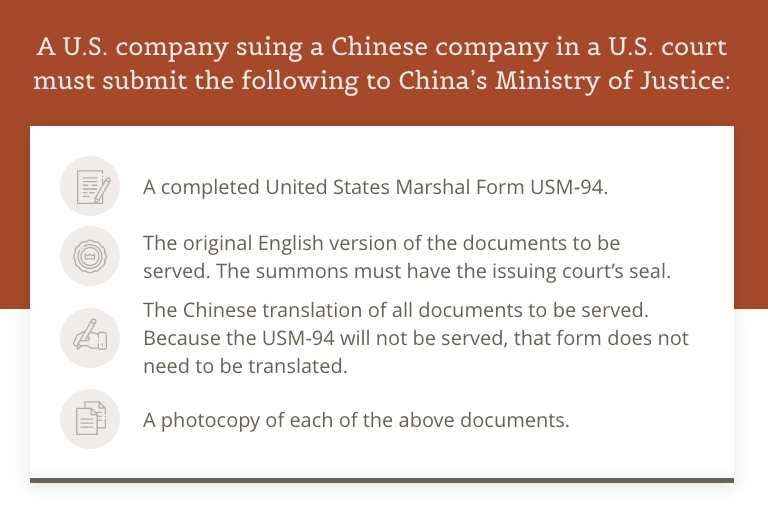
When a lawsuit requires documents to be transmitted abroad to serve a defendant at a known address in mainland China, the Hague Service Convention generally governs. China has objected to the Convention's Article 10 channels, including service by mail. When the Convention applies, mailing a complaint to China does not solve the problem. Hiring a private process server there does not solve it either.
 Two federal courts of appeals have now held that the Convention bars email service on defendants in mainland China when the Convention applies. The Second Circuit reached that conclusion in Smart Study Co. v. Shenzhenshixindajixieyouxiangongsi, 164 F.4th 164 (2d Cir. 2025), decided December 18, 2025. The Seventh Circuit followed in Kangol, LLC v. Hangzhou Chuanyue Silk Import & Export Co., Ltd., No. 25-2205 (7th Cir. May 29, 2026). Those decisions bind federal courts in their respective circuits, including courts in New York and Chicago. Courts elsewhere are not bound by them, but both opinions rely on Supreme Court precedent. A district court order authorizing email service is therefore no guarantee that the service will survive later scrutiny.
The Convention does not apply when the defendant's address is genuinely unknown. Even then, an alternative method requires court approval and must be reasonably calculated to provide notice. Kangol remanded for the district court to decide whether the seller's address was actually unknown, so expect future fights to focus heavily on what plaintiffs did to locate defendants before seeking email service. Contractual waivers present another issue. Whether a Chinese court will honor something short of an explicit waiver remains uncertain under Chinese law. A U.S. court's approval of the service method says little about whether a Chinese court will later recognize the resulting judgment.
Where China is the likely place of collection, we virtually always recommend properly completed Hague service. It gives you a far better record of lawful notice, though it does not eliminate every possible service or due-process objection. The Central Authority route requires a correctly prepared request and Chinese translations of the documents being served. China tells the Hague Conference that service takes around six months. We generally advise clients to plan on six to nine months, and some U.S. cases have described Chinese service requests taking much longer. Keep the returned service certificate. It can become an important part of a later recognition proceeding in China. Our guide to Hague service on Chinese defendants covers the process in detail.
Schedule A Cases Against Online Sellers
Many companies asking how to sue a Chinese company are brand owners pursuing counterfeiters on Amazon, Temu, Alibaba, and other platforms. Their usual vehicle has been the “Schedule A” case: one lawsuit, commonly filed in the Northern District of Illinois, against dozens or hundreds of sellers listed on a schedule attached to the complaint. Plaintiffs seek an ex parte temporary restraining order freezing marketplace accounts, serve defendants electronically, obtain default judgments, and collect from frozen funds.
Smart Study and Kangol were both Schedule A cases. In Kangol, the plaintiff sued 25 online sellers, most based in China, over alleged counterfeits sold through platforms including Alibaba. It served by email, obtained a default judgment, and collected part of that judgment from one seller's Amazon account. The Seventh Circuit reversed the district court's refusal to vacate the judgment and sent the case back for further proceedings concerning the seller's address. These decisions change the economics of Schedule A litigation, especially because the Northern District of Illinois is in the Seventh Circuit. When a Chinese seller's physical address is known or reasonably ascertainable, email service is no longer a substitute for Hague service in the Second and Seventh Circuits. Existing defaults based on email service also deserve review.
The account freeze remains important because frozen marketplace funds are sometimes the only assets a brand owner can reach. Plaintiffs contemplating these cases should therefore investigate each defendant's address before asking for alternative service. A buyer seeking a refund for defective goods from an online seller presents a different case. The Schedule A model was built primarily for brand owners pursuing counterfeiters.
Discovery
If a U.S. court properly has jurisdiction, American discovery can be an important reason to litigate there, particularly when banks, customers, marketplaces, or other U.S. third parties hold useful evidence. A Chinese party properly before a U.S. court has discovery obligations under the applicable American rules. Getting production from China is another matter.
China restricts evidence-taking for foreign proceedings. Article 36 of its Data Security Law restricts the provision of data stored in China to foreign judicial or law-enforcement authorities without approval from the competent Chinese authorities. China also does not permit foreign lawyers to conduct depositions in China for use in foreign courts. Putting the witness on a video connection does not avoid the problem if the witness is physically sitting in China. Evidence-taking through authorized procedures under the Hague Evidence Convention is a separate route. The U.S. State Department warns that unauthorized deposition activity can expose participants to arrest, detention, or deportation.
A U.S. discovery order does not erase Chinese legal restrictions. But “Chinese law prevents us from producing this” should not simply be accepted without analysis either. The objection needs to be evaluated on its facts and legal basis. Build the evidence plan with lawyers in both countries. Can You Subpoena a Chinese Company? explains the differences among party discovery, subpoenas directed at nonparties, and Hague Evidence Convention procedures. Hague service of a complaint does not give you the powers provided by Hague evidence procedures.
Can You Enforce a U.S. Judgment in China?
Chinese courts can recognize and enforce qualifying U.S. judgments, but the judgment creditor must bring a separate proceeding in China. A final U.S. judgment has no operative force against assets there until a Chinese court recognizes it. In 2017, the Wuhan Intermediate People's Court recognized a Los Angeles County Superior Court judgment in Liu Li v. Tao Li. Chinese law has continued to develop since then. The Supreme People's Court's 2022 conference summary concerning foreign-related commercial and maritime trials adopted de jure reciprocity. Under that approach, a Chinese court can find reciprocity when the law of the foreign country would permit recognition of a Chinese judgment, even without a prior case actually doing so.
Amendments to China's Civil Procedure Law, effective January 1, 2024, further clarified the recognition framework. The Chinese court examines whether the U.S. judgment is final and whether the U.S. court had jurisdiction under Chinese recognition standards. It also considers whether the defendant received lawful notice and a reasonable opportunity to be heard. Fraud in obtaining the judgment, a conflicting judgment, and Chinese public policy can each prevent recognition. Satisfying the U.S. court's jurisdictional and service requirements therefore does not end the inquiry.
The form of relief matters as well. A U.S. injunction does not operate directly against a mainland factory. Recognition of non-money relief is substantially less certain than recognition of an ordinary money judgment. Chinese courts can also refuse to recognize a portion of a damages award that significantly exceeds the actual loss, putting punitive damages at particular risk. Separate compensatory damages, punitive damages, interest, attorneys' fees, and costs in the judgment and support each category. In a default case, expect close scrutiny of service and of the defendant's opportunity to participate.
If China is where the assets are, plan the Chinese recognition proceeding while the U.S. lawsuit is still underway. Bring in the Chinese lawyer who will eventually handle recognition early enough to spot problems with jurisdiction, notice, damages, or the form of relief before the U.S. court enters judgment. Our guide to enforcing U.S. judgments in China goes through the recognition application and collection analysis in detail.
What Can You Recover?
Proving Damages
A contract claim can support repayment, performance, or damages. Begin with the law governing the claim, including whether the CISG applies. Where the Civil Code governs, Article 584 allows damages for breach that can include profits the injured party would have earned had the contract been performed. Recovery is limited to losses the breaching party foresaw, or should have foreseen, when the contract was made. Article 591 limits recovery for losses that the injured party allowed to increase by failing to take reasonable mitigation measures. The contract's limitation-of-liability and exclusive-remedy provisions also matter.
Separate losses you can document from those built on projections. Recovering a specific advance payment is one kind of case. Claiming several years of hypothetical profits is another. Replacement purchases, repairs, lost orders, and reasonable mitigation costs can establish what the breach actually cost. But not every financial problem occurring after a breach was caused by that breach. If the claim depends heavily on a financial model, test its assumptions before committing to litigation. Accurate historical numbers do not make an unsupported growth projection reliable, and a decline in sales does not by itself establish causation. Our post on forensic accountants in China-related litigation discusses this problem in the context of actual disputes.
Liquidated Damages
Article 585 of the Civil Code permits parties to agree on a damages amount or a formula for calculating damages. At a party's request, a court or tribunal can increase an amount set below the actual loss or reduce one set excessively above it. An absurdly high liquidated damages figure therefore does not make a contract stronger. It gives the other side an argument for reduction. A defensible figure does something much more useful: it gives a Chinese court a concrete basis for deciding how much of the manufacturer's money to preserve when the contract has been breached. Manufacturers know that. The prospect of a bank-account freeze often does more work than the damages clause ever has to do at trial.
A supportable damages amount also helps you decide, before filing, whether the claim justifies the expense of preservation and enforcement. Keep proof of the actual loss regardless of what the contract says. China Contract Damages explains how we use these provisions and why the amount stated in the contract is not a guaranteed recovery.
Lawyers' Fees and Costs
Budget on the assumption that winning will not reimburse every dollar you spend. Whether lawyers' fees and litigation expenses are recoverable depends on the forum, the claims, the contract, and the governing rules. Ask counsel for the legal basis behind each category you intend to demand. Adding every litigation expense to a damages claim without a supportable basis does not make the demand stronger.
Tooling and Intellectual Property
When the goal is recovering molds or stopping unauthorized production, identify exactly which rights are involved. Ownership of physical tooling, ownership of the underlying design, and the right to use manufacturing files are separate questions. Paying an invoice labeled “tooling” does not necessarily answer any of them. Intellectual property rights are also territorial. A U.S. patent or trademark does not by itself give you a registered right in China. Determine what rights actually exist there and which parties are subject to contractual restrictions. Copyright, trade secret, trademark, patent, and contract claims all have different elements.
Some disputes call for administrative, customs, or marketplace remedies in addition to litigation. An enforceable China NNN Agreement can restrict disclosure, unauthorized use, and circumvention. It does not replace registering trademarks and other registrable rights in China. China NNN Agreement or Trademark Registration? Usually Both explains the distinction. “They stole our IP” is not a claim. Identify the particular right, who owns it, what the supplier did, and what remedy follows.
What Will It Cost, and How Long Will It Take?
A useful budget separates the preliminary assessment from the full proceeding. The first stage should identify likely defendants, available forums, essential evidence, and preliminary collection prospects. Sometimes that work uncovers a problem serious enough to stop before the client commits to litigation. In a strong case, it gives you the information needed to budget what comes next. The litigation or arbitration budget should cover counsel in every country involved, court or institutional fees, translations, experts, and security required for provisional relief. In China that security is often provided through an insurance-company guarantee.
Chinese court filing fees are calculated on a sliding scale based on the amount claimed. Budget separately for an appeal or an award challenge and separately again for enforcement. Ask what assumptions drive the estimate and what events would require a revised budget. A quote covering only preparation of a complaint or arbitration filing tells you very little about what it will cost to get paid. Do the same thing with timing. Ask separately about the first-instance case, an appeal or challenge, and enforcement. Chinese law exempts foreign-related cases from some of the trial deadlines applicable to domestic litigation, so domestic timetables are a poor guide.
Urgent preservation moves much faster. Hague service can add months to a U.S. lawsuit. Recognition of a U.S. judgment in China requires another proceeding altogether. Anyone promising you an exact completion date is guessing.
Legal fees are not the whole cost. Management time and business disruption matter too. If the dispute has interrupted production, establish replacement manufacturing or another business-continuity plan while the lawyers work. Your company's survival should never depend on a court's calendar.
How Do You Get Paid?
Forget what you have read about “face.” Chinese companies settle for the same basic reason American companies settle: settling looks better than the likely alternative. Chinese courts actively encourage mediation. A frozen bank account also has a way of concentrating everyone's attention. But a settlement is useful only if you can enforce it. Put the settlement in Chinese and have it properly signed and chopped. Even then, a private settlement agreement remains a contract. If the supplier defaults, you may be litigating again.
When mainland proceedings are already pending, ask Chinese counsel whether the settlement should be embodied in a court mediation statement or an enforceable arbitral award or mediation statement. If the proceeding is outside mainland China, work out the Chinese recognition and enforcement route before agreeing on the form of the settlement. An unsecured promise by a struggling supplier to pay over time is not the same as payment. Before releasing frozen assets or dismissing a valuable proceeding, know what you can do if the next installment never arrives.
If the money must leave China, resolve the mechanics before calling the dispute settled. Specify the currency and receiving account. Address fees and withholding. Have counsel confirm what documents the remitting bank will require. Otherwise the parties can agree on the headline settlement amount and still fight about how the money is supposed to reach you. If the debtor refuses to comply with an enforceable decision, collection proceeds through the court enforcement system. Chinese courts have real powers to investigate and seize debtor assets. They cannot seize property that does not exist, wipe out valid secured claims, or ignore insolvency proceedings.
Deadlines continue after judgment. The general period for applying for enforcement is two years, subject to rules governing when that period begins and what suspends or interrupts it. For a foreign judgment or award, have Chinese counsel calculate the deadline for the initial recognition application promptly. When a foreign judgment is recognized without simultaneous enforcement, the period for applying for enforcement begins again when the Chinese recognition ruling takes effect under the Supreme People's Court's Civil Procedure Law interpretation. Calendar the recognition deadline and any later enforcement deadline separately.
Frequently Asked Questions
Is a smaller claim worth pursuing?
For claims under roughly $350,000, we generally advise against litigation or arbitration in China because legal costs consume too much of a realistic recovery. Marketplace remedies, insurance, a payment-provider dispute, or a negotiated inventory return often produce a better economic result. Where the facts genuinely point to fraud rather than an ordinary contractual dispute, a criminal referral in China may be worth evaluating.
Do I need a signed contract to sue a Chinese company?
No. A good contract makes an enormous difference, but purchase orders, correspondence, invoices, electronic records, and performance can establish an agreement under Chinese law. A missing company chop does not automatically defeat the claim either. What changes is the amount of factual fighting required. Without a signed, chopped, Chinese-language agreement, more of the case tends to revolve around identifying the parties and proving exactly what they agreed to.
Can I sue a Chinese company in small claims court?
A U.S. small-claims case is usually impractical when the defendant has to be served in mainland China and its assets are there. Hague service followed by a separate Chinese recognition proceeding can easily cost more than the claim. A defendant with assets that can be reached where the small-claims case is filed, coupled with a legally valid means of service there, presents a different calculation.
Do I need a Chinese lawyer?
If you are suing in a Chinese court, yes in practice, and anyone representing you there must be licensed in China. We generally do not recommend that a foreign company simply pick a Chinese firm and manage the litigation itself. Lawyers outside China who understand the client's business and the broader dispute should usually remain involved in strategy, selection and management of Chinese counsel, and decisions about sensitive information. A U.S. lawsuit or foreign arbitration does not itself require Chinese counsel. If collection eventually has to occur against assets in China, Chinese lawyers will almost certainly become necessary.
Can I sue a Chinese seller on Amazon, Temu, or Alibaba?
Potentially. First identify what kind of case you actually have. A brand owner pursuing counterfeiters has traditionally used a Schedule A action. After Smart Study and Kangol, email service on Chinese sellers with known or reasonably ascertainable addresses will not stand in the Second and Seventh Circuits when the Hague Convention applies. A buyer trying to recover money for defective goods has a different claim. In either situation, the defendant's location affects jurisdiction, service, and ultimately collection.
Will a Chinese court enforce my U.S. judgment?
It can. You must first obtain recognition through a separate Chinese proceeding. The Chinese court will examine, among other things, the U.S. court's jurisdiction under Chinese recognition standards and whether the defendant received lawful notice and a genuine opportunity to be heard. If China is the expected place of enforcement, build the U.S. case with those questions in mind from the beginning.
How long does it take to sue a Chinese company?
There is no useful single answer. An urgent asset-preservation order in China can sometimes be obtained within days. The underlying case takes much longer. A U.S. lawsuit involving a mainland defendant can add six to nine months for Hague service alone, sometimes more. Recognition of a U.S. judgment in China adds another proceeding. Ask for separate estimates for the emergency relief, merits case, appeal or challenge, and enforcement.
Before You Authorize a Lawsuit
Give your lawyer a short chronology and the complete contract set, along with payment records, the core evidence of breach, and a supportable calculation of your loss. Include the supplier's complaints about your performance and identify any proceedings already underway. Then explain the business result you actually need and when you need it.
The lawyer's recommendation should address more than whether a plausible claim exists. It should tell you who can be held liable, why the proposed forum is available, which urgent remedies are worth pursuing, where the defendant's reachable assets appear to be, and how a successful judgment or award becomes actual money or other useful relief. It should also identify the important facts that remain unverified. A well-prepared claim aimed at reachable assets and supported by a contract written to be enforced in China can justify decisive action. A case against a disappearing defendant, based on weak evidence and no realistic collection plan, requires a much better reason to keep spending.
If you are weighing a claim against a Chinese company, contact us with the parties' names, the approximate amount in dispute, and any immediate deadlines. Our International Dispute Resolution lawyers handle cross-border litigation, arbitration, judgment enforcement, and related disputes involving China and other countries. Once conflicts are cleared, we will tell you what we need to determine whether the case is worth bringing. I would rather tell a company that its proposed lawsuit is a poor investment before it files than explain that problem after it has paid to obtain an uncollectible judgment.