The Hong Kong Intermediary Trap: Do Not Contract with the Wrong China Company
Foreign buyers like dealing with Hong Kong intermediaries. The emails are clear, the invoices look familiar, the bank account feels safer, and the person on the other end usually speaks better English than the factory contact.
But in China manufacturing, invoices are beside the point. If a mainland factory has your technical files, molds, formulas, packaging, and specifications, that factory controls the part of the deal that can hurt you.
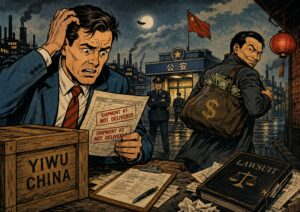
When your first shipment is defective, late, or unsellable, or your product appears online under someone else's name, you may discover your contract binds the company least able to fix the problem: the Hong Kong entity, not the mainland factory.
A $2 Million Payment to the Wrong Company
Years ago, I represented a mainland Chinese company. A U.S. company owed it $2 million. I sent a demand letter. Nothing. So we sued.
A few weeks later, the U.S. company wired $2 million to a Hong Kong company. Not to my client. Not to the mainland Chinese company that had sued them. To a Hong Kong company.
The lawyer then demanded I dismiss the lawsuit “because the debt had been paid.” The U.S. company had sent the money to the Hong Kong company because it wanted to keep me from getting a contingency fee. They even told my client that. They did not know that we had the case on an hourly basis.
I was not amused.
I explained why we would not be dismissing the lawsuit. My client was a mainland Chinese company that had sued for the $2 million it was owed. The U.S. company had sent $2 million to a Hong Kong company that was not my client and was not owned by my client.
Yes, that Hong Kong company was where the U.S. company had always sent its payments. But it was not my client, and the $2 million was still owed to my client.
The case ultimately resolved with my client receiving an additional six figures. I do not know whether the company made this additional payment or whether its lawyer paid some or all of it. But I do know the Hong Kong company never returned any of the funds, and no one sued it to try to get them back.
A Hong Kong company is not a mainland Chinese company. Even if the two companies are related, sending money to the wrong entity does not pay a debt owed to the right one.
The Wrong Company Problem
Hong Kong companies can play legitimate roles in China manufacturing deals. Some are trading companies, logistics managers, payment handlers, sourcing agents, or offshore sales arms for mainland factories. They may help foreign buyers communicate with manufacturers, manage schedules, consolidate shipments, and handle export paperwork.
Others exist mainly to move money offshore, reduce tax exposure, or place a thin Hong Kong entity between the foreign buyer and the mainland factory. Many consist of little more than a low-rent office, a cheap desk and chair, and an old computer.
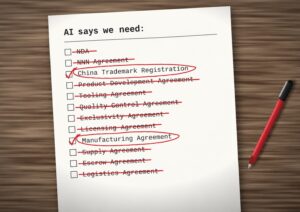
This is where buyers get into trouble. They have a signed purchase order, an English-language NDA, and a clean Hong Kong invoice. But if the mainland factory never signed the manufacturing agreement, China NNN Agreement, or mold ownership agreement, the buyer may be protected only against the least useful company in the chain.
Buyers sign with Hong Kong companies because it feels easier. The Hong Kong company communicates better, responds faster, sends familiar-looking documents, and provides a bank account that feels safer. It may call itself the factory’s “international office,” export company, sourcing agent, sales arm, or payment vehicle.
Do not stop at the description. Look at the operational reality: who holds the molds, who has the files, who controls production, and who can stop the damage.
Many discussions of Hong Kong intermediaries focus on the difference between Hong Kong’s common law system and mainland China’s legal system. That difference matters. But in most China manufacturing disputes, physical control matters more.
The key facts are usually on the ground in mainland China. The factory has the production files, workers, subcontractors, component suppliers, samples, tooling, and production line. It may also have your packaging, brand assets, test results, product improvements, and customer information.
If the mainland factory never signed your contract, you may have a clean claim against a company that cannot give you the remedy you need. You may need tooling returned, production stopped, defective goods destroyed, confidential information protected, or quality problems fixed before a shipment leaves China. A Hong Kong intermediary likely cannot do any of that.
And when the Hong Kong company tells you it “owns the China factory,” that is usually irrelevant, and often untrue.
The Mold Hostage Problem
You pay a Hong Kong intermediary tens of thousands of dollars for custom injection molds for a plastic consumer product. The molds sit at a mainland factory. Business starts well. Then quality slips, prices go up, shipments run late, and you decide to move production.
The Hong Kong company tells you it does not have the molds. The mainland factory tells you it has no contract with you. The factory refuses to release “your” molds unless you pay more money, accept a price increase, or place more orders.
A purchase order with a line item for “mold fees” usually will not save you. Without a dedicated mold and tooling agreement signed by the factory physically holding the steel, you likely will not be able to prove you own the tooling or force its return. At that point, you may have financed the factory’s next production line.
My law firm has turned down dozens of these cases.
When Your Files Reach the Wrong Factory
You send CAD files, a bill of materials, packaging designs, firmware notes, and pricing targets for a small electronic device to a Hong Kong intermediary. The intermediary forwards those materials to one or more mainland factories for quoting, sampling, or production.
Months later, similar products appear online. You suspect one of the factories is responsible, but you do not know which factory received which files, who signed what, or whether any mainland manufacturer ever agreed to confidentiality, non-use, or non-circumvention obligations.
China-focused NNN Agreements need to be signed by the party receiving the sensitive information. A Western-style NDA with a Hong Kong intermediary may not reach the mainland factory that actually received the files. Worse, if you never identified the actual factory, you may not even know whom to pursue.
By then, your product is being sold by other companies, your files are gone, and pursuing anyone is likely to be difficult, expensive, and commercially pointless. My law firm has turned down hundreds of these lawsuits.
Hong Kong Judgments Are Not a Cure
Hong Kong and mainland China have a formal mechanism for reciprocal recognition and enforcement of certain civil and commercial judgments. But none of that fixes a contract signed by the wrong party.
A Hong Kong judgment against a thinly capitalized trading company may still leave you without a practical remedy. If the mainland factory did not sign the contract, did not agree to the dispute clause, and is not the judgment debtor, its machinery may keep running.
Hong Kong can make sense when the Hong Kong company genuinely controls the deal: real assets, real authority, and actual operations, not just a useful address. A Hong Kong distributor that buys product from a mainland factory, takes title, and resells into international markets from a real Hong Kong business is different. If the dispute is about unpaid invoices from that distributor, a Hong Kong forum clause may be exactly right. The contract structure should follow the deal structure, not the other way around.
But if the mainland factory, molds, witnesses, documents, and remedy are all in mainland China, a contract with a Hong Kong entity may leave you with no practical way to stop the factory that has your product, tooling, and IP.
Your contract and dispute resolution clause should be built around your most likely remedy. Stopping a mainland factory from using your molds or confidential information requires a different structure than collecting from a Hong Kong distributor with real assets in Hong Kong.
Contract Directly With the China Factory
When the mainland factory is manufacturing the product, receiving confidential information, holding tooling, controlling subcontractors, or creating the infringement risk, that factory usually needs to sign the relevant contracts directly.
This does not always mean cutting out the Hong Kong company. The better structure may be a three-party agreement among the foreign buyer, the Hong Kong intermediary, and the mainland factory. The Hong Kong company can still handle payment, sales, logistics, or export paperwork, while the mainland factory signs the NNN Agreement, manufacturing agreement, tooling agreement, quality agreement, and IP provisions.
What usually does not work is pretending the Hong Kong company and the mainland factory are legally interchangeable.
The Worst of All Possible Worlds
We are seeing more contracts between American and European companies and Chinese factories that call for disputes to be resolved in a Hong Kong court. The clauses have grown fashionable. They seem reasonable, and foreign buyers find them familiar.
A Hong Kong court may refuse to hear the case if the dispute has no real Hong Kong connection and the defendant is a mainland Chinese manufacturer. Hong Kong is not automatically the forum for every China manufacturing dispute merely because the contract says so.
A U.S. court is unlikely to hear a dispute between a Nigerian company and a Kenyan company over a matter with no U.S. connection. A Hong Kong court is similarly unlikely to want a mainland China manufacturing dispute with no real Hong Kong connection.
The fix is not complicated, but it must happen before the factory has your molds, files, and leverage: identify the mainland entity, verify its Chinese legal name, and get the right China-side contracts signed before money or technical information changes hands.
China Manufacturing Red Flags
Stop the transaction if you see any of these red flags during negotiations:
- The Hong Kong company refuses to identify the mainland factory, or says the factory cannot, will not, or is too informal to sign.
- Drawings, samples, CAD files, or tech packs are going to the mainland factory before anything has been signed.
- Mold fees are being paid without a mold ownership agreement signed by the factory holding the tooling.
- Branding is being shared before China trademarks have been filed.
- The contract says nothing about subcontracting.
- The contract does not identify the Chinese manufacturer by its legal Chinese name.
- The dispute resolution clause appears to have been copied from a Western template with no thought given to enforcement in China.
Demand direct contracts with the party that actually controls production. If the company holding your molds, your files, and your production line did not sign, your contract protects the wrong party.