







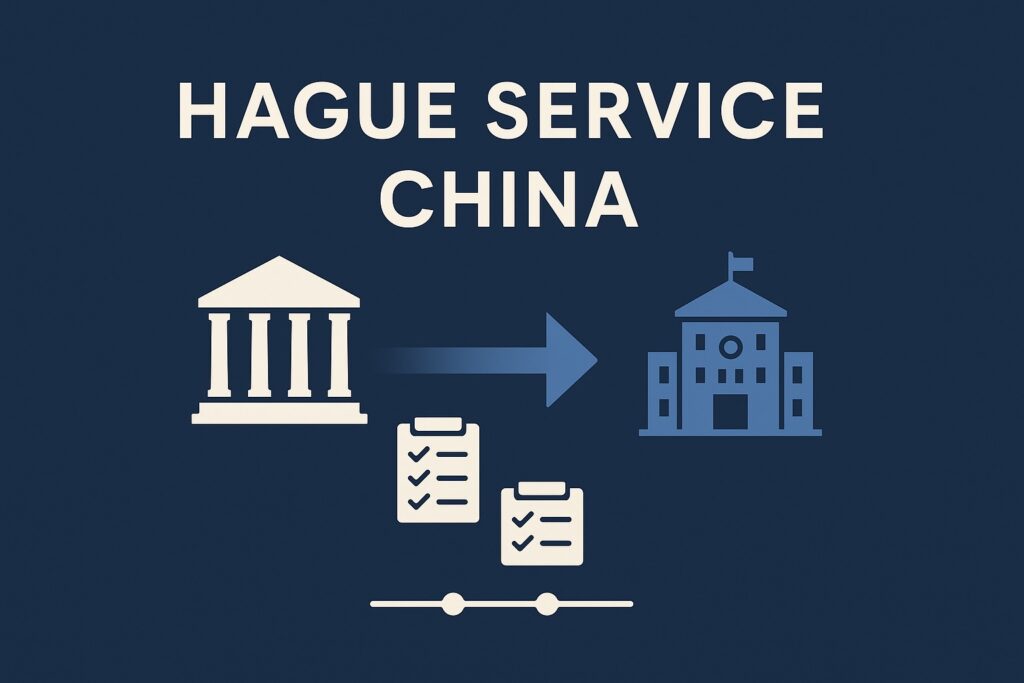
Hague Service in China: Serving Defendants and Enforcing U.S. Judgments
Consider an American company that spends years litigating a breach of contract case against a Shenzhen supplier. It wins. Then a Chinese court refuses to recognize and enforce the judgment because the defendant was not properly served. This is a risk we see regularly. Companies hire "someone in China" to serve papers, or try to serve by mail or electronically, only to discover years later that their service was defective and their judgment is difficult or impossible to enforce.
Here's rule number one: do not assume that suing a Chinese company in a U.S. court will get you paid. Chinese courts have become more willing to recognize U.S. judgments, and amendments to China's Civil Procedure Law (CPL) that took effect in 2024 provide a clearer framework for enforcement. But enforcement remains difficult and must be considered from day one. Improper service can make an otherwise valid judgment worthless.
More than a decade ago, I wrote an article for The Wall Street Journal, Chinese Companies Court Disaster, on the growing number of lawsuits brought by foreign companies against Chinese companies and on how those Chinese companies handle them. If you are involved in a lawsuit against a Chinese company or even just considering one, I urge you to read that article. Much of it remains as true today as it was then.
Note: This post addresses Mainland China. Service in Hong Kong and Macau follows different procedures and timelines.
How Not to Serve a Chinese Defendant Under the Hague Convention
When a U.S. lawsuit requires transmitting documents to a defendant at a known address in Mainland China, the reliable route is service through China's Central Authority under the Hague Service Convention. Anything else deserves careful legal scrutiny, particularly if you eventually want a Chinese court to enforce your judgment. We often hear from companies that hired someone in China to "privately" serve their lawsuit, only to discover (usually years later) that the service was invalid. Imagine spending hundreds of thousands in litigation costs, only to have the defendant successfully challenge the judgment because service was defective.
Private service carried out independently by a process server in China is generally not permitted. Service by mail is also ineffective because China has formally objected to service by mail under Article 10(a) of the Hague Convention. The U.S. Supreme Court confirmed that Article 10(a) permits mail service only if the destination state has not objected. China has objected, so direct mail service is unavailable.
We see the same pattern in other areas of China law. Just as there are unqualified lawyers, non-lawyers, and outright fraudsters who claim to draft enforceable contracts for China but deliver documents worse than having no contract at all (see China Lawyer Scams and Bad China Contracts: How Foreign Companies Get Burned), there are also people who will take your money to effect worthless service of process in China. They cost less up front, but in the long run they can leave you with a case that collapses.
Electronic service under Rule 4(f)(3) is another frequent problem. Some U.S. courts have authorized email service on Chinese defendants, but courts have disagreed about whether the Hague Service Convention permits it. Two recent federal appellate decisions make this risk especially important. In December 2025, the Second Circuit held in Smart Study Co. v. Shenzhen shixindajixieyouxiangongsi that email service on Chinese defendants is prohibited when the Hague Convention applies. In May 2026, the Seventh Circuit reached the same conclusion in Kangol LLC v. Hangzhou Chuanyue Silk Import & Export Co..
There are exceptions worth understanding. The Hague Convention does not apply when the defendant's address is genuinely unknown after reasonable efforts to locate it. It also does not govern service validly completed within the United States without transmitting documents abroad. A valid waiver of service presents another possibility. But these exceptions are not invitations to avoid Hague service merely because it takes time. Even where a U.S. court authorizes an alternative method, a judgment based on that service can face serious challenges in China. If you expect to enforce your judgment against Chinese assets, Hague Central Authority service is usually the safer choice.
Beware of "International Service of Process" Companies
So-called international service companies are another common pitfall. In our experience, many providers that routinely handle simpler international service matters do not understand China's particular requirements. They apply procedures that work in countries such as Canada, Germany, or the U.K., but not in China. The result can be eight to twelve months wasted, followed by the realization that service never happened at all. By the time our law firm is brought in, we often must start over as if it were day one.
I'm currently serving as an expert in a legal malpractice case in which the plaintiff alleges that an attorney failed to properly serve a Chinese defendant. The case illustrates just how serious these mistakes can become. A botched service attempt can put the client's underlying lawsuit at risk and leave the lawyer defending a malpractice lawsuit of their own.
If you have already attempted service on a Chinese defendant and are not getting results, contact our Hague Service team for a service validity assessment before you waste more time on a process that may never produce valid service.
How to Properly Serve a Chinese Defendant Under the Hague Convention
China has updated the procedures for submitting Hague service requests. In particular, its Ministry of Justice now encourages electronic submission through its online system instead of requiring every applicant to send a physical packet to Beijing. For a U.S. plaintiff seeking service through China's Central Authority, the required materials generally include:
- A completed Hague Service Convention request using the prescribed model form, commonly called U.S. Marshals Service Form USM-94.
- The English-language documents to be served, including the summons bearing the issuing court's seal, complaint, and any exhibits or related documents that must accompany service.
- Chinese translations of all documents to be served, generally in simplified Chinese. The Hague request form itself ordinarily need not be translated.
- Electronic copies of the completed forms and documents for submission through China's online system.
- Proof of payment of the $95 service fee per recipient, paid by international wire transfer to the Supreme People's Court of China.
The old procedure involved sending original documents and copies by international mail or courier. That remains possible, subject to the Ministry's requirements, but China's Central Authority now strongly recommends using its online judicial assistance portal. The online system allows applicants to submit requests, receive a case number, track progress, and obtain service results electronically. China's Ministry of Justice states that online requests receive priority over paper submissions.
China is a party to the Hague Convention on the Service Abroad of Judicial and Extrajudicial Documents in Civil and Commercial Matters. Its designated Central Authority is the Ministry of Justice, acting through its International Legal Cooperation Center in Beijing. The Ministry reviews the request and forwards it to the Supreme People's Court, which distributes it to the appropriate local court. The local court then attempts service under Chinese law. The results return through the court system to the Ministry, which issues the Hague certificate.
The Hague Conference's official China information page identifies the current Central Authority, service requirements, payment instructions, and applicable reservations. In our experience, everything must be correct. An incomplete translation, inaccurate company name, wrong address, or missing payment confirmation can prevent service or delay it substantially. Online submission now makes tracking easier, but it does not eliminate the need for careful preparation and follow-up.
Our Chinese-speaking legal team monitors requests, follows up with the Ministry and local courts when appropriate, and works to resolve problems before they consume months of litigation time. We typically tell clients to budget several months for Hague service in China. The Hague Conference currently lists approximately six months as the expected period. Some requests are completed much faster, particularly through the online system, but we have also seen cases take more than twelve months.
What If the Chinese Defendant Refuses Service?
Chinese companies and individuals sometimes refuse to accept service, whether to stall the case or for other reasons. A refusal does not necessarily mean service has failed. Under Chinese civil procedure, the local court may be able to complete service through another legally authorized method and document what happened. If the court confirms that service was properly completed, the resulting Hague certificate can establish service in the U.S. proceeding.
When service is refused or the Chinese authorities do not complete it, we work to obtain whatever documentation is available and prepare declarations explaining the circumstances to the U.S. court. U.S. courts sometimes allow a case to proceed despite the absence of a completed service certificate. Article 15 of the Hague Convention provides a procedure under which a court can enter judgment without a certificate after certain requirements have been satisfied, including the passage of at least six months and reasonable efforts to obtain proof of service.
But proceeding without a certificate is not the same as establishing that Hague service was completed. A Chinese court reviewing a later enforcement application may scrutinize whether the defendant was lawfully summoned and had a reasonable opportunity to defend itself. That is particularly important when the U.S. judgment is a default judgment.
Should You Even Bother Trying to Serve a Chinese Defendant?
When our law firm is retained to serve process on a Chinese company, the first question we ask is whether pursuing service is a sound strategic investment. Hague service in China can be slow and costly, and sometimes the payoff simply isn't there. We've been called at least a dozen times by litigators wanting to sue specific Chinese vape battery and fireworks companies. From experience, we already know that some of these defendants have structured themselves to make collecting a judgment extraordinarily difficult. In those cases, service is often a waste of resources. For more on why winning a lawsuit does not necessarily mean collecting anything, see International Litigation: Winning the Lawsuit Is Often the Easy Part.
That is why we nearly always begin with basic due diligence, which we provide for a flat fee of $1,500. This involves pulling the company's official Chinese government registration records and conducting Chinese-language research into its ownership, operations, reputation, and litigation history. These sources can be surprisingly revealing. Sometimes they identify a legitimate operating company with assets or business interests worth pursuing. Other times, they expose a company that is little more than an empty shell. Most of the time, the results fall into a gray zone where other litigation factors determine whether pursuing service makes sense. For a real-world example of why litigation is not always the best option, see China Supplier Fraud in Yiwu: Why We Recommended the Police, Not a Lawsuit.
In addition to assessing whether the defendant is worth pursuing, due diligence helps prevent problems with the Hague service request itself. In China, a company's registered Chinese-language legal name is essential to identifying the correct defendant. The English name used in contracts or on websites is often just a trade name or an informal translation. For example, "Chairman Mao's Widgets" might be the name used publicly, but the company's registered Chinese name could be entirely different. A Hague request that does not accurately identify the legal entity risks rejection or unsuccessful service.
Address accuracy is just as critical. Many unsuccessful Hague service attempts produce the dreaded response: "No such defendant at the address provided." This often means the plaintiff relied on an outdated or incomplete address from a contract, bill of lading, or website. We check the company's government registration records and, where possible, determine whether it still operates at its registered or other known address. A registered address is an important starting point, but it is not a guarantee that the local court will find the company there.
Before committing resources to Hague service, first ask whether the defendant has the ability and incentive to satisfy a judgment. A modest investment in due diligence can prevent a six-figure mistake and years of wasted effort. See China Due Diligence: NOT Optional.
The China Service of Process Timeline
For litigators and their clients, it's essential to understand how long Hague service in China really takes. Below is a practical timeline, assuming the documents are prepared correctly from the start. These are planning estimates, not mandatory processing deadlines.
Days 1 to 14: Preparation
- Finalize and file the English-language pleadings.
- Translate all required documents into simplified Chinese.
- Assemble the complete service packet, prepare the Hague request form, and arrange payment of the Ministry's required fee by wire transfer.
Days 14 to 21: Submission
- Submit the completed service request through the Ministry of Justice's online portal.
- Upload the required documents and payment confirmation.
- Obtain the electronic submission confirmation and case number.
Weeks 3 Through Month 6: Service Execution
- The Ministry of Justice reviews the request and forwards it through the Supreme People's Court to the appropriate local court.
- The local court attempts service using procedures authorized under Chinese law.
- Track the request through the online system and follow up in Chinese when needed. Our firm's Chinese-speaking legal team monitors this step closely.
Following Service: Documentation and Filing
- Obtain the Hague certificate showing whether, when, and how service was completed, or documenting why service could not be accomplished.
- Review the certificate and any accompanying documentation.
- File proof of service with the U.S. court or determine whether further proceedings are needed.
Note: If your request contains an error, the authorities may require additional information, corrected documents, or a new submission. Some problems can be addressed before the process starts over. Others require substantial additional time. Precision at the outset remains essential.
Can You Enforce Your United States Judgment in China?
For many years, having a U.S. court judgment recognized and enforced in Mainland China was extraordinarily difficult. That began changing before 2024. In 2017, a court in Wuhan recognized and enforced a California judgment based on reciprocity. Other recognition decisions followed. The 2023 amendments to China's Civil Procedure Law, which took effect on January 1, 2024, further clarified the legal framework for foreign judgment recognition and enforcement.
One important development concerns reciprocity. Historically, Chinese courts commonly relied on de facto reciprocity. Under that approach, courts looked for evidence that a foreign court had previously recognized and enforced a Chinese judgment. China has since moved toward a more flexible approach known as de jure reciprocity. Under this approach, a Chinese court can consider whether the foreign country's laws would, in principle, allow recognition of a Chinese judgment, even without an actual prior enforcement decision.
The distinction matters, but the timing is important. The 2024 CPL amendments did not themselves formally define or adopt de jure reciprocity. That development arose from earlier Supreme People's Court guidance, including conference guidance issued in 2022. The amended CPL retains reciprocity as a basis for recognition while adding more specific rules on jurisdiction, refusal grounds, and related procedures.
Chinese courts can now consider a broader basis for reciprocity than the older requirement of a prior enforcement decision. This has improved the prospects for recognition of U.S. money judgments in China. Nonetheless, judgment creditors are in a stronger position when they can identify actual decisions in which U.S. courts recognized Chinese judgments.
For a fuller discussion of the current framework and the practical difficulties of collecting against Chinese assets, see Enforcing U.S. Judgments in China: What Judgment Creditors Need to Know.
Grounds for Chinese Courts Refusing to Enforce a U.S. Judgment
Even where reciprocity exists, recognition is not automatic. Article 300 of China's amended Civil Procedure Law identifies circumstances in which Chinese courts must refuse recognition and enforcement, including:
- The foreign court lacked jurisdiction under the standards set out in Article 301, including situations involving an insufficient connection to the dispute or a violation of China's exclusive jurisdiction rules.
- The defendant was not lawfully summoned, did not receive a reasonable opportunity to present its case, or, where required, was not properly represented.
- The judgment was obtained through fraud.
- A Chinese court has already decided the same dispute or recognized a judgment from a third country involving that dispute.
- Recognition would violate fundamental principles of Chinese law or harm China's sovereignty, security, or public interests.
The foreign judgment must also be final and legally effective. Punitive damages create additional difficulties. Chinese courts have recognized compensatory portions of some U.S. judgments while declining to recognize punitive damages. Plaintiffs should therefore make sure their judgments clearly distinguish actual damages, punitive damages, interest, attorneys' fees, and costs.
For a judgment creditor, the practical lesson is straightforward: a clean service record, proper jurisdiction, clear damages, and proof of finality all matter. Those issues need to be addressed during the U.S. case, not for the first time when seeking enforcement in China.
A Checklist for Serving a Chinese Defendant
Getting Hague service right in China requires care at every stage. A single misstep can set your case back by months or more. One advantage of working with our law firm is that we can coordinate the process from due diligence and translation through preparation of the Hague request, Chinese-language follow-up, and the declarations or other filings the U.S. court requires. Handling the work through lawyers experienced in both U.S. litigation and Chinese procedure also reduces the risk of communications getting lost between a domestic litigation firm, a translation vendor, and an international process provider.
Conduct basic due diligence first.
Begin by pulling the defendant's official Chinese government registration records and conducting a Chinese-language internet search. This helps assess the company's ownership, operations, litigation history, and potential collectability. Skipping this step often means throwing good money after bad.
Confirm the defendant's exact legal Chinese-language name.
The company's registered Chinese-language name is the most reliable way to identify the correct legal entity. The English names appearing in contracts, invoices, or websites may not correspond to that entity's registered name. An inaccurate name can prevent successful service.
Verify the defendant's registered service address.
One of the most common reasons for unsuccessful service is "no such defendant at the address provided." This happens when plaintiffs rely on an outdated or informal address. Confirm the company's registered address and investigate whether it remains a usable location for service.
Do not rely on private servers, mail, or electronic service in China.
China has formally objected to the alternative channels under Article 10 of the Hague Convention. Private service and direct mail service are not reliable methods for serving defendants in China. Email service presents additional legal risks and has been rejected by federal appellate courts where the Convention applies.
If Hague service is required, use the Central Authority process rather than assuming a U.S. court order authorizing an alternative method will satisfy a Chinese court.
Translate every document to be served into simplified Chinese.
The summons, complaint, exhibits, and other documents to be served must be accompanied by appropriate Chinese translations. Missing or incomplete translations can prevent service. Use professional translators who understand legal terminology. China's Ministry of Justice recommends qualified human translators. Notarization or legalization of the translation is generally unnecessary. The Hague request form itself ordinarily does not need to be translated.
Include the USM-94.
The Hague Convention model request form, commonly referred to in U.S. practice as USM-94, must be completed correctly by a person authorized to forward requests under the applicable rules. The form identifies the requesting party, receiving authority, defendant, documents, and requested service method. The certificate portion is completed by the receiving authority after processing.
Pay the $95 fee by international wire transfer.
China charges $95 per recipient for Hague service requests originating in the United States. The current payment instructions require a wire transfer to the Supreme People's Court of China, with the beneficiary receiving the full $95 after any bank charges. A copy of the payment confirmation must accompany the request. Do not rely on older instructions calling for an international money order.
Expect several months.
Hague service in China commonly takes several months. The Hague Conference lists approximately six months as the expected period, though individual cases can be substantially faster or slower. Plan your litigation timeline accordingly, and do not assume a quick turnaround.
Hire counsel fluent in Chinese.
Follow-up remains important, particularly when a request stalls at a local court. Chinese-language communication with the Ministry of Justice and local courts can help clarify problems and obtain information that would otherwise be difficult to secure. Our firm uses Chinese-speaking legal professionals to monitor service requests and handle the necessary follow-up. The online portal provides additional visibility into the process.
Document refusals.
Defendants in China sometimes refuse service. Obtain the local court's report and any available explanation of whether service was completed under Chinese law. If formal service was not completed, U.S. counsel must determine what additional steps are available. A defendant's refusal does not automatically establish valid service.
Think strategically about enforcement.
Service is just the first step. Consider whether the Chinese defendant has assets in China or abroad that can realistically be reached, and whether your eventual judgment will satisfy China's recognition and enforcement requirements.
Frequently Asked Questions About Hague Service on China
Why can't my local U.S. litigation firm simply handle this process?
Your litigation firm can handle Hague service if it knows the applicable procedures and has the resources to manage them. The difficulty is that Hague service in China involves requirements unfamiliar to many domestic litigators, including Chinese translations, specific payment procedures, the Ministry of Justice's submission system, and follow-up with Chinese authorities. Our international litigation team handles these procedures and works with U.S. litigation counsel to make sure service is properly documented.
How much time will I lose if the service request is rejected?
A rejection due to a technical error, such as an incomplete translation or incorrect defendant information, can require corrections or a new submission. Some errors can be addressed relatively quickly. Others may cost many months, particularly if the problem is discovered only after the request reaches a local court. Given that service itself often takes several months, a serious error can easily add six months or more to the litigation timetable.
The defendant has refused service. Is my lawsuit now dead?
No. Refusal does not automatically defeat service. The Chinese local court may be able to complete service through another method authorized by Chinese law. If it does, the Hague certificate should document the result.
If service was not completed, we work to obtain the relevant records and prepare a declaration for your U.S. court explaining what happened. Your U.S. lawyer can then determine whether further service attempts or proceedings under Article 15 of the Hague Convention are appropriate. The important distinction is between a documented refusal and legally completed service. They are not necessarily the same thing.
My case is time-sensitive. Can you expedite the process?
We cannot control the Chinese government's processing speed or force a local court to complete service by a particular deadline. We can eliminate avoidable delays by ensuring the paperwork is correct, using China's online submission system, tracking progress, and following up when necessary. The Ministry says online requests receive priority. That makes online submission especially valuable, though it does not guarantee any particular service date.
I hired a cheap "private server" in China. What should I do now?
Do not assume that the attempted service is valid merely because someone delivered the documents to the defendant. Have counsel review exactly how service was carried out, where the defendant was located, and whether the applicable service rules were satisfied. If service was defective, the safest solution is usually to begin proper Hague service before investing additional time and money in a judgment that may later be challenged.
Can I serve a Chinese defendant by mail or email (including Rule 4(f)(3))?
Direct mail service into China is unavailable under the Hague Convention because China has objected to Article 10(a). Email service is more complicated. Some U.S. district courts have permitted it, but the Second Circuit in 2025 and Seventh Circuit in 2026 held that email service is prohibited where the Convention applies to Chinese defendants.
When the defendant's address is genuinely unknown after reasonable investigation, the Convention does not apply, and court-authorized alternative service may be available. If you expect to enforce your judgment in China, however, avoid email service as a shortcut when the defendant has a known Chinese address.
Can I enforce a U.S. judgment in China after Hague service?
Possibly. Proper Hague service helps establish that the defendant received legally adequate notice, but enforcement requires a separate application to a Chinese court. The court will examine reciprocity, jurisdiction, finality, the defendant's opportunity to participate, public policy, and the other applicable recognition requirements. Hague service improves your position. It does not guarantee recognition or collection.
What documents must be translated for service in China?
All documents to be served must be in Chinese or accompanied by Chinese translations. That generally includes the summons, complaint, exhibits, and other materials included in the service package. The Hague request form itself does not ordinarily require translation. Translations should be complete and accurate. China's Ministry of Justice recommends qualified professional human translators.
Can a Chinese company waive Hague service and accept service in the U.S.?
Yes, in appropriate circumstances. The Hague Convention generally applies when documents must be transmitted abroad for service. If a Chinese company validly waives service under the applicable U.S. rules, or service is properly completed within the United States without transmitting documents abroad, the Convention may not apply. An advance contractual waiver of service raises different questions and should be reviewed carefully.
If you intend to enforce the judgment in China, preserve clear evidence that the defendant consented to the method used, received adequate notice, and had an opportunity to defend the case. There is no rule that Hague service must occur in every case involving a Chinese defendant regardless of where or how valid service is accomplished. We have seen many cases where an attorney believed a Chinese defendant had validly waived service, but our Hague service lawyers had serious doubts about the waiver's validity.
What happens if the Chinese company changes its address during the service process?
An address change can complicate service considerably. If the defendant relocates before service occurs, you may need to provide updated information, amend the pending request, or submit a new request. The proper response depends on how far the request has progressed and whether the Chinese authorities can locate the defendant. This is another reason we verify the defendant's current registered and operating addresses before initiating service.
What if I used the wrong Chinese company name or English trade name?
Service may be rejected or unsuccessful if the request does not identify the correct legal entity. Many Chinese companies use English trade names that differ substantially from their registered Chinese names. A company may also conduct business through a different affiliated legal entity. We recommend checking the company's official registration records before submitting the request. If you discover an error after submission, determine promptly whether the existing request can be corrected or must be replaced.
Do I need to serve both the company and its individual directors or officers?
It depends on your claims and who you are suing. If you are suing only the corporate entity, you ordinarily serve that entity. If you are also suing individual directors, officers, or shareholders personally for fraud, personal guarantees, or other claims, each defendant must be served in accordance with the applicable rules.
If those individuals must be served at addresses in China, separate Hague requests may be necessary. If they can be validly served elsewhere, different procedures may apply. Adding individual defendants can increase the time, cost, and complexity of service.
What if my judgment includes both monetary damages and injunctive relief?
Chinese recognition and enforcement of foreign money judgments is considerably more established than enforcement of foreign injunctions. Do not assume that a Chinese court will enforce an order requiring a defendant to stop manufacturing products, cease using intellectual property, or destroy goods merely because a U.S. court issued it.
A judgment containing both monetary and nonmonetary relief requires careful analysis. The Chinese court may be able to recognize enforceable portions without recognizing all the relief granted, but severance is not guaranteed. If China enforcement is your goal, make sure the monetary damages are clearly identified and independently supported in the U.S. judgment.
How much does the complete Hague service process typically cost?
Expect to spend approximately $5,000 to $8,500, depending on the number of defendants, documents, translation volume, and complexity of the service process. Your fees and costs will typically include:
- Professional translation of the documents to be served.
- The Chinese service fee of $95 per recipient, paid by wire transfer, plus applicable bank charges.
- Legal fees for preparing the request, submitting it, monitoring progress, and handling follow-up with the Chinese authorities.
The above costs are for service of process. Our $1,500 due diligence fee is separate and ordinarily precedes service, allowing you to make an informed decision before committing to the larger expense.
Key Takeaways
- Hague Central Authority service is generally the safest method when a U.S. lawsuit requires service on a defendant at a known address in China.
- Many defendants are difficult or impossible to collect from. Due diligence is critical.
- Private service, direct mail service, and improperly authorized electronic service can undermine an otherwise valid judgment.
- China now encourages online Hague requests and requires the $95 fee to be paid by wire transfer.
- Service often takes several months, sometimes considerably longer.
- Chinese courts have become more willing to recognize U.S. judgments, but enforcement remains difficult and depends on satisfying statutory requirements.
- Success depends on planning for collection and getting service right from the beginning.
If you are suing a Chinese company, get everything right the first time. Contact our International Litigation Team to discuss Hague service, due diligence, and enforcement strategies tailored to your case.