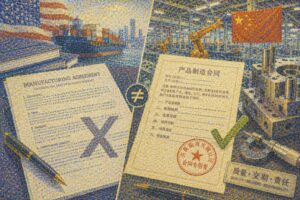
China Contract Damages: How to Give Your Contract Real Teeth
When a Chinese factory refused to return our client’s custom molds, it apparently believed possession gave it leverage. Our client had paid for the tooling, owned it outright, and could not continue production without it.
Our Chinese litigation counsel filed suit and obtained a freeze on the factory’s bank accounts within about five days. The factory released the molds the next day.
Ownership alone would not have produced that result. The agreement identified the tooling, imposed a clear return obligation, set a defensible damages amount, and provided access to a Chinese court that could act. Drafted with enforcement in mind, a China contract can discourage breach, sharpen settlement negotiations, and give the injured party a practical route to relief.
What Are China Contract Damages?
Chinese law calls agreed damages for breach 违约金 (wéiyuējīn). The term is commonly translated as “liquidated damages.” We often use “contract damages” because Chinese law does not apply the common-law penalty doctrine in quite the same way.
The provision fixes in advance what a defined breach will cost. Depending on the obligation, it might require a fixed payment for disclosing confidential information, a daily amount for late delivery, a percentage of the affected purchase order for defective goods, or a specified sum for unauthorized manufacturing, customer circumvention, or failure to return tooling.
Because breaches cause different kinds of harm, one agreement may need several damages provisions. A three-day delivery delay, an unauthorized production run, and the theft of a customer relationship should carry different consequences.
The underlying obligations need the same level of separation. Depending on the transaction, that may require separate China manufacturing agreements or distinct provisions within one agreement. Tooling obligations, NNN restrictions, quality requirements, product-development duties, and delivery terms should be clear enough for a court or arbitrator to identify the breach and apply the proper remedy.
Why Contract Damages Matter Before a Dispute
Foreign companies often focus first on whether a Chinese court will enforce the damages clause. Enforcement is only part of its value. A well-drafted provision begins working when the Chinese counterparty reads it.
Factories rarely take a vague promise to compensate “all losses” seriously. They may assume the buyer will struggle to prove its losses and will not spend the money required to pursue them.
The calculation changes when each unauthorized production run carries RMB 500,000 in damages. Before using the buyer’s molds and designs to manufacture competing products, the factory knows exactly what the contract says that decision will cost.
To work, the amount must influence behavior and still look credible. An exaggerated figure may impress an inexperienced buyer. A seasoned Chinese company may sign the same clause without concern, expecting a court to reduce or disregard it.
Contract damages also give negotiations a number. A demand letter claiming “substantial losses” invites an argument over what “substantial” means. A demand tied to the contract is harder to dismiss:
The agreement requires payment of RMB 20,000 for each day of delay. The shipment is now 18 days late, producing contract damages of RMB 360,000. Unless the goods ship and the matter is resolved by the stated deadline, the buyer will pursue those damages and its other contractual remedies.
The supplier can still contest the breach or challenge the amount. At least the negotiations begin with a defined contractual claim rather than an unsupported assertion of harm.
That advantage becomes especially important when losses resist precise calculation. Once a factory discloses a design, uses the buyer’s tooling for unauthorized production, or approaches the buyer’s customers, the resulting lost sales and damage to commercial relationships may be impossible to reconstruct.
Contract Damages and Asset Preservation
Chinese courts can preserve assets before final judgment when the legal and procedural requirements are satisfied. Depending on the case, the court may freeze bank accounts or preserve other property up to the amount of the claim.
Under the Supreme People’s Court’s rules governing property-preservation applications, a court generally must decide an application within five days after accepting it or after the applicant provides any required security. In urgent circumstances, the court must decide within 48 hours.
Those deadlines govern the court’s decision. Success depends on the strength of the claim, the evidence, any required security, and the information available about the defendant’s assets. The same factors affect how quickly an approved freeze can be implemented.
An agreed damages amount can help establish how much property should be preserved. That is particularly useful when the dispute concerns unauthorized production, stolen intellectual property, customer circumvention, or withheld tooling rather than a straightforward unpaid invoice. As discussed in Contract Enforcement in China: What Works and What Doesn’t, the prospect of a frozen bank account often changes a Chinese company’s view of the dispute more quickly than another angry email.
What Chinese Law Allows
Article 585 of the PRC Civil Code permits parties to agree on a specific amount payable for breach or on a method for calculating that amount.
Where the agreed damages fall short of the loss, a court or arbitral tribunal may increase them at the injured party’s request. The breaching party may seek a reduction when the amount substantially exceeds the loss.
Payment of late-performance damages ordinarily leaves the underlying obligation intact. A factory required to pay for late delivery may still have to deliver the goods.
Chinese courts and arbitral tribunals begin with the parties’ number and may adjust it under Article 585. For that reason, the amount needs a defensible commercial basis rather than an arbitrary punitive figure.
How the 30 Percent Benchmark Works
A persistent misconception is that Chinese law caps contract damages at 30 percent.
Article 65 of the Supreme People’s Court’s 2023 interpretation of the Civil Code’s general contract provisions states that agreed damages exceeding the loss caused by the breach by more than 30 percent may generally be regarded as excessively high.
The comparison is to the loss caused by the breach. The benchmark is not 30 percent of the contract price, purchase-order value, amount paid, or amount in dispute.
Courts do not apply the figure mechanically. They also consider the nature of the transaction, the extent of performance, the parties’ fault, and the background of the deal. Fairness and good faith remain part of the analysis, and courts generally should not reduce the amount payable by a party that breached maliciously.
The same statute permits an injured party to seek an increase when the agreed amount proves too low. The figure in the contract remains an important starting point without necessarily becoming an absolute ceiling or floor.
Supporting the Amount
The breaching party seeking a reduction ordinarily bears the burden of showing that the amount is excessively high. The non-breaching party should be ready to explain why the figure was commercially reasonable.
Language stating that neither side may request an adjustment will not remove the authority granted by Article 585. Careful calculation and good documentation provide far better protection.
Useful evidence may include development costs, expected orders, customer commitments, replacement expenses, and the value of protected information. When losses will be difficult to calculate after a breach, the parties should record their reasoning when they sign the agreement.
Drafting a Contract Damages Clause That Works
The amount should create real pressure while remaining defensible in court or arbitration. Four issues usually determine whether the clause succeeds.
Define the Breach Precisely
General language such as “failure to comply with this agreement” is rarely specific enough. The contract needs to identify the prohibited conduct, required deadline, applicable specification, protected information, restricted use, or customer relationship involved.
Delivery terms should say whether performance occurs when the products leave the factory or reach the agreed destination. For unauthorized production, the clause should explain whether each production run, shipment, or sale counts as a separate breach.
For tooling, spell out when the factory must return the molds, where the handover will occur, and what condition the tooling must be in. Uncertainty over any of these points weakens the claim before the parties reach the damages calculation.
Match the Formula to the Harm
Use a daily rate when the buyer’s losses increase over time, as they often do with late delivery or withheld tooling. Fixed damages frequently fit unauthorized disclosure and customer circumvention because the harm is serious and difficult to prove.
Percentage-based damages can work for certain quality or delivery defaults. The clause must identify the relevant order, shipment, batch, or product value and state the currency, any cap, the payment deadline, and the treatment of repeated breaches.
No single percentage works across transactions. A figure that makes sense for a multinational licensing its core technology may be absurd for a startup placing its first RMB 300,000 order. Whatever the formula, the parties should be able to explain how they chose it and how it relates to the harm they anticipated.
Build the Evidence Into the Agreement
The claimant still has to prove the breach. Records and procedures established in the contract can make that proof possible.
Depending on the transaction, useful evidence may include product specifications, approved samples, inspection reports, delivery records, tooling inventories, and production records. Audit rights and subcontracting restrictions can be equally important.
Even a sophisticated damages formula will fail if the underlying obligation cannot be proved. This is one reason so many apparently complete China manufacturing contract drafts collapse when tested against a real dispute.
Draft for the Forum That Matters
Even a well-calibrated damages clause will fail if the contract names the wrong company, selects an ineffective forum, or cannot be presented efficiently to the court that will hear the case.
Name the counterparty by its exact registered Chinese company name, rather than relying solely on an English trade name. The dispute-resolution clause should send the parties to a forum capable of granting the remedies the transaction is likely to require.
When the likely dispute involves Chinese assets, local evidence, tooling, or urgent preservation measures, access to an appropriate Chinese court may be more valuable than the familiarity of a U.S. forum.
In that setting, use a carefully drafted Chinese version and designate Chinese as the controlling contract language. Doing so reduces ambiguity and gives the court a cleaner path to enforcement.
Buyers should also preserve the rights they are likely to need, including termination, rejection of defective goods, refunds, recovery of additional proven losses, and return of tooling. Payment of a modest damages amount should not buy the factory a continuing right to breach.
Common Manufacturing Breaches
The right formula depends on the obligation. The following approaches are common, though none should be copied into a contract without considering the actual transaction.
Late Delivery
Late-delivery damages in China manufacturing contracts often use a daily percentage of the delayed goods’ value, sometimes with a cap and a right to terminate after a specified period.
State the delivery date, define when the calculation begins, address partial delivery, and establish the point at which the buyer may cancel and demand a refund.
Set the rate by reference to the commercial risk. Missing a holiday sales window, delaying a construction project, or triggering downstream customer penalties causes greater harm than a routine shipment with no fixed resale date.
Real consequences also tend to produce more honest schedules. A factory facing financial exposure for delay is more likely to reject an unrealistic deadline before signing.
Defective Products
Quality damages may be tied to the value of the defective batch, inspection expenses, rework costs, replacement shipping, or customer claims. Serious defects should preserve the buyer’s right to reject the products altogether.
Those remedies are useful only when the quality requirements are objective. Specifications, tolerances, approved samples, inspection rights, defect classifications, and failed-inspection consequences must be clear enough to establish whether the factory breached.
The contract should not allow the factory to deliver unusable products, pay a modest percentage, and walk away from the remaining consequences.
NNN and Intellectual Property Breaches
In a properly drafted China NNN agreement, fixed damages often make sense for unauthorized use, disclosure, manufacturing, or customer circumvention.
Once a design reaches competitors or unauthorized products enter the market, proving the full loss becomes exceptionally difficult. Lost sales, price erosion, damaged customer relationships, and additional competition can continue long after the original breach. The contract should define each violation and connect the damages amount to expected orders, development costs, anticipated margins, and the value of the protected information.
Molds and Tooling
For molds and tooling, damages may apply to delayed return, unauthorized use, unapproved modification, or transfer to a subcontractor.
Delayed return may justify a daily rate because the buyer’s losses increase while production remains blocked. Unauthorized use generally calls for a separate fixed amount and presents a different commercial risk.
Cover ownership, permitted use, location, maintenance, return procedures, and restrictions on transfer or subcontractor possession. Stating that the buyer owns the molds does not resolve who may hold them, how they may be used, or what happens when the relationship ends.
How Contract Damages Clauses Fail
Failure patterns are familiar. The damages figure is untethered to the likely loss, the triggering breach is vague, every violation carries the same amount, or the contract offers no practical route to enforcement.
An amount ten times the value of the transaction will invite attack unless the parties can explain exposure of that magnitude. An inflated figure may also weaken the claimant’s credibility and complicate an application to preserve assets.
Using one number for every violation creates a separate problem. Stealing core intellectual property, shipping three days late, and failing to provide a routine production report do not cause comparable harm.
Definitions matter just as much as the amount. Even a reasonable figure accomplishes little when terms such as “defective,” “late,” “confidential information,” or “unauthorized use” remain unclear. The claimant must still prove the contract, the breach, the relevant dates, and the facts needed to apply the formula.
Contract damages also need a workable enforcement framework. The clause must be part of an agreement built around the correct Chinese counterparty, usable evidence, an effective forum, identifiable assets, and the remedies the company will actually need.
The drafting requires judgment. Set the amount high enough to change behavior, then make sure the contract, evidence, forum, and available assets can support the claim.