How often do you stop to think about the ubiquitous “Made in China” label? If you are buying products from China, you should think about this all the time. The same holds true if you are buying your products from any third party manufacturer anywhere.
Para convencer a los clientes más reacios de la necesidad de contar con una cobertura de responsabilidad civil por productos defectuosos para los artículos que mandan fabricar en el extranjero, a veces les envío las siguientes preguntas que se le formularon en una declaración a un fabricante estadounidense cuyo producto, fabricado en China, había causado lesiones graves a un niño:
1. ¿Cómo elegiste inicialmente a tu proveedor de productos en China? ¿Qué tipo de investigación de fondo llevaste a cabo sobre ese proveedor?
2. ¿Dejaste claras tus especificaciones en el contrato con tu proveedor chino? ¿Estaba redactado el contrato de tal forma que realmente obligara al fabricante según la legislación china? ¿Cómo sabes que así era?
3. ¿Podría mostrarme las cláusulas de su contrato relativas a la calidad y la seguridad del producto? ¿Qué especificaciones del producto exigió a su fabricante chino? ¿Figura esto en el contrato que tiene con ellos? ¿En qué parte?
4. ¿Se limitó a creer lo que le decía su proveedor chino sobre la seguridad de su producto o lo probó usted mismo? Describa todas y cada una de las pruebas de producto que realizó.
5. ¿Qué medidas concretas tomó para asegurarse de que el producto que recibía de China se ajustara a lo estipulado en el contrato y a la normativa estadounidense vigente en materia de seguridad de los productos?
6. What made you first suspect problems with the product? Did you at that time immediately cease importing them?
7. ¿Cuánto te habría costado por unidad solucionar los problemas?
Once clients read the above questions, they get it almost immediately. And their next question is invariably, “What can I do?” At this point we provide them something along the following lines:
1. Know Your Foreign Suppliers
Manufacturers run the gamut from superb to criminal (as in criminally negligent). This means you must thoroughly check out your product suppliers in advance. At minimum, you should do a due diligence check on your supplier, as these are almost invariably quite revealing. Such a check usually can reveal whether your potential product supplier company is in fact the factory owner, or just some broker posing as the factory owner. It can also tell you whether the company is properly registered for manufacturing the product you will be buying from it. If your potential supplier of toasters is in the dog-walking business (which once happened to one of our clients), you know you have a problem that you do not want to have to explain to a judge or a jury.
A due diligence check will also usually give you a good sense for your potential supplier’s financial viability. A manufacturer that pays its bills is less likely to risk its reputation by cutting corners than a company on the verge of going under. It will also usually reveal lawsuits involving your potential manufacturer. Do you want to have to explain to a jury why you went with XYZ company to make your widgets even though XYZ company had already been sued eight times for selling unsafe/defective widgets?
It also often makes sense to check U.S. import records to see whether other American companies get product from your potential supplier and then contact those American companies for information about the supplier. Just learning that a well-regarded company has been purchasing product from an overseas factory without major problems for the last five years is itself a very good sign. For more on what is typically entailed with due diligence on foreign manufacturers and the costs and various benefits that come with that, I urge you to check out Foreign Company Due Diligence Reports and also review this example of a due diligence report our international lawyers compiled for a client looking to determine whether to move forward with a particular manufacturer.
2. Quality Control
It is essential you take responsibility for quality control. Most consumer products arrive in the U.S. already packaged for retail sale, making inspection outside the country of manufacture cost-ineffective. You therefore should institute a statistically valid inspection system in the country in which your products are being made to validate the safety and quality of your product.
A modo de ejemplo, el Gobierno chino cuenta con su propio sistema de inspección de productos alimenticios y farmacéuticos, relativamente eficaz; sin embargo, para reducir costes, muchos proveedores chinos eluden deliberadamente los procedimientos gubernamentales. El propio Gobierno chino solía estimar que hasta el 50 % de los productos alimenticios y farmacéuticos exportados desde China infringían las normas de exportación del país. En otras palabras, independientemente del producto que compres, es tu responsabilidad asegurarte de que tu proveedor cuenta con la licencia necesaria para fabricar y exportar el producto que le compras, así como de que dicho producto haya pasado por la inspección adecuada del gobierno extranjero antes de su exportación. No puedes confiar en tu proveedor para nada de esto. Si alguien sufre daños a causa de tu producto, serás tú quien sea demandado.
3. History
If you have been using five suppliers for the last few years and four are good and one is not, dump the worst one as quickly as possible. It seems every time one of my law firm’s international manufacturing attorneys deals with a major supply chain problem, the American/European/Australasian company says something like, “We should have known we would have a problem with this supplier.”
You know who your problem suppliers are. Replace them now before they cause you even bigger problems. Ask a product liability defense lawyer how xix months of e-mails from you complaining of “continual quality shortfalls” will affect a product liability lawsuit against you. Actually, don’t bother, because you already know the answer.
4. Contracts
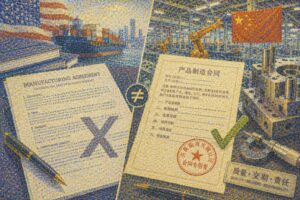
Your contracts with your foreign product suppliers should focus in detail on safety and quality control issues. These contracts should be clear and specific as to quality and safety expectations. They also should make clear your right to inspect the products and delineate responsibility for injuries and recalls. Using just Purchase Orders will not cut it.
Igualmente importante es que cumplas con lo estipulado en tus contratos. Si en ellos se establece que eres responsable de la inspección, debes llevarla a cabo. El contrato no es solo una formalidad; su finalidad es establecer un procedimiento que debe seguirse.
Your contract with your foreign product manufacturer can either shift liability towards you or away from you. You must recognize, however, that most courts will be reluctant to see an injured party walk away with nothing. Therefore, no matter how good a contract you have with your foreign manufacturer, you still must not abandon your other protections. But see China Factory Indemnification: Yeah, Whatever.
5. Insurance
Insurance is not a replacement for the above; it is your backup. Insurance rarely covers your time spent defending lawsuits or your damaged reputation. Make sure your policy fits your situation. For more on product liability insurance, check out China Manufacturing and Product Insurance.
6. Marketing
I had a client whose product brochure sported a cover touting it having the “best built______ in the world.” This company made a relatively dangerous product in an industry rife with product liability lawsuits. The plaintiffs’ lawyers that sued would almost invariably contend that my client should be held to a higher standard because it had expressly warranted its product to be better built than its competition. Make sure you are not making claims about your product you cannot back up.
There is obviously more to protecting your company from dangerous products than just abiding by that set forth above, and many of the things you do to protect yourself will be industry and company specific. But you should be reviewing at least these aspects of your business.
What do you think? What would you add to the above?