Manufacturing in China but Not Selling There? Your China Trademark Strategy Should Be Defensive, Focused, and Fast
A surprising number of companies manufacture in China without registering their trademarks there. They assume that because they are not selling into China, they do not need trademark protection there. That is a mistake.
If your products are made in China and exported from there, your trademarks are already exposed. They are on the goods, the packaging, the labels, and the hangtags. That alone can create serious problems.
The bigger risk usually is not local copycat sales. It is that someone registers your mark first and then uses that registration to interfere with your manufacturing, sourcing, or exports. We see this all the time. A company waits too long, a third party files first, and what should have been a routine manufacturing relationship turns into a problem.
If you are manufacturing in China but do not plan to sell there, your trademark strategy should usually be defensive, not broad. In most cases, that means being selective about what you file and why.
The goal of a defensive China trademark strategy
If you are not entering the China consumer market, you probably do not need a large trademark portfolio. You do not need filings in every possible class, and you do not need to register every slogan, sub-brand, or variation your company has ever used. You need to protect the marks tied to your ability to manufacture goods in China and get them out of China.
That usually means starting with the marks that actually appear on the goods coming out of China. Take a t-shirt. If your brand name is stitched into the shirt, printed on the label, embossed on the packaging, or shown on a hangtag, that mark should be high on your priority list. The same is true for logos and other brand elements physically used on the product or its immediate packaging.
But too often, companies start with a list of everything they own instead of focusing on what is exposed inside the China manufacturing and export process. Those are different exercises and they lead to different filing decisions.
If you are not selling in China, the marks that usually matter most are the ones that appear on the product, packaging, and labels. Those are the marks most closely tied to manufacturing and export risk. Other marks may still deserve protection, but for different reasons. A mark used only on your website or in advertising may still matter for brand integrity or future expansion, and registering it may still make sense. But it is rarely as urgent as protecting what appears on the product itself, because those are not usually the marks someone will use to disrupt your production flow.
If money or timing is tight, start with the marks that protect your ability to keep goods moving.
The real risk: supply chain interference
Many companies underestimate how much damage a bad-faith China trademark filing can cause, even when they have no Chinese sales. China is a first-to-file jurisdiction, which means delay can be costly. If someone else gets your mark registered first, you may be dealing with a problem that is expensive to fix and fairly easy to prevent if you act early enough.
Sometimes the problem shows up when goods are stopped by Chinese customs. Other times it appears when you try to move production to a different factory and discover someone else is claiming rights to your mark in China. The practical question is what you need to file to reduce the risk that someone else will register your mark in China and use it against you.
Register the mark as it is actually used
This sounds obvious, but companies get it wrong all the time. Your China trademark filing should match the way the mark is actually used in the real world. If you use a word mark by itself, file the word mark. If you use a logo by itself, file the logo. If you use both separately, you should seriously consider separate filings.
A common mistake is trying to save money by filing a single composite mark that combines the name and logo into one application. That can work if the combined version matches how the mark is actually used. If it does not, the registration may protect less than the company expects and leave real gaps. A company may file its brand name and logo together as one composite mark, then later start using only the brand name on packaging. At that point, the registration may not clearly cover the standalone word mark the company is actually using.
A trademark filing should create enforceable rights in the mark you actually use. If you distort that analysis to save money up front, you may end up with less useful protection. For many companies, especially those with a core brand name and a separate logo, the better approach is to look honestly at how each is used and file accordingly.
Do not blindly mirror your existing trademark filings
Your existing filings in the United States, the European Union, Canada, the United Kingdom, Australia, or elsewhere can be useful reference points. They show which brand assets and goods you already consider important and can help identify your core marks.
But you should not assume that a filing strategy that works elsewhere will work in China. China has its own subclass system and its own rules on goods descriptions. The marks may be the same, but the filing mechanics and strategy often are not.
China’s goods description rules can work in your favor
One detail that surprises many foreign companies is that in China you can usually list up to 10 goods in a class without additional official fees. In many other countries, adding more goods can increase cost, examination risk, or both. Companies used to those systems sometimes approach China filings too narrowly.
Because of China’s fee structure, it often makes sense to use the available room within a class and draft a broader specification, as long as the goods are commercially justified and consistent with CNIPA practice. An apparel company, for example, may be able to cover shirts, pants, jackets, hats, and several other clothing items within a single class for one official fee. Used correctly, that structure can give a company more practical coverage than it expected.
One class is not always enough. It depends on the products, packaging, accessories, expansion plans, and how the mark is actually used. Your China filing strategy should be built for China, not borrowed from filing habits developed somewhere else.
Factory disputes over trademarks often escalate when manufacturers file claims with Sinosure, China's state-owned export credit insurer, alleging unpaid invoices, transforming IP leverage into formal collection actions pursued in your home country. Our guide to Sinosure claims explains how financially distressed factories weaponize export credit insurance to extract payment during disputes and why proper documentation matters.
The hidden cost of cheap online filing services
This is where many online filing services get it wrong. They treat China trademark work like a numbers exercise rather than a business-risk problem. Instead of asking what actually reduces operational risk, they push companies toward a stack of applications that may look comprehensive but is often poorly targeted. They sell volume, not protection.
We have seen companies pay for far more China trademark applications than they needed. In one matter, after reviewing the products, packaging, and manufacturing setup, it became clear that one carefully chosen filing would have covered the company’s immediate defensive need. The extra applications did not materially improve its position.
If the strategy is wrong, the cheap service often costs more than competent counsel would have and leaves the company less protected.
Filing is not the end of the job
Filing in China is not a set-it-and-forget-it exercise. Registered marks can become vulnerable to non-use cancellation after three years. That matters even for companies that manufacture in China only for export.
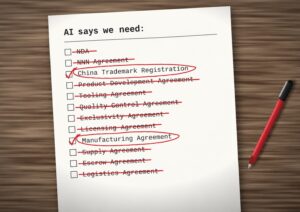
Export-only or OEM use may help defend against non-use challenges, but only if you can prove it. That means keeping the right records, including invoices, customs documents, manufacturing contracts, shipping paperwork, and other evidence tying the mark to the goods leaving China. A defensive filing strategy should therefore include both the right applications and a plan for preserving evidence of use. A defensive trademark filing protects the brand, but it does not control what the factory can do with your designs, specifications, or customer information. Most branded custom-manufacturing projects therefore need an NNN Agreement as well.
Speed matters more than most companies think
If you know you are going to manufacture in China, and you know what mark will appear on the goods, you should file as soon as you reasonably can. Waiting until launch is often a mistake. Many China trademark problems start with delay. Someone else files first. Once that happens, your options get worse and the solution gets more expensive.
What companies should do now
1. Identify the marks physically used in China.
Look closely at the products, labels, packaging, hangtags, inserts, and shipping materials leaving the factory. If a mark appears there, it should be high on your filing priority list.
2. Separate core brand assets from secondary ones.
Your main product mark is not the same as a website-only slogan or a rarely used sub-brand. Rank your marks based on the damage someone could do if they registered them first in China.
3. Make sure the filing matches actual use.
Do not file a combined word-and-logo mark just because it seems cheaper unless that is genuinely how the mark is used. A filing that does not match real-world use can leave you with weaker protection than you expected.
4. Build the goods description for China, not for your home country.
Use CNIPA-compliant descriptions and think carefully about how to get useful coverage within China’s class structure.
5. File before someone in your supply chain has a reason to move first.
The cheapest China trademark problem is usually the one you prevent.
Final thought
If your brand appears on products leaving China, assume it needs protection there. File the right marks, in the right form, before someone else does.