International Contract Manufacturing: 8 Ways to Protect Your IP, Products, and Payments
International contract manufacturing gives small and midsized companies access to lower costs, specialized expertise, and production capacity they could not justify building themselves. It also exposes them to defective goods, stolen intellectual property, delayed shipments, regulatory violations, and suppliers that become difficult to reach when something goes wrong.
Most manufacturing disasters begin before production. The buyer chooses the wrong company, discloses valuable information too soon, pays too much up front, or relies on a purchase order that says little about what happens if the manufacturer fails to perform.
There is no universal international manufacturing contract. An agreement intended for enforcement against a Chinese factory may look very different from one used in Mexico, Vietnam, or Cambodia. Governing law, contract language, dispute resolution, and available remedies must reflect where the manufacturer operates, where its assets are located, and what the local legal system will enforce.
The laws differ, but the failures follow familiar patterns. These eight steps address the problems our international manufacturing lawyers see most often.
1. Confirm Who You Are Actually Doing Business With
Before negotiating contract terms, confirm the manufacturer’s exact legal identity. The company named on a website, sourcing platform, invoice, or email signature may not own the factory. It may be a broker, trading company, affiliate, or shell company. Sometimes the contract names one entity, the payment account belongs to another, and production takes place at a facility owned by a third.
We often see a version of this problem. A company signs a polished contract with a trading company it found through a sourcing platform and wires the deposit to the account shown on the invoice. After defective goods arrive, the buyer learns that the trading company never owned a factory, the bank account belonged to an individual, and production took place at a facility that had never heard of the buyer. The contract may be well drafted, but the contracting party owns no equipment, inventory, molds, or other meaningful assets.
At a minimum:
- Confirm the company’s full legal name, registration number, and registered address.
- Verify that it is active and authorized to manufacture the product.
- Determine who owns or controls the factory where production will take place.
- Confirm that the person signing the agreement can bind the company.
- Make sure the payment account belongs to the contracting party.
- Determine whether that party owns assets against which a judgment or arbitral award could be enforced.
Complete this work before paying a deposit. For a fuller discussion, see Overseas Manufacturing Due Diligence: A Guide for Avoiding Costly Mistakes.
2. Identify the Intellectual Property That Needs Protection
Intellectual property rights are territorial. A U.S. trademark or patent generally does not give you equivalent rights in the country where your product is manufactured. Start by identifying what gives the product or business its value. For some companies, that will be the brand and product design. For others, it will be software, a formula, a manufacturing process, or confidential technical specifications.
Few businesses can justify registering every right in every country. Focus first on the jurisdictions where the product will be manufactured, sold in significant volume, shipped through, or most likely to be copied.
In many countries, trademark, patent, and design rights depend heavily on who files first. Waiting until a manufacturer, distributor, sourcing agent, or unrelated third party files can turn an inexpensive registration into a prolonged and expensive dispute.
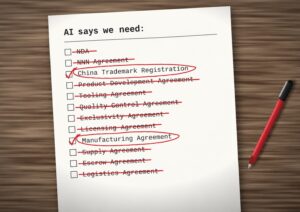
3. Register Your Trademark in the Manufacturing Country
A company may need trademark protection in a manufacturing country even if it never plans to sell there.
Consider a familiar scenario. A brand manufactures in China solely for export and assumes it does not need a China trademark because it has no Chinese customers. Its sourcing agent files first, records the mark locally, and then interferes with the brand’s exports while demanding payment for the return of the name the brand created.
A local trademark dispute can disrupt far more than branding. It can interfere with production, warehousing, customs clearance, and exports.
Many manufacturing jurisdictions follow predominantly first-to-file systems. Earlier use or registration in the United States may help in certain disputes, but it should not be treated as a substitute for filing locally. A local registration can help prevent a manufacturer, distributor, or trademark squatter from registering the brand, producing unauthorized goods, or using the mark against the rightful owner.
Our post on defensive China trademark strategies explains why companies manufacturing in China (and other first to file trademark jurisdictions) often need local trademark protection even when China is not a sales market. Whenever possible, file for your trademark before disclosing the brand to manufacturers, distributors, or sourcing agents.
4. Protect Confidential Information Before Sharing It
Many companies derive more value from unregistered know-how than from patents. Their competitive advantage may lie in a formula, manufacturing method, product specification, software system, or customer information that cannot be made secret again once disclosed. The right agreement depends on the country and the transaction. In China, a properly drafted NNN agreement addressing non-disclosure, non-use, and non-circumvention may be appropriate. Elsewhere, similar protection may come through confidentiality, restricted-use, non-circumvention, exclusivity, or intellectual property provisions.
Whatever the agreement is called, it must identify the protected information, limit how and by whom it may be used, address subcontractor access, allocate ownership of improvements, and explain what happens when the relationship ends.
The remedies must also work under the governing law. Agreed or liquidated damages may reduce the difficulty of proving the precise loss caused by misuse, but an arbitrary or excessive amount may be reduced or rejected. A damages clause also does not freeze a bank account or authorize the seizure of factory equipment. Interim asset preservation generally requires a separate court or arbitral order and may require the applicant to post security.
For more on when an NNN agreement makes sense and when it does not, see China NNN Agreements: The Hard Truth.
5. Define the Product and Quality Standards Precisely
Terms such as “high quality” and “industry standard” sound useful but are usually too vague to enforce. The agreement must describe the product in measurable terms. Depending on the product, that may include materials, dimensions, approved components, performance requirements, packaging, testing procedures, and acceptable defect levels.
If an approved sample will serve as the production standard, the contract must identify it and explain its legal significance. A perfect sample offers little protection if the manufacturer remains free to change components or production methods during the production run. The agreement should prohibit unapproved changes to materials, components, production methods, factory locations, and subcontractors. Inspections should occur before final payment and, whenever possible, while the goods remain at the factory.
For mass-produced consumer goods, the parties may also need to define the inspection method, sample size, acceptable quality limits, and zero-tolerance defects. AQL sampling is not appropriate for every product, particularly where laboratory testing, destructive testing, or safety-critical defects are involved.
6. Address Compliance, Customs, and Product Liability
A product can satisfy the commercial specifications and still be illegal or unsafe to import or sell. The same change may also trigger a regulatory violation, recall, or product liability claim.
Depending on the product and destination market, the importer or brand owner may be responsible for safety standards, certifications, labeling, warnings, restricted substances, technical records, and recalls. Buyers cannot safely assume that an overseas manufacturer understands these requirements or will bear the consequences of getting them wrong. The agreement should identify the applicable standards, assign responsibility for testing and certification, and allocate the costs of corrective action, rejected shipments, and recalls. It should require authentic test reports, bills of materials, technical files, and component information. Important certificates should be verified directly with the issuing laboratory because a report may cover a different product, an earlier design, or components that never went into production.
In many transactions, the buyer, brand owner, or its affiliate is the importer of record and the party most exposed to destination-market regulators, customers, and product liability claims. A contractual right to recover against an overseas factory offers limited protection if the factory has no reachable assets or refuses to respond. Country-of-origin rules, customs valuation, tariff classification, sanctions, antidumping duties, and forced-labor restrictions may also delay or block a shipment even when the goods themselves are well made.
The buyer should confirm what product liability coverage the manufacturer carries, including the limits, exclusions, covered products, and geographic scope. In most cases, the buyer will also need its own product liability, cargo, recall, and business-interruption coverage.
7. Structure Payment Terms to Preserve Leverage
A buyer’s leverage is usually strongest before payment and weakest after the manufacturer has been paid in full. Many manufacturers require a deposit before production and the balance before shipment. That may be commercially unavoidable, but the payment schedule should still be tied as closely as possible to verified performance. Depending on the transaction, a smaller deposit, milestone payments, retainage, escrow, or a letter of credit may be appropriate. For many products, final payment should follow a satisfactory pre-shipment inspection rather than the mere passage of time.
The agreement must explain what happens when an inspection fails, who pays for rework and reinspection, and when the buyer may reject the goods. A passed inspection reduces risk, but it does not establish regulatory compliance or reveal every latent defect. Every request to change payment instructions should be independently verified, especially when the new account belongs to an affiliate, an individual, or a company in another country. Payment-diversion fraud remains common.
For more detail, see China Manufacturing Payment Terms.
8. Use a Country-Specific Manufacturing Agreement
A purchase order may identify the product, quantity, price, and delivery date. It rarely deals adequately with quality failures, intellectual property misuse, tooling, subcontracting, compliance, recalls, termination, or dispute resolution.
A proper manufacturing agreement must address those risks and be written for the country where the manufacturer and its assets are located.
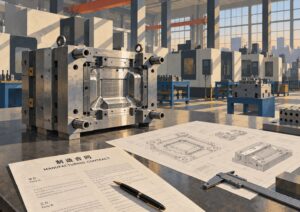
If the buyer pays for molds, dies, fixtures, or custom equipment, the agreement should establish ownership, prohibit unauthorized use, and give the buyer the right to inspect and remove the tooling. It should also explain what happens when the relationship ends, including the transfer of drawings, production files, raw materials, unfinished goods, packaging, and completed inventory. Without an exit plan, a buyer may remain trapped with a failing manufacturer because it cannot move the tooling or information needed to produce elsewhere.
Dispute resolution must be designed backward from enforcement. The correct forum depends on where the manufacturer’s assets are located, whether interim relief is available, whether the resulting judgment or award will be enforced, which language should control, and how much the proceeding is likely to cost. Local litigation may be best when the manufacturer and its assets are concentrated in one country. Arbitration may be preferable when the parties need a neutral forum, confidential proceedings, or an award that can be enforced across borders. The right answer depends on the country, the transaction, and the assets available to satisfy a judgment or arbitral award.
The goal is not to draft the clause that sounds toughest. It is to choose the law, forum, language, and remedies most likely to work when they are needed.
For more on why generic and U.S.-centric drafts so often fail, see China Manufacturing Contracts: Why Your Draft Does Not Work. For more on what should go into your dispute resolution clause, check out A Guide to Dispute Resolution Clauses in International Contracts.
The Bottom Line
No contract can turn a bad manufacturer into a good one, and no contract replaces inspections, regulatory work, insurance, supplier monitoring, or sensible payment controls. The strongest manufacturing programs begin with careful supplier selection and registered intellectual property, then reinforce the contract with regular inspections and close monitoring of production and payment.
Put those protections in place before disclosing designs, paying a deposit, or authorizing production. Once the manufacturer has the buyer’s money, molds, or intellectual property, or has become indispensable to its supply chain, the buyer’s position has already weakened.
A good manufacturing agreement is not written merely to win a lawsuit. It is written to prevent disputes, make nonperformance costly, and provide remedies that can be enforced where the manufacturer and its assets are located.
Editor’s Note: This post was originally published on October 9, 2006, and has been substantially revised and updated.
Need Help with Your International Manufacturing Contracts?
Contact Harris Sliwoski to discuss your manufacturing agreements and IP strategy before you disclose sensitive information, pay a deposit, or authorize production. We help companies build protections that work in the countries where their products are made.