Table of Contents
ToggleDoing Business Internationally: 10 Things to Get Right
Most international business disasters I see do not begin with an obscure point of foreign law. They begin earlier, when a company commits money, intellectual property, people, or leverage before asking the questions that should have come first.By the time we get the call, the expensive part has often already happened. The factory has the drawings and the deposit. The distributor has exclusivity and perhaps the trademark. The customer is six figures behind, but someone is still approving new orders. Or the contract points to a court that seemed convenient when the deal was signed but is nearly useless now that enforcement matters.
Whether you are buying products abroad, putting your first employee overseas, licensing technology, or appointing a foreign distributor, the same ten questions recur.
1. Legal Viability Comes First
Years ago, a U.S. credit reporting company contacted us about setting up a subsidiary in China. It had already spent hundreds of thousands of dollars researching the market and had concluded that China had enormous pent-up demand for its services. Nobody had checked whether a wholly foreign-owned company could legally provide those services. At the time, it could not. A quick legal review killed the project, along with the value of the market research that came before it.
China's foreign-investment rules have changed repeatedly since then, so the story says nothing about whether that particular business would be permitted today. The lesson is about sequence: check for legal deal-killers before spending heavily on everything else.
Years ago, another U.S. company bought roughly $3 million in equipment for its new China operation, assuming the equipment would count toward the $5 million it had committed to contribute as registered capital. It did not. The equipment had been purchased before it was properly designated and approved as a capital contribution. The company suddenly had to come up with another $3 million in cash. The company's in-house awyer kept telling me that China was putting form over substance. I kept agreeing with him. That did not change the result. Procedures that look excessively formal often exist precisely to limit what individual officials can decide after the fact. Whatever you think of the rule, you still have to follow it in the right order.
Depending on the country and business, the obstacle might be a foreign-ownership restriction, a license you cannot obtain, or a product that cannot be imported or sold as planned. U.S. law can create its own problems even when the transaction is perfectly legal in the other country. Sanctions and export controls are obvious examples. You also need to know whether your planned activities require a local company. Some businesses form foreign subsidiaries they do not need. Others hire people, hold inventory, or service customers for years before discovering that their activities created registration, licensing, or tax obligations they never addressed. The legal structure should follow what the business will do on the ground.
2. Make Sure the Economics Survive International Friction
Once the business is legally possible, run the numbers again. Factory price is only the beginning of landed cost. Freight, duties, testing, warehousing, and returns can turn an attractive sourcing price into an ordinary one before a distributor takes its margin. A foreign operation brings different expenses, including payroll, taxes, accounting, and mandatory employee benefits. Currency movements and long payment cycles add more. I have talked with importers facing extraordinarily high tariffs on Chinese goods who had never included those tariffs in their cost calculations. I still get an "I don't know" answer about half the time when I ask a client what the tariffs will be on their new product.
We once worked with a U.S. company that chose a Chinese city largely because local officials offered tax incentives we warned were on shaky legal ground. Less than six months later, the local government changed, the incentives disappeared, and the company eventually moved to the city it should have selected in the first place. The move cost hundreds of thousands of dollars. We saw the same basic risk years ago in the Russian Far East, where the murder of a vice-governor with whom we had strong connections was followed within a year by most of our clients shutting down their operations in that province.
If the economics depend on a subsidy, tax treatment, tariff classification, or unusually favorable shipping arrangement, verify the assumption before building the business around it. The same goes for time. A customer paying in 120 days does not have the same economics as one paying in 30, especially when the goods spend another month crossing an ocean.
Foreign subsidiaries raise another question few companies ask before they need the answer: how does the money get home? Earning a profit abroad and repatriating it freely are different things. Taxes, dividend rules, foreign-exchange controls, and local banking requirements can affect when and how cash moves. Work that out before the subsidiary accumulates money you expected to use elsewhere.
3. Who Are You Really Dealing With?
A toy importer once paid $2 million upfront to what it believed was a Vietnamese toy manufacturer. It never received a single toy, so it hired us to sue the manufacturer. Our research revealed there was no manufacturer. There was just a guy who had once rented an office with an old table and computer and was probably living on a remote island somewhere. My favorite extreme example is still that of a large American food company that bought $5 million in fish from a nonexistent Russian company, with a Mauritious phone number, for shipment on a 40-year-old Cambodian vessel that could not have carried even half the fish purchased.
Good overseas manufacturing due diligence should tell you who owns and controls the company, what business it conducts, whether it has meaningful litigation or regulatory problems, and whether it appears capable of performing what it has promised. With a manufacturer, find out who owns the facility and who will make your products. With a distributor, verify the sales reach and customer relationships that attracted you.
Pay attention when the names change. If negotiations are with Company A, the contract names Company B, and the invoice directs payment to Company C, understand why before you sign or wire money. Multi-company structures can be perfectly legitimate. You still need to know what each company does and which one has the assets or control you will care about if something goes wrong. We have worked on perhaps a dozen deals supposedly involving “Alibaba,” only to discover when it came time to draft the contract that our client's actual counterparty was a company Alibaba had formed a week or two earlier.
There is also a commercial side to diligence. A first-rate factory can be the wrong factory if your $300,000 account will always come behind customers spending $50 million. A successful distributor carrying thirty brands may have little reason to build yours. That will often matter more to the relationship than anything in a corporate registry.
4. Protect the IP Before Disclosure
An industrial coatings manufacturer we represented signed an exclusive Southeast Asia distribution agreement with a distributor that looked excellent on paper. It had warehousing, relevant experience, and a sophisticated management team. Eighteen months later, our client learned that the distributor had registered the client's trademark in its own name in Vietnam and was selling unauthorized product. Unwinding the relationship took more than a year and cost more than the arrangement had earned.
Trademark, patent, design, copyright, and trade secret rights are territorial. A U.S. registration does not simply follow the business abroad. In first-to-file trademark countries, waiting until launch can leave you fighting someone else for a brand you thought you already owned. The assets at risk are often unregistered. You hand a foreign developer your source code. A factory receives drawings, specifications, or tooling. A prospective partner learns the customer relationships or processes that took years to develop.
Identify where your trademarks, designs, and other IP need protection early enough that disclosure or launch does not come first. Put confidentiality, non-use, and ownership protections in place where they matter. And do not disclose more than the other side needs. If a factory needs enough information to quote the job, that does not necessarily mean it needs every drawing, formula, or process before you have decided to hire it.
5. Limit Your Payment Risk
A U.S. company came to us after losing more than $860,000 to a foreign customer. It had a contract and potential legal claims. Its larger problem was commercial: it had extended too much unsecured credit, kept performing after payments slowed, and allowed the receivable to grow far beyond anything it would have approved at the beginning of the relationship. Set the credit limit while everyone still expects to be paid on time. A deposit, guarantee, letter of credit, or right to stop shipments can keep one troubled customer from becoming a balance-sheet problem. Before extending substantial unsecured credit, find out where the customer's assets are and what collection would look like there.
International payments also attract fraud. In another matter, a criminal changed one character in a Chinese supplier's email domain and sent a U.S. electronics company new wiring instructions. The company wired $580,000 to the wrong account. It caught the fraud fast enough that the banks froze and recovered the money. When a supplier asks you to send money somewhere new, call the person you deal with at the number you already have. Do not verify new wiring instructions by replying to the email that supplied them.
6. The Contract Has to Fit the Country and the Deal
One California company we represented bought molded plastic products for nearly two years through a Hong Kong company it believed controlled the mainland Chinese factory. When the client decided to move production, it asked for its molds back. Only then did it learn that the Hong Kong company did not own the factory and had no molds to return. The mainland factory holding the molds had never signed the contract and claimed the tooling as its own. A well-drafted contract with the wrong company is still the wrong contract.
The substance needs the same discipline. A manufacturing agreement should concentrate on the risks most likely to hurt the buyer: quality, delivery, tooling, and useful remedies. A distribution agreement needs different machinery around territory, exclusivity, sales performance, and termination. Trade risk now belongs in that contract discussion too. If a new tariff adds 25 percent to the landed cost halfway through a two-year supply agreement, who pays it? Does the buyer absorb everything? Does the supplier share the increase? Does a large change trigger renegotiation or a right to terminate? These questions should be answered while the parties still agree on the price. Our work on modern manufacturing contracts and tariff-allocation provisions has made this a much bigger issue over the last two years.
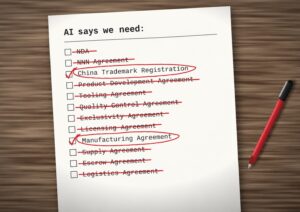
With a Chinese manufacturer, for example, we generally want the exact registered Chinese company name, the right dispute forum, and proper execution, usually including the appropriate company chop. Our current approach to China manufacturing contracts also puts substantial weight on the Chinese-language drafting because that is the document that needs to work if the relationship ends up in China.
Controlling language deserves attention in any bilingual contract. Decide which version governs and make sure the translations actually match. We have reviewed bilingual contracts where the English text appeared to protect the foreign company and the Chinese text did something materially different. If the version you cannot read controls, having someone tell you that the English “basically says the same thing” is not enough.
Dispute resolution should follow enforcement reality. Choose the forum with an eye toward the other side's assets, the remedies you need, and whether the resulting judgment or award can be enforced where it matters. The courthouse closest to your office is not automatically the best answer. Finally, write for the dispute you hope never occurs. If specifications change in a WeChat thread, confirm the change somewhere you can later prove it. Keep inspection reports. Document rejected goods and accepted deviations. Make sure the purchase orders and master agreement do not quietly contradict one another. If a dispute comes later, the case will be built from the record the parties created while they were still getting along.
7. Compliance Is Part of the Deal
One of the more dangerous sentences in international business is: “The factory says this is fine.” We have repeatedly seen Chinese manufacturers propose moving goods through Vietnam, Malaysia, or another country and changing the country-of-origin paperwork to reduce U.S. tariffs. Third-country processing can change origin, but routing goods through another country or relabeling them does not.
The factory's assurances do not transfer the U.S. importer's customs responsibilities. Section 592 of the Tariff Act, 19 U.S.C. § 1592, reaches material false statements and omissions connected with the entry of merchandise. For fraudulent violations, the maximum civil penalty can reach the domestic value of the merchandise; gross negligence and negligence carry lower statutory caps. If your tariff strategy depends on a supplier's origin theory, get that analysis right before the goods ship. The risks around DDP shipping and customs compliance make blind reliance on a supplier particularly dangerous.
Forced-labor compliance goes further. The Uyghur Forced Labor Prevention Act creates a rebuttable presumption against goods mined, produced, or manufactured wholly or in part in Xinjiang or by entities on the UFLPA Entity List. An importer seeking an exception must satisfy demanding statutory requirements, including clear and convincing evidence that the goods were not made wholly or in part with forced labor. For higher-risk supply chains, traceability is not optional paperwork. Other businesses face export controls, sanctions, product regulation, or anti-corruption risk. The Foreign Corrupt Practices Act also reaches corrupt payments made through third-party agents and intermediaries; using someone else to make the payment does not insulate a company from liability.
Data belongs here too. If you hire an employee in Spain and send that employee's HR information to U.S. headquarters, you have created a cross-border data issue whether or not anyone thought of the company as “doing data privacy.” Under the GDPR, employee information is personal data, and sending it from Spain to U.S. headquarters requires compliance with the GDPR's international-transfer rules, whether through an applicable adequacy decision or another permitted transfer mechanism such as Standard Contractual Clauses.
8. A Foreign Contractor May Not Be a Contractor
A local salesperson starts on a contractor agreement. Over time, that person gets a company email address and a country-manager title, works only for the U.S. company, negotiates pricing, deals directly with customers, and reports to headquarters every day. The agreement still says “independent contractor.” Local law may say otherwise.
Worker classification usually turns on the relationship in practice, and the tests vary by country. Commercial-agent laws create another complication. In the European Union, for example, the Commercial Agents Directive has long shaped member-state protections for qualifying independent commercial agents, including rights that can matter when the relationship ends. An Employer of Record can solve real employment and payroll problems, but it does not eliminate tax, agency, immigration, privacy, or regulatory issues. We have seen worker-classification disputes reach seven figures in relationships the company thought it could end with a termination email. Our foreign contractors and distributors FAQ goes deeper into those distinctions.
We have had companies come to us after getting caught in one country for failing to pay required income taxes, employer taxes, and employee benefits, and then ask whether they might have the same problem in the other three countries where they use the same arrangement. They almost invariably do.
Immigration needs the same fact-driven approach. A business visitor is not automatically entitled to spend weeks installing equipment or delivering services merely because headquarters considers the trip temporary. Define what the person will do first, then choose the structure that fits those facts.
9. Liability Does Not Stop at the Border
Years ago, I started sending some clients a set of deposition questions from a product-liability case involving a U.S. company whose China-made product had badly injured a child. The questions were painfully basic: How did you choose the supplier? What testing did you do? When did you first suspect a problem, and what did you do then? What would it have cost per unit to fix the defect? Clients usually understood the point before they reached the end. Those are much easier questions to answer before an injury than in front of a plaintiffs' lawyer afterward. Our longer piece on reducing product-liability risk from foreign-manufactured products grew out of exactly those issues.
If you sell a physical product abroad or import one for sale at home, know what standards apply and who is responsible for testing, warnings, quality control, and recalls. Your contract with the factory matters, but it does not prevent an injured customer from suing the importer, brand owner, or seller. Companies assume their insurance follows them abroad. Often it does not. Have your broker confirm that the countries, activities, and products at issue are actually covered.
The other side's insurance needs verification as well. We have seen manufacturers promise to obtain insurance and then not do it. We have also seen fake insurance certificates. If another party's policy matters to your risk allocation, make sure the coverage exists and comes from an insurer you could collect from. Much of the time, it is no more expensive to get your own insurance in your own country, with your own insurance agent, in a language you understand. If you are requiring your Chinese manufacturer to take out insurance that costs them ten cents a widget, the odds are that they are charging you an extra ten or eleven cents to cover that.
10. Plan the Exit While You Still Have Leverage
A U.S. client contacted us after discovering what it believed was widespread corruption inside its China subsidiary. The company wanted to shut the operation and terminate roughly 47 employees almost immediately. That was not a realistic shutdown plan. The employees had to be dealt with under local law, and the company had tax, creditor, regulatory, and corporate wind-down issues as well. What looked from the United States like closing an office turned into a full wind-down.
Less dramatic versions of the same problem appear everywhere. A distributor expects compensation when terminated. A manufacturer controls the tooling needed to move production. A local partner owns the domain name. Money remains in a foreign subsidiary after the business has stopped. Think about these issues while the relationship is still good. A distribution agreement should address what happens to customers, trademarks, and inventory after termination. A manufacturing agreement should deal with tooling and unfinished product. A joint venture needs a workable answer to deadlock. If you are forming a foreign company, understand what closing it will require. Our experience with shutting down foreign operations in China shows how much harder the exit can be than the entry.
The beginning is usually when you have the most bargaining power. Use some of it on the exit. I've gone to some very unusual countries as part of my work: Papua New Guinea, Cuba, Russia, to name a few. I never went into those countries without a Plan B for how I might get out.
The Order Matters
When an international deal goes bad, the legal problem is usually real, but it is rarely the whole story. The company disclosed the IP before protecting it, kept extending credit after payments slowed, let a contractor become a country manager, or discovered at termination that the other side held most of the leverage. These problems are easier to deal with while the transaction can still be changed. Verify the important assumptions early. Protect what will be hard to recover. Put a ceiling on the amount of money one relationship can cost you. And keep the records you will need if people's memories later improve in their own favor.
Once the money is wired, the trademark is in someone else's name, the employee is on the ground, or the factory controls the tooling, your choices narrow quickly.