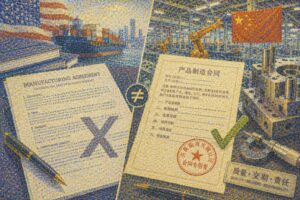
Who Owns Your Molds? How to Stop a Factory from Holding Your Tooling Hostage
You decide to switch overseas suppliers after repeated price increases, missed deadlines, and rising defect rates. You paid for the molds, so you tell the factory to prepare them for shipment.
The factory says no.
It may demand an engineering fee it never mentioned, claim the mold designs and CAD files as its own, or simply stop responding, knowing you cannot restart production without the tooling on its floor. The factory now controls whether you can keep making your product.
Companies frequently assume that paying for molds means they own them and can move them whenever they choose. Payment helps, but it does not necessarily establish who owns the physical tooling, who owns the technical files and intellectual property behind it, or whether the factory must release everything promptly and without additional payment.
Paying for the Mold Does Not Mean You Control It
Tooling disputes usually arise after you have developed the product, secured customers, accepted orders, and built your supply chain around one factory. By then, the factory knows what leaving will cost you.
Without the molds and technical files, you may have to recreate the tooling, repeat validation testing, delay customer orders, and spend months rebuilding a production process that already worked. Possession gives the factory leverage even when your ownership claim is strong.
A good contract can change that calculation. We have drafted thousands of China manufacturing agreements, and only once has a factory tried to retain a client’s molds.
We engaged Chinese litigation counsel, filed suit, and secured a court property-preservation order freezing the factory’s bank accounts within about five days. The factory released the molds the next day.
Few disputes move that quickly, but a contract built for local enforcement can give you leverage before litigation and make fast relief possible when litigation becomes necessary.
Most buyers have nothing nearly that strong. They rely on an invoice stating that they paid a “mold fee,” “tooling charge,” or “development cost” and assume the invoice settles ownership.
The factory may argue that the payment covered only materials and fabrication, while its engineering work, design rights, and production know-how remained separate. It may acknowledge that you own the physical molds but insist that it owns the drawings and specifications needed to reproduce, repair, or modify them.
Some factories claim you paid only for the right to have products made with the molds. Under that theory, the tooling must remain at the factory and cannot be transferred to another manufacturer.
The strength of those arguments will turn on the contract, the evidence, and local law. The immediate problem is practical: the factory has possession and can interrupt production while the parties fight over what the payment meant.
A purchase order saying “buyer owns all tooling” is better than silence, but it usually leaves too many questions unanswered. For more on how product development, confidentiality, production, IP, and enforcement agreements fit together, see China Manufacturing Contracts: When One Agreement Is Not Enough.
The Mold, the Files, and the IP Are Separate Assets
Tooling usually involves three categories of property: the physical production assets, the technical materials needed to use or reproduce them, and the intellectual property and know-how embodied in the tooling or product. Address each category separately.
A factory that must return the physical molds but may keep the editable design files can still prevent you from repairing, modifying, or duplicating the tooling. If it retains rights in engineering changes or production improvements, it may also argue that the molds cannot lawfully be used elsewhere.
For some products, the distinction is decisive. The internal components may be standard while the molded enclosure gives the product its identity, or a specialized mold may contain much of the engineering that makes the product function.
Losing control of that tooling can mean losing control of the product. Physical ownership alone does not solve the problem.
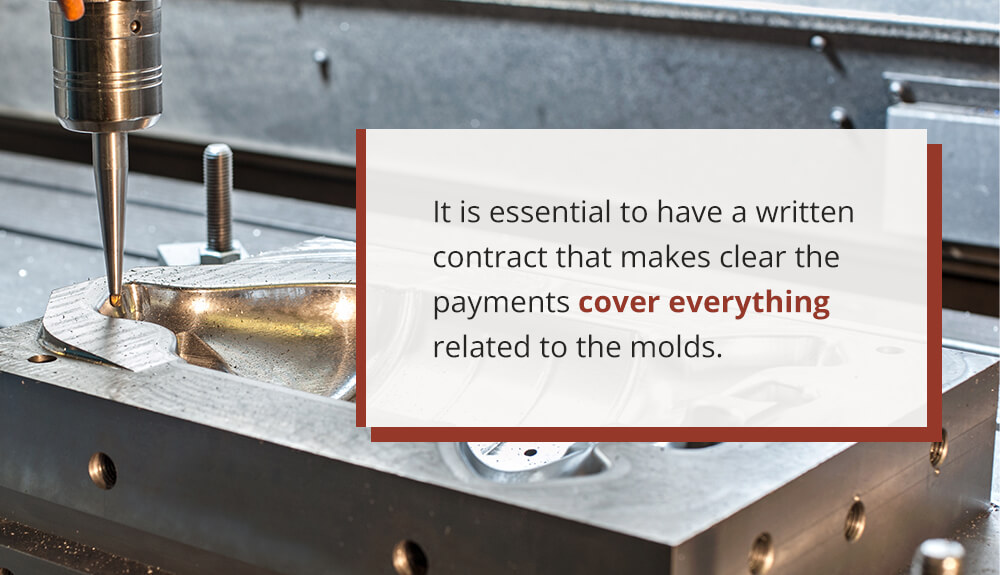
What the Factory Says When You Ask for Your Molds
Factories use several recurring arguments to keep tooling after a customer decides to leave. Your contract should anticipate each one.
“You Still Owe Us for Engineering”
The factory agrees that you paid the tooling invoice but claims the price did not include CAD work, testing, revisions, mold integration, or engineering time. It then presents a new invoice and refuses to release the tooling until you pay it.
You may have no practical way to verify the claimed costs. The demand is often a departure fee dressed up as an engineering bill.
State that the agreed price includes all approved design, engineering, fabrication, testing, adjustment, integration, and subcontractor expenses. Any additional charge should require your advance written approval.
“The Mold Is Yours, but the Design Is Ours”
The factory concedes that you own the physical mold while claiming ownership of the design embodied in it. It may offer you a limited right to use the existing mold but prohibit copying, modifying, repairing, or replacing it.
Cover the native design files, engineering drawings, specifications, modifications, and improvements, not only the physical mold. Obtain current, usable copies while the relationship is still functioning.
“Our Engineers Own the IP”
A factory that contributed design or engineering work may assert patent, design, copyright, trade-secret, or other rights in the tooling or product. It may also file an intellectual property application in its own name without telling you.
Inventorship, ownership, and the right to file an application are separate legal questions, and the answers vary by jurisdiction. Paying the development bill does not necessarily resolve them.
Specify who owns work created for the project and require the necessary assignments. The factory should obtain matching assignments from its employees, engineers, affiliates, and subcontractors and should be prohibited from filing related IP applications without your written approval.
“We Are Not Releasing Anything”
Some factories do not bother constructing a legal theory. They stop responding, claim the molds cannot be found, move them to another facility, or condition release on payment of unrelated invoices.
Set a firm release deadline and identify exactly what must be delivered. The contract also needs meaningful consequences for noncompliance and a practical route to relief where the factory and tooling are located.
The Mold Shop You Never Knew Existed
Many buyers assume the factory making their products also designed and fabricated their molds. That assumption is increasingly unreliable.
Product factories routinely outsource tooling work to specialized mold shops. The subcontractor may prepare the detailed drawings, cut the steel, retain the native CAD files, and possess everything needed to make additional copies.
You may not learn the subcontractor’s name until a dispute begins. Because your agreement may not bind the mold fabricator, this outsourcing creates a serious contractual gap.
The product factory may promise that you own the tooling, while the fabricator later claims it was never paid, never assigned its design rights, or never agreed to release the molds. Undisclosed subcontracting also increases the risk of copying and information leakage.
A mold shop with the product design, technical files, and manufacturing specifications may be able to sell duplicate molds or technical information to competing factories. Disclosing sensitive information without confidentiality restrictions and other reasonable safeguards can also weaken trade-secret protection.
Identify every company that will design, fabricate, store, maintain, or possess your tooling before releasing technical information. Require the product factory to obtain your written approval before subcontracting and to bind every approved subcontractor to equivalent ownership, confidentiality, non-use, and release obligations.
When the manufacturer is in China, those early protections may include a China-specific NNN agreement covering affiliates, related companies, and subcontractors, rather than merely the named factory. China NNN Agreements: The Hard Truth explains what these agreements should accomplish and why an NNN agreement is only the first layer of protection.
For expensive tooling or products built around valuable proprietary designs, consider contracting directly with the mold fabricator. A three-party agreement among the buyer, product factory, and mold shop may also make sense.
Eight Things Your Tooling Agreement Needs to Do
A useful tooling agreement must govern the tooling from initial design through final release.
1. Define What Counts as Tooling
Define tooling broadly enough to cover molds, dies, jigs, fixtures, gauges, templates, testing equipment, prototypes, software, CAD files, engineering drawings, specifications, and other materials created or used for production. Precision here prevents later arguments over what the factory must return.
List each physical tool in a schedule with photographs, identifying numbers, and its current location. Permanent plates or tags should identify it as the buyer’s property, and the factory should need written approval before moving it to another facility.
2. Make Clear Who Owns It and Who Merely Holds It
Specify when ownership passes to the buyer. The factory should hold the tooling as custodian, not as owner.
Storage, maintenance, repair, and use should not create ownership rights. To the extent local law permits, address liens, security interests, retention rights, and claims by subcontractors or other third parties.
3. Secure the Design Files and Engineering Rights
Identify who owns the native design files, drawings, specifications, modifications, and improvements created for the project. Do not leave the answer to implication or industry custom.
Require delivery of current editable source files and, where useful, neutral exchange formats such as STEP or IGES. Waiting until the relationship has deteriorated to request these materials is a common and expensive mistake.
4. Ban Unauthorized Use and Copying
Limit use of the tooling and technical information to authorized production for the buyer. Prohibit unauthorized copies, excess production, third-party sales, use of rejected products as samples, and use of the tooling or technical information for competing products.
Once a factory has your designs, molds, technical knowledge, and production experience, it is well positioned to become your competitor. That risk is examined more fully in The Growing Threat of Chinese Factory Competition, and How to Fight Back.
5. Do Not Lose Control Through Subcontractors
Do not permit the factory to send technical information or tooling work to an undisclosed subcontractor. Require written approval before any outside company becomes involved.
Every approved subcontractor should accept protections at least as strong as those in the main agreement. The product factory should remain responsible for the subcontractor’s conduct.
6. Close the Door on Surprise Charges
State that the agreed price includes all approved design, engineering, fabrication, testing, modification, integration, and subcontractor costs. Prohibit release fees, unapproved storage charges, and newly invented engineering expenses.
Legitimate additional work still needs a process. Require a written quote, a clear description of the work, and advance approval before the factory incurs the cost.
7. Track, Inspect, and Maintain the Tooling
Keep the tooling marked, segregated from other customers’ property, and maintained in suitable condition. Give the buyer access to records showing where each tool is located, who is using it, and whether it has been modified, damaged, or moved.
Allocate responsibility for ordinary wear, maintenance, repair, loss, and damage. Those questions are much easier to resolve before a mold cracks or reaches the end of its useful life.
8. Set the Handover Procedure Before You Need It
Spell out when the factory must release the tooling, how quickly it must act, where delivery will occur, who will arrange transportation, and which files and records must accompany it. Cover packaging, loading, export documents, access credentials, inspection records, and the information a replacement factory will need to restart production.
The remedies must work where the tooling and factory assets are located. A U.S.-style agreement with a distant court clause may establish rights on paper while doing little to recover molds sitting inside a foreign factory.
In China, the contracting entity, language, governing law, dispute forum, and damages provisions can determine whether the agreement produces timely relief. China Manufacturing Contracts: Why Your Draft Does Not Work explains why a contract drafted for another legal system often fails when enforcement matters most.
Do Not Announce the Move Too Soon
Companies often investigate tooling ownership only after deciding to change factories. That is when the existing supplier has the greatest incentive to resist.
Before announcing a move, know what the contracts, purchase orders, invoices, and payment records say; where every mold and related tool sits; who holds the native CAD files; whether outside mold shops or engineers participated in the work; whether every approved tooling charge has been paid; whether the factory has filed or asserted related IP rights; and what remedies are available where the tooling is located.
A premature announcement can prompt the factory to move the molds, restrict access, accelerate an IP filing, or manufacture a dispute over unpaid amounts. The right move depends on the country and the facts, so understand your position before alerting the factory that its leverage may soon disappear.
Before You Pay the Tooling Deposit
Before wiring money for molds or tooling, get clear written answers to four questions. Do not proceed on assumptions that will be difficult to prove after the relationship deteriorates.
First, who is actually designing and fabricating the tooling? If a third-party mold shop is involved, identify it and bind it to enforceable ownership, confidentiality, non-use, and release obligations.
Second, who will possess the editable design files? Do not assume the product factory will provide the native CAD files, engineering drawings, and later modifications when you need them.
Third, who owns improvements suggested by the factory or mold shop? Resolve that issue before their engineers begin changing the design.
Finally, what happens when the relationship ends? The contract should specify the release deadline, delivery location, required files and records, transportation arrangements, and consequences of noncompliance.
If you cannot answer those four questions before the deposit goes out, you may be paying for an asset your supplier will control. Settle the ownership, file-delivery, subcontracting, handover, and enforcement terms before the steel is cut.