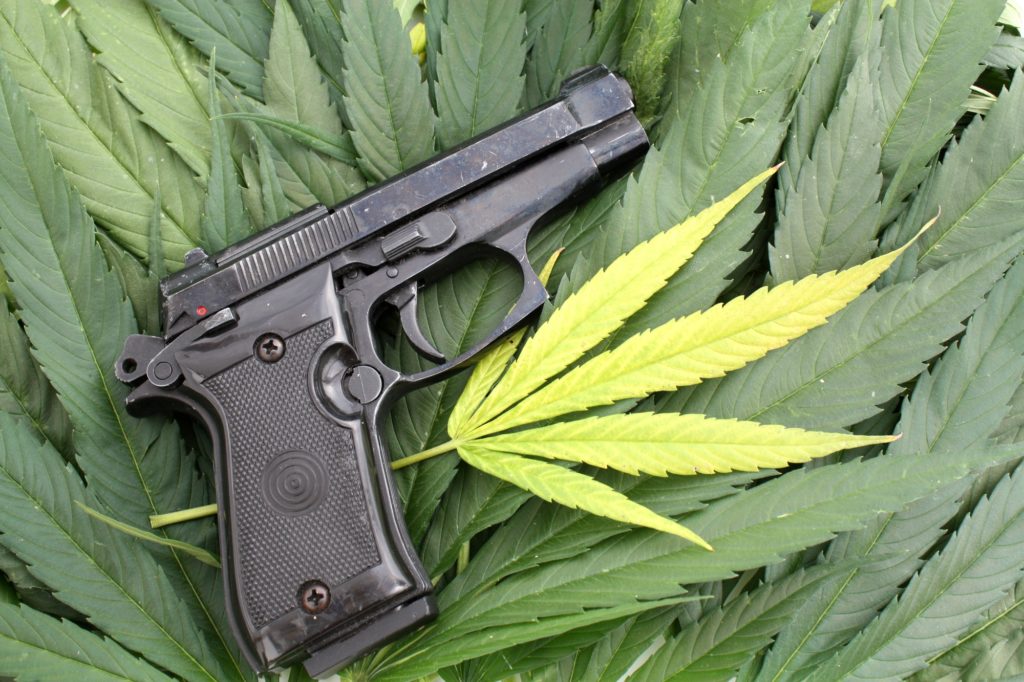
Until last week, federal law prohibited marijuana users from owning or possessing firearms, even in states where marijuana is legal. In recent years, we have covered the differing opinions by federal courts challenging this status quo. On June 18, 2026, the Supreme Court held in a 9-0 decision in U.S. v. Hemani that 18 U.S.C. § 922(g)(3)’s blanket prohibition on drug users possessing guns is inconsistent with the Second Amendment.
U.S. v. Hemani
Ali Hemani is a dual citizen of the U.S. and Pakistan, born in Texas. In 2022, the government searched his family home over suspected terrorism-related activity. During the search, Hemani surrendered his gun, pointed agents to marijuana on the property (agents also found a small amount of cocaine in a closet), and told them he used marijuana several times a week. Based on that statement and his possession of the firearm, the government charged him under 922(g)(3) for knowingly possessing a gun while being an unlawful user of a controlled substance. It was the only charge brought against him. No charges were filed related to terrorism, drug trafficking, or anything else.
Notably, the government never alleged that Hemani was an addict, that he posed a danger to himself or others, or that he did anything with the gun beyond keeping it at home. At trial, Hemani successfully moved to dismiss the indictment on Second Amendment grounds, and the Fifth Circuit upheld the dismissal, prompting the government to seek Supreme Court review. The Court found that the government “fail[ed] on every metric” to make its case. The outcome itself wasn’t surprising, but the unanimity was.
I, along with our law firm, have been saying for years that 922(g)(3) was unconstitutional. In fact, Shane Pennington, Christian Sederberg, and I once tried raising money to bring this same type of challenge. At the time, there was a lot of interest, but no one wanted to pay – a common reality in this industry. I have researched this issue thoroughly, and after the Supreme Court’s decision in N.Y. State Rifle & Pistol Association v. Bruen, it was clear that 922(g)(3) would not survive.
The Supreme Court’s decision is narrow in its findings but broad in its application.
N.Y. Rifle v. Bruen
Before I discuss the Hemani case in further detail, I should provide a brief overview of the case that reshaped Second Amendment review (and constitutional challenges generally). In 2021, the Supreme Court held that courts evaluating a claimed constitutional right, such as the right to bear arms, must follow a two-step framework. First, courts ask whether the conduct at issue falls within what the Amendment’s text covers. If it does, the regulation is presumed unconstitutional unless the government can justify it.
To rebut that presumption, the government must show that the regulation fits within the nation’s historical tradition – in this case of firearm regulation. This doesn’t require a historical law that’s a perfect match or near-identical precursor to the modern regulation. Instead, courts must look at whether the regulation reflects the same principles that have historically justified firearm restrictions. The government can satisfy this by drawing analogies, and by demonstrating that today’s regulation serves a comparable purpose–i.e., that it imposes a comparable burden to regulations that were well established historically, even if the specifics differ.
In Bruen, Justice Thomas made clear that courts must confine their analysis to history, eliminating any inquiry into means-end scrutiny, and that the government bears the burden of proving the regulated conduct falls outside the Amendment’s original scope. It cannot meet that burden by simply asserting an important interest; it must show the regulation is consistent with that historical tradition.
The Hemani analysis
Moving now to Hemani, the government had the burden of proving that disqualifying an entire category of people, illegal users of controlled substances, from possessing nearly any firearm for any reason whatsoever had a historical corollary. To do so, the government had to point to historical evidence showing that the firearm ban “comport[s] with history and tradition.” This required proof that 922(g)(3) was “part of the historical tradition that delimits the outer bounds of the right to keep and bear arms.” The government didn’t come close to making that case.
922(g)(3) automatically kicked in the moment someone became a user of any non-prescribed controlled substance and stayed in effect for as long as that use continued. Nothing more was required from the government, not even a trial.
To justify the prohibition, the government, under both the Biden and Trump administrations, relied on what it called “habitual drunkard” laws, while also comparing marijuana users to the mentally ill and terrorists. Not surprisingly, Smart Approaches to Marijuana (“SAM”), a famously pro-alcohol, anti-marijuana advocacy group, submitted a brief to the Hemani Court in support of the gun ban.
SAM and 21 other prohibitionist groups said that while cannabis is “marketed as a ‘chill’ drug by its peddlers,” today’s product has “become increasingly known for its relationship with violence.’” (I’ll ignore their inaccurate conclusion to avoid adding another 1,000 words to this blog post.) SAM, again, is a pro-alcohol group that does nothing to address the extreme violence and harm associated with alcohol use. That’s because (as provided on in SAMs FAQ page) alcohol has a long history in America, is legal, and clears the body within 24 hours. SAM doesn’t seem concerned with the danger’s alcohol poses to society and violence associated with its use. It just seems contented that alcohol is already legal and that most of Western civilization has used it for thousands of years.
The problem with SAM’s arguments and analogizing marijuana users to the mentally ill and to “habitual drunkards” is that the facts don’t support the comparison. On the “habitual drunkard” front in particular, the government’s case had more holes than Swiss cheese.
Habitual drunkards
Historically, before someone could lose any of their rights, even temporarily, the laws the government pointed to generally required some kind of process first. As the Court pointed out: (1) vagrants, for example, typically couldn’t be jailed or sent to a workhouse without first being convicted of an offense; (2) someone deemed a habitual drunkard usually needed a hearing before a body like a probate court before a guardian could be appointed or before they could be committed to an asylum; (3) surety laws commonly called for a hearing before a justice of the peace or similar official before any bond requirement could be imposed. 922(g)(3) includes no such process. It automatically divested someone of their constitutional right to bear arms the moment they became an unlawful drug user.
The Court’s opinion included a rather humorous discussion of the nation’s founders’ drinking habits, noting that if habitual drunkard laws had applied to anyone who simply drank regularly, several of the nation’s most prominent early figures would have been at risk. John Adams reportedly started each day with a tankard of hard cider. James Madison was said by some to drink as much as a pint of whiskey a day, though others dispute this and suggest he favored wine instead, viewing it as the more respectable option. George Washington was known to enjoy several glasses of madeira most evenings, a habit that wouldn’t have marked him as a heavy drinker by the standards of his time. Thomas Jefferson reportedly enjoyed several glasses of wine with dinner. And my favorite example from the Court opinion, just days before the Constitution was signed, a farewell gathering for Washington at a Philadelphia tavern saw 55 guests order 164 bottles of wine, liquor, and beer, plus seven bowls of punch.
In short, early America had a culture where heavy drinking was simply commonplace. One estimate from the era suggests that a large share of the nation’s laborers drank several ounces of hard liquor daily.
Given this backdrop, the historical laws targeting “habitual drunkards” weren’t aimed simply at regular or even excessive drinkers. Instead, they were aimed at people whose drinking left them effectively incapacitated and unable to manage their own affairs. That’s a much narrower category than the one captured by the unlawful user provision in 922(g)(3), at least as the government interprets it.
The Government’s own actions of the past two decades weakened Its arguments
The Court also questioned whether 922(g)(3) actually accomplishes what the government says it’s meant to do: disarming people who are categorically violent, or who pose an unusual danger to others. The Government’s own actions over the past two decades undermine that position. The Department of Justice has instructed federal prosecutors to scale back enforcement against marijuana users, most states have legalized marijuana to some extent, and the government has taken steps to reclassify certain marijuana products under a less restrictive drug schedule. Some surveys now even suggest that regular marijuana users outnumber regular drinkers in the United States.
If the government can strip away a constitutional right just because it thinks that is necessary, with no evidence, no historical precedent, and no legal justification, that’s a slippery slope. The Court stated that affording the government “broad power to designate any group as dangerous and thereby disqualify its members from having a gun” would risk allowing it to “quickly swallow” the Second Amendment.
Effects of the Hemani decision
This ruling is a narrow. It doesn’t address whether the Government could bar addicts, or people who are currently intoxicated, from possessing firearms. Further, the Court was clear to say that legislatures have powers to disarm categories of people they’ve identified as posing a special risk of misusing firearms. The decision also leaves open whether §922(g)(1) (the separate provision disarming people convicted of felonies) would be affected by this reasoning. And it doesn’t resolve whether the government could still prosecute someone under §922(g)(3) by offering individualized evidence that the person’s drug use makes them a danger to themselves or others, or evidence that a particular drug is so potent, or dangerous for some other reason, that it renders all of its users dangerous. The Court simply found that the historical record the Government put forward doesn’t support the sweeping, categorical restriction it asked the Court to uphold.
The Thomas concurrence and personal possession under the Commerce Clause
Just a quick note on Justice Thomas’ concurrence. He drew on Gonzales v. Raich (the case that expanded interstate commerce review and prevented a medical patient from growing her own medical marijuana at home under federal law) to argue that §922(g)(3) goes beyond what Congress is permitted to regulate under the Commerce Clause. The Constitution gives Congress authority to regulate commerce among the states, but as Thomas argues, based on both the original understanding of that power and the Court’s existing precedents, Congress can’t regulate someone’s possession of a firearm based solely on the fact that the gun once crossed state lines, long before that person ever possessed it. As originally intended, Thomas argues that the Commerce Clause gives Congress authority only to regulate the buying and selling of goods and services that move across state lines. It doesn’t extend to activities that have nothing to do with commercial transactions, such as simply possessing a firearm.
I mention this only to highlight that the same argument could be made to support the legality of simple marijuana possession. Marijuana markets are entirely intrastate, so applying Thomas’ rationale, a person shouldn’t be considered to violate federal law simply by possessing a controlled substance that once crossed state lines and has nothing to do with a commercial transaction. Again, I’m only talking about simple possession, not the purchase and sale of controlled substances under a state legal framework–although I think it too applies.
Conclusión
Hemani is a significant decision, not because it breaks new constitutional ground, but because it forces the Government to actually do the work Bruen demanded of it. The Government must point to history and actual show the danger. it can’t just rely on saying it’s so.
For years, 922(g)(3) operated on the assumption that drug use alone was reason enough to strip someone of a fundamental right: no hearing, no individualized findings, no historical grounding required. The Court unanimously rejected that assumption, and rightly so. A constitutional right that can be switched off by the Government, with no process and no proof of danger, isn’t much of a right at all.
Hemani doesn’t open the door to drug addicts or intoxicated individuals carrying firearms, and it doesn’t strip legislatures of all power to regulate this space. What it does is remind the Government that broad, categorical restrictions on constitutional rights require more than a plausible-sounding policy justification. They require evidence, history, and tradition, exactly the kind of evidence the Government couldn’t produce here.