AI Didn't Replace Lawyers. It Gave Us the 48-Page Contract.
In 1972, two lawyers a few years out of school opened a storefront office in Van Nuys and called it the Legal Clinic of Jacoby and Meyers. Leonard Jacoby and Stephen Meyers were going after the large group of people who earned too much to qualify for legal aid and too little to retain a traditional law firm. To reach them, they cut costs wherever they could. They relied heavily on paralegal assistants and part-time specialists, charged a flat $15 for an initial consultation, skipped the traditional office building, and concentrated on simple but recurring legal problems that could be handled through standardized techniques.
The State Bar brought disciplinary proceedings over the publicity surrounding the clinic and even its use of the name "Legal Clinic." The Disciplinary Board recommended a 45-day suspension, primarily on the theory that their interviews with newspapers and a radio station amounted to improper solicitation. The California Supreme Court dismissed the proceedings in Jacoby v. State Bar, 19 Cal.3d 359 (1977), holding that the rules could not constitutionally prohibit lawyers from cooperating in legitimate news coverage simply because the coverage might also attract business.
The episode illustrates one reaction the profession has had to new ways of delivering legal services for as long as I have practiced: regulate first and adapt later. The other reaction—the prediction that the latest innovation will make lawyers unnecessary—has returned with almost every major technological change.
I never thought the clinic model would do what either its admirers or its opponents expected. Standardization was going to take over some work at the bottom of the legal pyramid, especially the work that amounted to filling out forms and processing predictable matters. It was not going to take over the work of figuring out what a client actually needed.
Then came Google. Legal information that once required a trip to a law library was suddenly available to anyone with a browser, which was a genuine improvement, and which also produced clients armed with cases from the wrong jurisdiction, obsolete forms, and complete confidence that three hours online had resolved their problem. Finding information got easy. Knowing which information mattered did not.
Now we have AI, and the prediction is back at a much larger scale. I hear regularly that AI will eliminate the need for lawyers in most matters, and I spend a good part of my week reading AI-generated contracts that suggest otherwise.
I use AI every day. One of my favorite uses is to hand it something I have drafted and ask what I missed. It gives me six things. Three are usually worthless and two I already considered and rejected, but every so often the sixth is worth real research, and that alone pays for the exercise. I also use it to proofread, with the settings locked so it cannot change a word without my permission. Our firm has written before about using AI to improve the practice of law, and lawyers who refuse to learn it are running the profession's second reflex, the one the California Supreme Court had to correct in 1977.
AI will eliminate legal tasks. It already has, and it will keep cutting lawyer hours, particularly on large document reviews. What I keep running into in my own practice is messier. In some corners of it, AI is creating work, because producing legal material has become almost free while the expensive part, judgment, has not moved at all.
How a Five-Page Deal Becomes a 35-Page Contract
Before generative AI, most non-lawyers could not produce a 25-page commercial contract. They modified an old agreement, downloaded a form, or wrote something short covering the business terms that seemed to matter. Those agreements had serious holes, but you could see the holes.
In a domestic deal that is survivable. Statutes, common-law doctrines, course of dealing, and trade usage fill some of the gaps. Internationally, counting on that is dangerous. Different countries supply different default rules, recognize different remedies, and treat silence differently, so a protection an American company assumes is implicit may simply not exist under the law that governs the deal. I give clients a blunt rule for international contracts: if it matters, put it in.
Anyone can now produce what looks like a sophisticated agreement in minutes. Ask AI what is missing and it adds provisions. Ask it to make the contract safer and it adds more. A few prompts later the five-page deal runs 35 pages. Getting enough clauses is no longer anybody's problem. Deciding which clauses belong, making them work together, and catching the one that quietly contradicts another still is.
I have not kept count, but I have read well over a hundred contracts in the past year that were drafted or heavily revised with AI. Clients rarely volunteer that. The drafting gives it away, and a remarkable number of them are so internally inconsistent that I cannot tell you what they mean. Before generative AI I might see one of those a year.
We recently represented a German company in a dispute with an American company. The American company had drafted a 48-page contract for a transaction that needed five to seven pages. I needed to answer one basic question about what the contract required, and answering it meant tracing six provisions scattered through the document.
One provision incorporated another. The second contained an exception that sent me somewhere else. A third appeared to undo that exception, though its effect turned on a definition buried in an unrelated section. I went around the chain several times and still could not tell whether the contract meant A or not-A.
That helped us, because the other side had written it. So instead of arguing about what the contract meant, we showed the American company how hard it would be to convince a court that its reading was the right one. We sent a 20-page letter walking through the contradictions and the litigation risk they created. The matter settled for a relatively small amount, and their lawyer more or less conceded the point. Litigating under that contract would have been rolling the dice.
I do not know how much AI went into that contract. It hardly matters. Producing 48 pages like that now takes an afternoon, and the document read like it took no longer than that.
Two Optimistic Litigants
More words do not prevent disputes. Sometimes they give both sides better reasons to think they will win.
When a contract clearly favors one party, the weaker side has a reason to settle. When a short contract is silent, experienced lawyers can look to the governing law and make a decent prediction. But a long agreement full of provisions pointing in different directions hands each lawyer language supporting the client's position, and lets each party talk itself into its own reading. Uncertainty becomes optimism, and two optimistic litigants are far harder to settle than one party that knows it has a bad case.
We had a client in exactly that position, in a dispute with a company in Central America. Our client was sure it would win. The other side was just as sure. Neither was bluffing. They had read the same contract and reached opposite conclusions, which stopped being surprising the moment we learned the parties had drafted the agreement together using AI.
I suggested we bring in opposing counsel, and we got lucky. The lawyer on the other side was experienced, knew the local law, and was interested in solving the problem. Once the two of us worked through the document the trouble was obvious. We could not determine which language version controlled or which country's law governed. The jurisdiction provisions were unclear, and even if one side won a judgment, whether it could be enforced against the other in another country was an open question.
Those are not technicalities. They are the first questions an international lawyer asks before recommending a lawsuit. Both of us could see the parties spending a fortune fighting over what the contract meant, which law applied, and where the case belonged, all before anyone got near the actual commercial dispute. So we each went back to our clients, said so plainly, and spent the next several weeks putting together a settlement that made sense for both of them.
I cannot prove AI-generated contracts are a meaningful reason good litigators seem so busy right now. Plenty of other things drive litigation volume. But I am not the only one watching AI generate cleanup work. Elizabeth Bratton reported in the Financial Times on April 11, 2026 that law firms are getting barrages of AI-generated client emails and letters that take longer to work through, and that some are rethinking fixed-fee arrangements as a result.
I know one lawyer who will not take on a client whose first email was plainly written by AI. I know another who prices those inquiries higher, on the straightforward theory that a long, confident, slightly wrong email takes considerably longer to sort through than a short one that admits what the sender does not know. He is right about that part.
I do neither. Most people sending those emails are not trying to game a lawyer into producing a free memo. They are trying to understand a problem they know is over their heads, and AI was the tool they had. So I write back and explain the issues, and I point them to the posts on our blog that go into more depth. Some never write back. Most do, and they say the explanation helped, and by then the AI draft has essentially gone out the window and we are talking about their actual deal. This is not pure generosity, either. The people who engage with the explanation tend to be the ones worth working with.
What the China Contract Revealed
I wrote a narrower version of this in June, on why AI-generated China manufacturing contracts look better than they are. A prospective client has since handed me an example that makes the problem clearer.
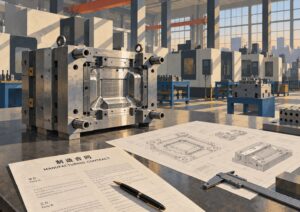
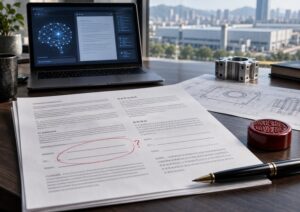
The company was getting ready to send an agreement to a Chinese manufacturer that would help develop and produce a lighting product. This one I did not have to guess about. The client told me it had used AI to draft the contract. I have anonymized the parties, but the contract is real, and it was a good-looking document. It dealt with tooling, project work product, and subcontractors. It required confidential material to be returned or destroyed. It even recognized the importance of the Chinese company chop, one of the principal ways a Chinese company executes and authenticates a contract.
Then you get underneath it. The manufacturer's official Chinese legal name had never been confirmed. English controlled even though enforcement against the factory would likely occur in China, creating unnecessary translation and interpretation risk. The remedies assumed U.S.-style injunctive relief. Governing law and the dispute forum were unresolved. Every one of those goes straight to whether the agreement would be worth anything the day something went wrong.
The contract also contained provisions any sensible Chinese factory would fight. One effectively required the buyer to approve the mold makers and component suppliers needed to build the product. Another could be read to restrict products the factory had been making before this customer ever showed up. A third barred the manufacturer from challenging any of the buyer's intellectual property anywhere in the world, apparently forever.
Which produced a strange result. A competent Chinese lawyer reviewing the agreement for the factory could see that the provisions supposedly protecting the American buyer had almost no practical bite, and might well tell the factory to go ahead and sign. Factory management could see that the operational provisions were intolerable and might refuse before any lawyer laid eyes on it. The contract had become difficult to sign without becoming useful to enforce.
A capable American lawyer can make this worse with the best intentions. Home-state law feels comfortable. English feels like the obvious controlling language. Broad IP restrictions look safer than narrow ones. Those instincts can be reasonable in a domestic deal and badly wrong when transplanted into a China manufacturing contract without regard to Chinese law and enforcement. Bind the wrong entity, send the dispute to the wrong place, or write remedies that do not work, and twenty well-drafted clauses elsewhere will not save you. We have written about what happens when a China contract looks protective right up until something goes wrong.
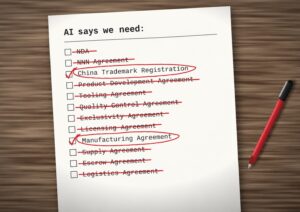
I told this client not to send the agreement to the factory, and not to pay us to repair it clause by clause. Fixing the document before diagnosing the problem would just repeat the mistake that produced it. What I needed to know first was what the manufacturer had already received and how deeply it would be involved in developing the product. The client came to us asking how to fix an NNN Agreement. The better question was whether an NNN Agreement was the right agreement at all at that stage.
The Hard Part Was Never the Words
Our China manufacturing lawyers have hundreds of provisions accumulated and refined over the years. Having them does not draft the agreement. We still have to work out what the factory will control, what the parties will create together, and what the client needs if the whole thing falls apart. That is why the questions we ask before drafting matter as much as the drafting does. A template, whether it was written ten years ago or generated ten seconds ago, cannot make those calls unless somebody supplies the facts and knows why they matter.
That is exactly what happened with the lighting client. Because the manufacturer would be participating in development and prototyping, the deal raised questions about who owned design changes, who owned the tooling, and whether the client could pick up the finished product and take it to another factory. Those are development questions rather than confidentiality questions, and no amount of additional language bolted onto an NNN answers them. The protections live in a China Product Development Agreement because that is the agreement built to carry them.
A Contract Does Not Tell You Where the Mold Is: Why Factory Verification Still Matters
Even the right agreement depends on facts outside the document. A manufacturing professional commenting on one of my LinkedIn posts made a point I wish more companies understood: tooling and subcontractor provisions can be beautifully drafted and accomplish nothing, because nobody checked what was actually happening at the factory. Bills of materials change. Production moves. The company named in the contract may not be the company doing the work.
A clause saying you own a mold is useful. You still want to know where the mold is. A prohibition on component substitution matters only if somebody has identified the approved components in the first place. Drafting and verification are different jobs, which is why overseas manufacturing due diligence belongs beside contract drafting rather than after it.
A Chinese supplier in that same discussion supplied the other half, and it stung a little. His point was that foreign buyers can spend weeks negotiating provisions no factory will ever accept, while neglecting the specifications, delivery requirements, and payment terms that actually determine whether the relationship works.
What AI Is Actually Replacing in Legal Work
The market is not behaving like a profession about to vanish. Thomson Reuters Institute reported that law-firm demand grew 2.7 percent in the first quarter of 2026, nearly three times its long-run average. Its August 10 second-quarter update found demand still strong and said that, if the pace continues, 2026 will be the strongest year for legal demand since 2021. None of that proves AI is creating the demand, but it is difficult to square with predictions that lawyers are about to become unnecessary.
In its August 27, 2026 projections, the Bureau of Labor Statistics expects employment of lawyers to grow 5 percent from 2025 through 2035, faster than the average for all occupations, with about 28,700 openings a year. It acknowledges that some routine legal work will be automated, but says the resulting efficiency is not expected to reduce overall demand for lawyers, and that automation should free lawyers up for other parts of the job, like meeting with clients.
Now go one rung down the ladder. In that same update, BLS projects little or no growth for paralegals and legal assistants through 2035, and says specifically that advances in technology, including AI, are expected to limit demand by making paralegals more efficient at research and document preparation.
Technology bears down hardest on work that can be reduced to a procedure. Deciding which procedure applies, or whether any of them do, is a different thing.
One part of this worries me more than the employment numbers. Junior lawyers have traditionally acquired judgment by doing research, reviewing documents, and preparing drafts that experienced lawyers then tore up. Brooke Loesby takes this up in The Hidden Shortage the Legal Profession Is Creating, in the July/August 2026 issue of the ABA's Law Practice Magazine. If AI removes too much of the work through which young lawyers learn, firms are going to need another way to produce the lawyers whose judgment clients eventually pay for.
The Prediction Keeps Coming Back
I have been hearing the lawyer-extinction prediction for most of my career. Legal clinics were going to routinize law. Google was going to make legal knowledge free. Now AI produces in seconds what used to take a lawyer hours. Each of those changed the profession, and AI will change it more than the first two.
What I see today is not the disappearance of legal work. I see contracts longer than they need to be and harder to read. I see sophisticated provisions written for the wrong country. I see clients showing up with far more legal material than they could ever have produced before, some of it useful and some of it badly confused. Somebody still has to sort it out.
AI will keep getting better, and lawyers should use it where it makes them better. But when it comes to contracts, I would rather have a client explain the actual deal to me on a napkin than hand me 30 pages of polished legal prose that nobody fully understands.