Por qué etiquetar sus importaciones como «muestras» no le librará de los aranceles
Many importers still operate under a familiar assumption: if a product is not being sold, it must be a sample, and samples are duty-free.
This assumption is wrong.
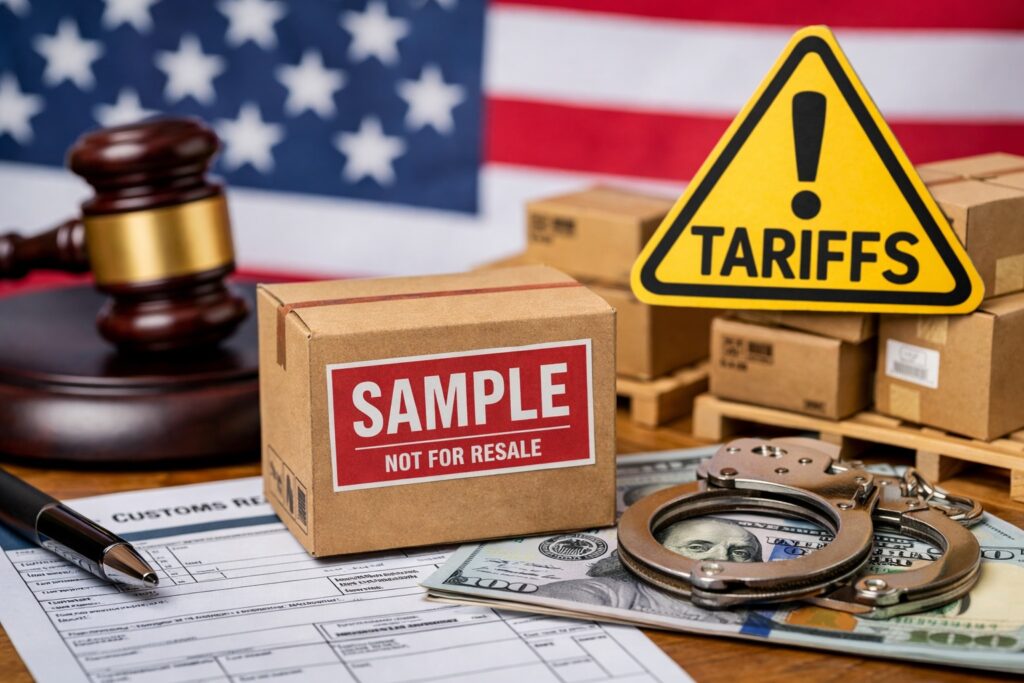
U.S. Customs and Border Protection generally treats samples as dutiable merchandise unless they meet very narrow legal definitions. Writing “sample” on a commercial invoice does not change that analysis, and in many cases it attracts more scrutiny rather than less. If you are importing product samples into the U.S., you should assume tariffs apply unless you have a clear, defensible path to duty relief.
The default rule: samples are dutiable
Start with the baseline. Imported goods are dutiable unless an exemption applies. Samples are still goods. Customs evaluates them using the same framework it applies to any other import: tariff classification, value, country of origin, admissibility, and whether the documentation matches what actually arrived.
One of the most common mistakes importers make is assuming the invoice description controls the outcome. It does not. Calling something a “sample” does not make it duty-free. If the product is finished, functional, and capable of being sold, Customs is likely to treat it as ordinary merchandise.
When commercial samples actually qualify for duty-free entry
There is a narrow carve-out for certain commercial samples. In practical terms, it is intended for items that are either of negligible value or have been altered so they are clearly not for sale. This is where importers look for a duty-free answer on commercial samples, but the legal reality is conditional and narrow.
HTS 9811.00.60 provides for duty-free entry of certain samples, but the requirements are stricter than most importers expect. To qualify, a sample generally must meet one of two standards.
The $1 rule. Each individual item must have a value of not more than one dollar.
The mutilation rule. The item must be physically altered so it cannot be sold.
Mutilation is not a polite concept. Customs officers look for obvious, permanent, resale-killing changes. Examples include holes drilled through the soles of shoes, sleeves cut on garments, parts removed, or “SAMPLE” permanently ink-stamped in a contrasting color. A removable sticker or hangtag is rarely persuasive. If the product could be resold with minimal effort, Customs will likely reject the claim.
This path can work for swatches, cut pieces, test strips, or intentionally damaged prototypes. If you rely on it, evaluate the shipment from the perspective of a Customs officer inspecting it briefly, not from internal intent.
The safer approach for real samples: temporary import options
If your samples are expensive, reusable, or intended for demonstrations, testing, or trade shows, the more defensible approach is usually to treat them as temporary imports.
Two tools are most commonly used.
Temporary Importation Under Bond (TIB) allows goods to enter the United States without duties if they are imported for a permitted temporary purpose and exported or otherwise properly disposed of within the required timeframe, in essentially the same condition. If you are importing higher-value items for evaluation or demonstration and expect to re-export them, a TIB is often the most defensible structure.
ATA Carnets are frequently used for trade shows and professional equipment. An ATA carnet for trade show samples can streamline temporary entry and re-export across multiple countries, provided the paperwork is handled correctly and the goods move as declared.
Neither option is automatic or casual. Both require planning and follow-through. But they are far safer than trying to force a valuable, sale-ready product into the “sample” category and hoping Customs agrees.
A quick example of how this goes wrong
A consumer electronics company ships ten “samples” of a new device to the United States for buyer meetings. Each unit is retail-ready, fully packaged, and valued at $250. The invoice states “samples, not for resale,” but the products are not altered or permanently marked.
Customs treats the shipment as ordinary merchandise. Duties are assessed based on the product’s classification and country of origin. The shipment is delayed, unexpected duties are paid, and future imports receive additional scrutiny because the original declaration did not match reality.
This scenario is common, and it is avoidable.
Why de minimis thinking is making sample imports riskier in 2025
For years, many companies relied on low-value shipment practices to move samples quickly and cheaply. That environment has changed.
As of May 2, 2025, the United States eliminated de minimis duty-free treatment for low-value shipments from China and Hong Kong. For many importers, this alone ended the long-standing “it’s under $800” assumption for China-origin samples.
More significantly, effective August 29, 2025, the United States suspended duty-free de minimis treatment under Section 321 more broadly. Low value alone no longer guarantees duty-free entry, and reliance on de minimis as a routine sample strategy is now a high-risk approach rather than a compliance shortcut.
Even where duties are not ultimately assessed, small shipments can still trigger brokerage fees, processing costs, documentation requirements, and delays. Treating samples as casual shipments often leads to sloppy valuation and classification, which becomes expensive under tighter enforcement.
If your internal logic is “it’s just a small package,” you are building risk into your import process.
How to choose the right import path
Use the following as a working checklist when importing samples.
Confirm what the goods really are.
If they are finished, functional, and sale-ready, assume duties apply unless you structure a valid duty-relief approach. Repeated shipments of the same “samples” should be treated as a pattern Customs will eventually notice.
Decide whether you can legitimately use HTS 9811.00.60.
If you rely on the $1 rule, confirm the value truly does not exceed one dollar per item and would hold up under inspection.
If you rely on mutilation, make the item clearly and permanently unsalable. Removable markings rarely suffice.
Do not undervalue samples to chase the one-dollar threshold. CBP expects realistic valuation and routinely challenges numbers that do not align with market data.
Use a temporary import structure for higher-value or reusable items.
Temporary importation under bond for samples is often the correct structure when goods will be evaluated or demonstrated and then re-exported.
An ATA carnet for trade show samples is often the right solution when goods will travel to multiple countries for exhibitions or demonstrations.
A customs compliance review is almost always cheaper than fixing a problem after a shipment is stopped.
An FAQ on Importing Product Samples into the United States
¿Se pueden importar muestras de productos a los Estados Unidos sin pagar aranceles?
A veces. La exención de impuestos no es automática. Depende de si las muestras cumplen unos requisitos estrictos relacionados con un valor insignificante o una alteración permanente que impida su reventa. La disposición HTS 9811.00.60 es la que se cita con más frecuencia, pero cumplir los requisitos es más difícil de lo que muchos importadores esperan.
¿El hecho de etiquetar un envío como «muestras» elimina los aranceles?
No. Las decisiones aduaneras se basan en la naturaleza de las mercancías y en cómo se importan, no en la descripción que figura en la factura.
¿Las muestras procedentes de China están sujetas a los aranceles de la Sección 301?
A menudo sí. El tratamiento de exención de derechos de aduana de minimis para los envíos procedentes de China se eliminó en mayo de 2025. Si la clasificación arancelaria del producto está cubierta y no se aplica ninguna exclusión, los derechos de la Sección 301 pueden aplicarse a las muestras de la misma manera que se aplican a las importaciones regulares.
¿Las normas de minimis siguen protegiendo los envíos de muestras pequeñas?
Mucho menos fiable que en el pasado. El tratamiento de exención de derechos de aduana de minimis se ha eliminado para los envíos procedentes de China y Hong Kong y se ha suspendido de forma más generalizada a partir de finales de 2025. El bajo valor por sí solo ya no protege a un envío de los derechos de aduana, los requisitos de documentación o el escrutinio de las autoridades.
¿Tengo que pagar derechos de aduana por las muestras que pienso reexportar?
No, si utiliza un proceso de importación temporal adecuado y cumple con sus condiciones, incluidos los requisitos de plazos y condiciones de exportación. Sin un mecanismo de importación temporal, normalmente se aplican derechos de aduana.
¿Qué ocurre si la Aduana rechaza mi declaración de muestra?
Como mínimo, deberá pagar aranceles y sufrir retrasos. Dependiendo de las circunstancias, pueden imponerse sanciones y un mayor escrutinio de los envíos futuros.
Conclusión
Samples are not a loophole. They are imports with conditions. If you are not confident your current approach would survive a Customs review, that is worth finding out before CBP does it for you.