Fred Rocafort

Fred leads Harris Sliwoski’s intellectual property practice and is the coordinator of the firm’s international team. Much of Fred’s practice consists of helping cannabis businesses protect their brands. He also works with entrepreneurs and companies entering the Web3 space, a new frontier for IP law. Prior to joining Harris Sliwoski, Fred worked overseas for more than a decade, in both government and private sector roles. Fred is a regular contributor to the award-winning China Law Blog and Canna Law Blog.

Fred began his career overseas as a U.S. consular officer in Guangzhou, China, where he advocated for fairer treatment of American companies and citizens in China and for stronger intellectual property rights enforcement. After entering the private sector, Fred worked at a Shanghai law firm as a foreign legal advisor and later joined one of the oldest American law firms in China, helping foreign companies navigate the Chinese legal environment. He also led the legal team at a Hong Kong-based brand protection consultancy, spending most of his time out in the field, protecting clients against counterfeiters and fraudsters in Greater China, Southeast Asia and Latin America.

In addition to his IP work, as a native Spanish speaker, Fred works closely with different Harris Sliwoski teams on Latin America and Spain matters. Fred also provides advice to cannabis industry participants and other businesses on import and export transactions.

Fred is an ardent supporter of FC Barcelona—and would be even in the absence of Catalan forebears who immigrated to Puerto Rico in the mid-1800s.


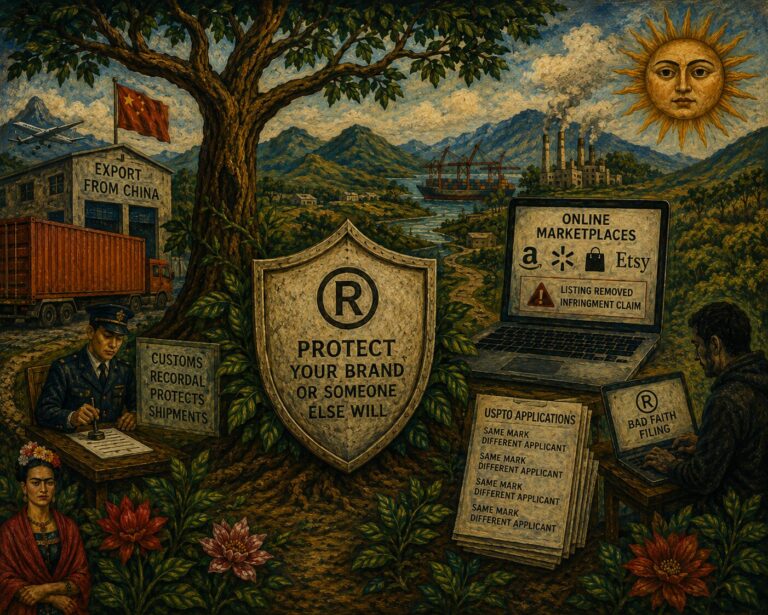
An oil painting depicting intellectual property protection, with elements of import/export, online marketplaces, and legal filings.

Trademark Squatters Are Coming for Your Supply Chain in Swarms Now

Trademark Squatters Are Coming for Your Supply Chain in Swarms Now For years, trademark squatters followed the same general script. They would identify a foreign brand that had not yet registered its trademark in China, the United States, or another key market. Then they would file first and wait. Eventually, the legitimate brand owner would

Mexico manufacturing lawyers

Moving Production to Mexico: What U.S. Companies Get Wrong

Moving production to Mexico is more than just a sourcing decision. It is a legal and operational rebuild. Companies that treat China/Mexico contracts, labor, IP, customs, and transition sequencing as afterthoughts often end up paying to fix avoidable mistakes.

A graphic with interconnected question marks and circles containing the letters "IP" and "P" on a dark blue background, suggesting questions or uncertainty about intellectual property.

A Global IP Protection Strategy FAQ

Global IP Protection Strategy FAQ My blog post yesterday, Global IP Protection: Why You Need a Strategy, Not Just an Application generated a lot of questions. In an attempt to answer those we received (and those we anticipate receiving), I give you the below FAQs. If you are manufacturing abroad, expanding internationally, or selling through

Illustration of a person with a telescope standing on a globe next to an upward arrow, a trademark symbol, and the text "You need a global IP strategy.

Global IP Protection: Why You Need a Strategy, Not Just an Application

Global IP Protection Strategy When brands think about protecting their intellectual property abroad, they often start with the most visible tasks: filing a trademark application, registering a patent, or sending a takedown notice to deal with a specific infringement. Those steps matter. On their own, though, they are tactical steps. They can be necessary, but

Illustration with the text "How to Protect the Value of your IP Portfolio," showing a shield, checkmark, briefcase, documents, and trademark and copyright symbols—key steps for monetizing your IP effectively.

Ten IP Monetization Mistakes That Quietly Destroy Global Trademark Portfolio Value

Ten IP Monetization Mistakes That Quietly Destroy Global Trademark Portfolio Value IP deals rarely fail because someone forgot to file a trademark. They fail because of small operational gaps that compound over time. The ten mistakes below directly erode valuation, licensing leverage, and your ability to survive diligence. Why IP Monetization Fails In Practice Deals

Orange graphic with the text "BEYOND CHINA: WHY YOU NEED A CENTRAL TRADEMARK HUB" next to a globe icon marked by location pins.

Beyond China and Why You Need a Central Trademark/IP Hub 

Beyond China and Why You Need a Central Trademark/IP Hub  What we’re seeing as companies diversify beyond China In recent years, a large chunk of our work has been helping long-term and new China clients shift manufacturing and supply chains to other parts of Asia, as well as to Latin America and Europe. As they

Graphic explaining that both the trademark and the company name must be translated in a China trademark application, with icons representing each item.

China Trademark Company Names: What You Must Know Before Filing

China Trademark Company Names: What Foreign Brands Must Know Before Filing Why a Chinese Name is Required for Your Trademark Filing in China If you file a trademark in China, you must provide a Chinese-language version of your company name for the application. China’s trademark registry maintains official records in Chinese, so the applicant’s name