







How to Protect Your Intellectual Property in China
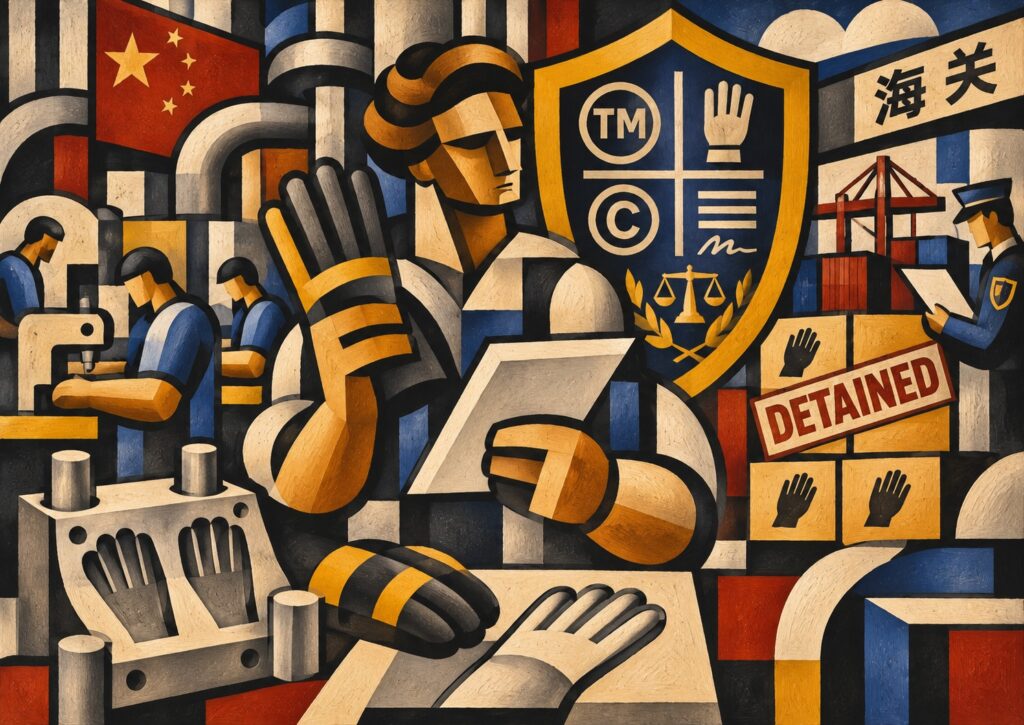
One of our clients registered its trademark in China well before trouble started and still ended up with a shipment stopped by China Customs. The company manufactured protective work gloves, and its Chinese lawyer had registered its trademark for gloves in Class 25, which covers gloves worn as clothing. Protective work gloves belong in Class 9. A competitor had registered the same mark in Class 9 and used that registration to block our client's shipment. The Chinese lawyer had done what the client requested. Nobody had thought to ask what kind of gloves the client sold.
Over the years, our lawyers have represented companies whose Chinese manufacturers registered their trademarks, claimed ownership of their inventions, copied their products, or refused to return their tooling. We have also helped companies stop counterfeiters and recover their property, and those companies succeeded because they had protected themselves in advance. China has laws protecting trademarks, patents, copyrights, and trade secrets, and those laws can provide effective remedies.
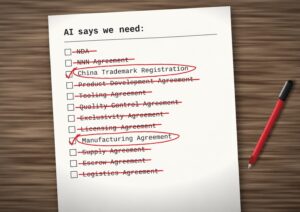
I am not a fan of advice telling companies to register every possible trademark, patent, and copyright. For most businesses, that would waste money. A company buying ordinary products from a supplier's catalog has very different needs from one giving a manufacturer proprietary technology, valuable designs, and custom tooling. The protections should reflect what the company actually stands to lose and what it would cost to recover. For many companies, the contracts governing their Chinese manufacturing relationships matter as much as any registration.
China Trademarks: Register Early and Register Correctly
China is principally a first-to-file trademark country. Registering your trademark in the United States, Europe, Canada, or Australia generally does not give you corresponding rights in Mainland China. Chinese law recognizes certain prior rights and provides ways to challenge bad-faith applications, but those proceedings can be expensive, slow, and uncertain. Registering first is far easier than dislodging someone who got there before you.
Why Trademarks Matter Even If You Never Sell in China
Many foreign businesses manufacture products in China solely for export. They have no Chinese customers or distributors and no plans to sell to Chinese consumers, but they still have good reasons to register their trademarks there. Their brands appear on products and packaging, and their manufacturers, sourcing agents, and everyone else involved in production know which marks they use. Someone else obtaining a Chinese registration for one of those marks can create serious problems even when every product is headed for a foreign market.
In a case discussed in How to Protect Your Trademarks as China Manufacturing Declines, an American company's Chinese manufacturer registered 17 of the company's trademarks without permission, covering essentially one product and nearly all of its components. It then approached the American company's customers and offered them the same products at prices 40 percent lower. We developed a workaround involving a trademark registration for a visible component of the product and changes to how the products were branded after arriving in the United States. It worked, but the American company had to change its operations to accommodate a problem it should never have faced.
Export-only manufacturing raises some complicated trademark questions, and whether particular manufacturing or export activities constitute infringing trademark use depends on the facts and Chinese legal standards. For most companies manufacturing branded products in China, I still recommend registering their principal trademarks there, whether or not they ever intend to sell to Chinese consumers.
What You Should Register
The first decision is which marks deserve protection. The starting point is usually the brand name on the product or packaging. A separate logo registration may also make sense, especially if the logo has substantial commercial value. Word marks often deserve priority because they generally provide more flexibility when a company changes its logo. A combined word-and-logo registration can be useful, but it does not necessarily provide the same protection as separate registrations.
Companies selling in China should also consider registering Chinese-language versions of their brands. Chinese consumers sometimes give foreign brands their own Chinese names, and those names can become commercially valuable. If the foreign company does not choose and protect a suitable Chinese name, someone else may try to register it. A business manufacturing exclusively for export is in a different position, because registering a Chinese-language mark that nobody uses and that has no realistic connection to the business may accomplish little.
China uses the international Nice Classification system, which divides goods and services into 45 classes, but it also divides many classes into narrower subclasses that affect the practical scope of trademark protection. The glove case at the beginning of this article, which we wrote about in China Trademark Registration: Why U.S. Companies Need More Than a Filing Agent, shows what registering in the wrong class costs. Even the correct class can leave gaps if the application fails to identify the relevant goods and subclasses. Our Guide to China Trademark Classes and Subclasses explains how these distinctions work.
Confirm which legal entity will own the registrations. The applicant should be the right company within the business's corporate structure, not a manufacturer, distributor, sourcing agent, or employee. We have seen companies discover during disputes or acquisitions that their Chinese trademarks were registered in the wrong entity's name. Correcting an ownership problem after the relationship has deteriorated can be difficult, and harder still when the registered owner refuses to cooperate.
Foreign applicants can file directly through a Chinese trademark agency or designate China through the Madrid System. Madrid can be efficient for companies maintaining international portfolios, but a direct Chinese application gives greater control over Chinese subclasses and goods descriptions, which is why we generally recommend direct filing. Mainland China, Hong Kong, Macao, and Taiwan also have separate trademark systems, and a Mainland China registration does not automatically extend to the other three.
A Chinese trademark registration is valid for ten years from registration and can be renewed for successive ten-year periods. Owners should keep their ownership information current and watch for conflicting applications, which matters more under China's revised Trademark Law.
What China's Revised Trademark Law Changes
China adopted a substantially revised Trademark Law on June 26, 2026, effective January 1, 2027. The revision cuts the opposition period from three months to two, giving businesses less time to oppose conflicting applications before registration. It strengthens provisions addressing certain bad-faith filings and excessive registrations. It also gives CNIPA authority to initiate cancellation proceedings against trademarks that have gone unused for three consecutive years without justification, subject to the applicable procedures. Our article Five Practical Steps Foreign Brands Should Take to Prepare for China's New Trademark Law addresses these changes in more detail, and the law's adoption and effective date are confirmed by the China National Intellectual Property Administration.
Businesses should review their existing registrations, maintain evidence of genuine trademark use, and consider whether their portfolios still reflect the products and services they actually offer. The revised law does not eliminate legitimate defensive registrations, but businesses should have a sound reason for the protection they seek. Chinese trademark practice recognizes that genuine use on goods manufactured in China solely for export can support a registration against non-use cancellation, provided the company has sufficient evidence. Manufacturing contracts, invoices, dated photographs of marked products, shipping records, and Customs documents can all help establish that use. Much of this evidence is held by the Chinese factory, so companies should obtain copies of production records, invoices, and shipping documents while the relationship is good, rather than trying to recover them after a dispute begins. Our article China Trademarks: When (and How) to Prove Use of a Mark in Commerce explains what evidence companies should preserve.
China Patents: Protecting Inventions and Product Designs
Whether Chinese patent protection is worth pursuing depends on what makes a product valuable and how easily competitors could reproduce it. It also depends on the product's expected commercial life, filing and maintenance costs, and likely enforcement expenses. A business whose advantage depends on a valuable technical invention may have excellent reasons to obtain Chinese patents, and so may a company whose product has a distinctive design that competitors can easily copy. A company with neither is usually better off spending its money on trademark registration, manufacturer due diligence, and a good supply agreement.
An American company retained what it believed was a leading U.S. manufacturer of a particular sporting goods product. The U.S. company was supposed to arrange production in China, but about a year later our client discovered that its supplier did not own a Chinese factory. It had subcontracted production to an unrelated Chinese manufacturer, which had begun selling our client's product as its own and had obtained a Chinese patent relating to the product. The dispute led to extensive litigation in China and several U.S. states. Our client had never established who would actually manufacture its product or what would prevent a subcontractor from exploiting its designs, a mistake we discuss in How to Find, Vet, and Contract with a Reliable Overseas Manufacturer.
Before disclosing proprietary technology to a manufacturer or development partner, a company should establish who owns existing inventions, who will own improvements developed during the relationship, and whether either party can seek patents based on that work. If the contract is silent, Chinese law generally favors the party that did the work. Under Article 8 of China's Patent Law, unless the parties agree otherwise, the right to apply for a patent on a commissioned invention belongs to the party that completed it. For a jointly developed invention, that right belongs to the parties that completed it together. A foreign company that pays a Chinese factory to develop a product without a written agreement on ownership may find that the factory holds the right to patent the result.
China's Three Types of Patents
China recognizes three principal types of patents. Invention patents protect technical inventions, including products, processes, and improvements. They undergo substantive examination and last 20 years from filing, subject to any permitted term adjustments. Utility model patents protect technical solutions involving the shape or structure of products. They have a lower inventive threshold than invention patents, undergo a more limited initial examination, and last ten years from filing. Design patents protect a product's appearance rather than its underlying technical function. Design patents applied for on or after June 1, 2021 last 15 years from filing, and earlier ones last ten.
Design patents are most useful for companies whose products have a distinctive appearance that contributes substantially to their commercial value. A business may have little technical innovation to patent and still have a product design competitors can readily copy. Our article China Design Patents: The Info We Need discusses the information and drawings needed for a Chinese design patent application.
Know the scope and likely defensibility of the patents you obtain. Utility model and design patents do not undergo the same substantive examination as invention patents before grant, and a granted patent can still be invalidated if it fails to satisfy the legal requirements. Owning a patent also does not necessarily give a company freedom to manufacture or sell a product, because an improvement may still fall within an earlier patent owned by somebody else.
File Before You Disclose Your Invention
China generally requires inventions and designs to be novel in light of earlier public disclosures anywhere in the world. A company that publicly discloses a new product before filing can destroy its ability to obtain valid Chinese patent protection, subject to limited statutory exceptions. Sales, trade shows, websites, crowdfunding campaigns, and anything else that reveals the invention or design can all create problems. A company planning to manufacture a new product should therefore settle its patent strategy before introducing the product publicly or sharing sensitive information without protection.
China recognizes foreign priority rights. A qualifying earlier foreign application can generally support a Chinese priority claim, provided the requirements are satisfied. The Chinese application must be filed within 12 months for inventions and utility models or six months for designs. Companies can also use the Patent Cooperation Treaty to pursue international protection for inventions and utility models. The PCT does not itself grant a Chinese patent, and the Chinese filing procedures and deadlines still matter.
Products developed in China carry one more requirement. Under Article 19 of China's Patent Law, anyone who wants to file a patent application abroad for an invention or utility model completed in China must first submit it to CNIPA for a confidentiality examination. A company that skips that step cannot obtain a Chinese patent on the invention. This catches companies whose engineering happens at their manufacturer or with Chinese engineers, because the invention may count as completed in China even though the company and its patent lawyers are elsewhere.
China Copyrights: When Registration Is Worthwhile
Copyright protection generally arises automatically when an original work is created. Under Chinese law and the international treaties China has joined, a foreign business ordinarily does not need to register its copyright in China to obtain protection there. This holds for software, photographs, illustrations, artwork, written materials, music, films, and other creative works. Copyright registration never needs renewal, and for many individually authored works the economic rights generally last for the author's life plus 50 years. Registration can still be worthwhile, particularly when a company expects it may need to prove ownership or pursue infringement in China.
Two Video Game Cases
Two gaming matters covered in China Online Gaming IP show what registration can do. Our firm represented a European video game company that registered its trademarks and copyrights in China before launching its game there. When a Chinese company tried to copy the game, we sent a cease-and-desist letter, and the Chinese company backed down. In the other matter, a well-known American game developer came to us after a Chinese company copied its game's characters and storyline. The American company had a strong potential infringement claim, but it had not registered its copyrights in China, and the evidentiary difficulties and resulting delays made pursuing the infringement commercially unattractive.
Chinese copyright registration is not a prerequisite to every infringement lawsuit. A copyright owner can establish its rights through original files, creation records, contracts, proof of authorship, and other evidence. The trouble comes when that evidence is incomplete, hard to authenticate, or scattered among employees and contractors. A Chinese copyright certificate can make it easier to establish the identity of the work and provide evidence of claimed ownership, though it does not conclusively settle every ownership question. For commercially valuable software, games, and other digital products likely to be copied in China, registration is often worth the cost, because infringing copies spread quickly and delay is expensive.
What Copyright Protects and Who Owns It
Copyright protects original expression. It does not generally give a company exclusive rights to the ideas, functions, manufacturing processes, or business concepts embodied in that expression. A company may own copyright in its product photographs, instruction manuals, packaging artwork, or original software and still have no right to stop competitors from manufacturing a product that performs the same function. Copyright can sometimes overlap with trademark or design patent protection. An original logo may qualify for copyright protection while also functioning as a trademark, and certain artistic features of products may receive copyright protection depending on the work and the legal requirements.
Companies frequently overlook ownership. A foreign business pays a Chinese contractor to develop software, prepare technical drawings, or design packaging, and assumes that paying for the work means it owns the copyright. Under Article 19 of China's Copyright Law, ownership of a commissioned work is determined by the contract between the parties. If the contract does not clearly address ownership, or there is no contract, the copyright belongs to the party that created the work. Before commissioning valuable creative work, a business should establish in writing who will own it, which rights are being assigned or licensed, and whether the creator can reuse it.
The problem gets more complicated when manufacturers hire subcontractors to develop software or other creative components. A foreign buyer may have paid for the finished product without obtaining all the rights needed to modify it or move production elsewhere. Our article Stop Your IP and Key Information from Leaking When Manufacturing Overseas discusses these ownership and disclosure risks.
Contracts and Trade Secrets: What Registrations Leave Exposed
A company can have excellent trademark, patent, and copyright registrations and still lose control of valuable intellectual property through poorly drafted manufacturing agreements. Trademark registration does not establish who owns your molds. A patent does not necessarily prevent a manufacturer from using confidential information outside the patent's scope, and copyright protection does not resolve every dispute over work created during product development. These issues belong in the agreements governing the business relationship. As the patent and copyright ownership rules above show, when those agreements are silent, Chinese law can fill the gaps in favor of the party that did the work.
China NNN Agreements and Manufacturing Contracts
For companies sharing proprietary designs, technical information, or confidential business information with prospective Chinese manufacturers, a well-drafted NNN Agreement can be useful. NNN stands for non-disclosure, non-use, and non-circumvention. Non-use is especially important because a manufacturer has little reason to disclose your proprietary information to anyone else if it can simply use that information to make competing products itself. An ordinary confidentiality agreement may prohibit disclosure without adequately restricting the manufacturer's own use.
The agreement should reflect the actual risks of the transaction, including what the manufacturer and its subcontractors may do with the company's designs, technical files, manufacturing methods, and other protected information. Not every manufacturing transaction requires an NNN Agreement, and a company that gives its manufacturer no designs or technical information has little to protect with one. Our Guide to China NNN Agreements explains when these agreements are useful and what they should cover.
Once the parties begin product development or manufacturing, more contractual provisions are usually necessary. The manufacturing agreement should establish who owns existing designs and other intellectual property and who owns improvements developed during the relationship. It should also say whether the manufacturer can use that intellectual property for other customers and what happens when the relationship ends. These agreements should be drafted with the Chinese legal system and its enforcement procedures in mind. Identifying the correct Chinese legal entity, choosing the right dispute-resolution forum, and establishing workable remedies can make an enormous difference when a dispute arises.
The $200,000 Mold Problem
One of our clients paid $80,000 for molds used to manufacture its products in China. Eight months later, when it wanted those molds back, its Chinese factory refused, and the company ended up paying another $200,000 to recover tooling it had already purchased. As we explain in The Guide to Molds and Tooling in International Manufacturing, the company lacked an adequate tooling agreement establishing ownership, permitted use, and the factory's obligation to return the molds. By the time the dispute arose, the factory controlled the tooling and our client needed it to continue production. A tooling agreement should also address the molds separately from the intellectual property embodied in them, because a company can own a mold without necessarily owning every related patent or design right.
Another client did much better because its manufacturing agreement clearly established ownership of the molds held by its Chinese manufacturer. When that manufacturer refused to return them, we worked with Chinese litigation counsel to bring suit and obtain preservation of the factory's assets. Within about five days, the Chinese court froze the factory's bank accounts, and the factory returned the molds the following day. The case is described in How to Sue a Chinese Company.
That result was unusually fast, and I would never promise another client the same outcome. This company had an enforceable agreement, the defendant had assets the court could reach, and the available remedy put immediate financial pressure on the manufacturer. That pressure is one reason we generally prefer Chinese court litigation to arbitration for our clients' manufacturing agreements. Although asset preservation can also be obtained through Chinese courts in qualifying arbitrations, direct court proceedings are often faster and less expensive in our experience.
Protecting Trade Secrets
For some businesses, the most valuable intellectual property is information they do not want to patent or disclose publicly, such as manufacturing methods, formulas, and technical know-how. China protects trade secrets under its Anti-Unfair Competition Law, but the information must meet the statutory requirements. Among other things, it must not be publicly known, it must have commercial value because it is secret, and the owner must have taken appropriate confidentiality measures. A company claiming that its manufacturing process was stolen should be able to identify the protected information and show what it did to keep it confidential. That can include restricting access, imposing confidentiality obligations, controlling the distribution of documents, and contractually restricting manufacturers and subcontractors.
Patent and trade secret protection involve different risks. Patenting generally requires disclosing the invention in exchange for the possibility of exclusive rights for a limited period. Trade secret protection can continue as long as the information remains secret and satisfies the legal requirements, but it does not ordinarily prevent another company from independently developing the same information or lawfully reverse-engineering a product. For technology that competitors can readily discover by examining the finished product, patent protection may be more useful. Valuable manufacturing know-how that can realistically remain confidential may be better protected as a trade secret.
Licensing Can Put Your IP at Risk
One of the worst proposed China licensing agreements our lawyers have reviewed would have given a Chinese company exclusive, perpetual, worldwide rights to a foreign company's intellectual property in exchange for 10 percent of sales proceeds. The Chinese company had no meaningful obligation to generate sales. It could have done nothing with the licensed technology, paid nothing, and still prevented the foreign company from licensing the same rights to anyone else, and the proposed agreement even allowed it to assign its rights. Our lawyers suggested that the Chinese company at least commit to minimum sales. It refused. Our client walked away. We describe the full proposal in China Licensing Agreements: Protecting Your IP and Technology.
Had the foreign company signed that agreement, owning its patents, trademarks, and copyrights would not have rescued it from the terms it had accepted. It needed to preserve its ability to exploit the technology if the licensee failed to perform. Licensing agreements should address the rights granted, territory, duration, payment obligations, performance requirements, sublicensing, ownership of improvements, and termination. I also want to know what happens if the licensee stops paying, misuses the technology, or refuses to return confidential materials, because those are the situations in which the terms of a licensing agreement matter most.
Enforcing Intellectual Property Rights in China
A company confronting infringement needs to decide what it wants to accomplish. Recovering molds requires a different approach from stopping counterfeit sales on an online marketplace, and a shipment detained by China Customs creates different problems from a manufacturer selling products made with a customer's proprietary technology. China provides several enforcement routes, including online platform complaints, administrative proceedings, court litigation, China Customs measures, and criminal enforcement for qualifying conduct. The right choice depends on the infringement, the available evidence, the other party's assets, and the urgency of the commercial problem.
For counterfeit goods sold online, a platform complaint may resolve the immediate problem faster than litigation. When infringement involves manufacturing or stored inventory in China, administrative enforcement or court proceedings may work better. China Customs can help companies concerned about infringing products entering or leaving the country. Trademarks, copyrights, and patents can be recorded with Customs, and recordation matters because Customs acts on its own initiative only to protect recorded rights. Without a recordation, the rights holder must identify a suspect shipment itself and apply for its detention. Recordation does not guarantee that Customs will catch infringing goods. Our Guide to China Customs IP Recordation explains the process.
When the Best Legal Argument Is Not the Best Business Solution
A Canadian coat manufacturer contacted our law firm after China Customs detained a major shipment. The company had sold coats under its brand for years, but another business owned the Chinese trademark registration and was using it to prevent the coats from leaving China. Our client wanted to sue. We examined its legal arguments, but every additional week the shipment sat in Customs created more expense and disruption.
We ultimately negotiated the purchase of the Chinese trademark for a six-figure amount, a story we tell in our China Trademark Registration Guide. The company might have had grounds to challenge the other party's registration, but pursuing them would have taken time its business did not have. Paying that much for rights it should have secured earlier was painful, but under the circumstances buying the trademark made commercial sense.
Before threatening litigation, businesses should also consider what the alleged infringer controls. A Chinese manufacturer may hold the company's molds, inventory, or technical files. Sending a demand letter without first considering evidence preservation, asset preservation, and the manufacturer's likely response can make matters worse. Even a strong infringement claim may not justify years of litigation if the likely recovery is small or the defendant has no assets that can realistically be reached.
Which China IP Protections Does Your Business Actually Need?
Before a client begins manufacturing, I want to understand what intellectual property it owns, what it will give the manufacturer, what that manufacturer is permitted to do with it, and what will happen if the relationship ends badly. I also want to know whether the company could realistically enforce the protections we are discussing. Those questions often reveal that the company needs fewer registrations than it expected, a different contract than it planned to use, or protection for something it had overlooked. It is considerably easier to answer them before a factory has your molds and drawings or somebody else has registered your brand.