







How to Negotiate Lower China Manufacturing Prices Without Putting Your Business at Risk
A U.S. company came to us after telling its Chinese manufacturer that it needed a second factory to handle increased production. The manufacturer responded by claiming it owned the Chinese trademarks and patents covering the company's products. It threatened to seek injunctions against any other Chinese factory that tried to make those products or export them from China. Six lawsuits later, the parties reached a settlement. The company hadn't threatened to leave China or reduce its purchases. It simply needed more manufacturing capacity.
I've seen Chinese factories agree to large price reductions, sometimes with surprisingly little resistance. I've also seen companies get themselves into serious trouble by making what they considered reasonable requests for lower prices. A manufacturer that believes its customer is preparing to leave may claim ownership of molds and intellectual property, resurrect old debts, or threaten to stop production. All of these have happened, and the resulting problems can cost far more than the hoped-for savings. I favor negotiating lower manufacturing prices when the circumstances justify it, but before approaching your Chinese factory, you should know what leverage each side has and what might happen if negotiations go badly.
Can You Still Negotiate Lower Prices with Chinese Factories?
Yes. Our international manufacturing lawyers have coached clients into getting reductions of 25 percent or more, and a few have achieved reductions as large as 50 percent. Some negotiated those savings by increasing purchase volumes or extending their manufacturing relationships. Others obtained double-digit reductions without making additional commitments. These are actual results, but I wouldn't tell every company to expect anything close to them. YMMV.
For years, Chinese manufacturers faced intense price competition, weak demand in certain industries, and pressure from foreign buyers moving production elsewhere. In February 2024, Reuters published China's Tumbling Prices Push Some Exporters to the Brink. It described a Chinese lighting manufacturer that accepted a $1.5 million order at a price 25 percent below what it had charged for a similar order the previous year. Worse, the new price was 10 percent below production cost. The manufacturer was willing to lose money rather than risk losing the customer and potentially shutting down production. For decades, people talked about "The China Price" to describe China's extraordinarily low manufacturing costs. I started calling situations like the one Reuters described as the China Desperation Price.
China's manufacturing economy has since changed. According to China's National Bureau of Statistics, producer prices rose 5 percent year over year in September 2026, while factories' input costs rose nearly 7 percent. Prices were still falling in some industries, including automobile manufacturing. Rising costs can make price cuts harder to get, but national statistics tell you little about what your own factory will charge. What we're seeing is that major manufacturers like Midea and Foxconn are thriving, while many smaller, less specialized factories are struggling. If you're a small company asking Midea for a price reduction, you have far less bargaining power than a company that buys 55 percent of a small factory's total annual production.
You also need to know why a factory is offering a reduction and whether it can afford the new price. A manufacturer with idle capacity might accept a smaller margin to keep its workers busy. Some factories agree to attractive prices and then substitute cheaper materials, delay production, or demand additional payments. A 20 percent price reduction won't help much if you end up with defective products or miss a major delivery deadline.
Using U.S. Tariffs to Negotiate Lower China Manufacturing Prices
Tariffs have given American companies another reason to seek lower prices from Chinese manufacturers. When President Trump imposed heavy tariffs on Chinese products during his first administration, many American buyers asked their suppliers to absorb some of the additional expense. The same issue has arisen as U.S.-China tariff policies have continued changing. I've seen this approach work, particularly when the factory values the relationship and understands that higher import costs threaten future orders. Some manufacturers prefer a smaller margin to losing a good customer.
Before using tariffs to justify a price reduction, make sure you know which duties actually apply to your products. Product classification, country of origin, trade measures, and exclusions all affect what an American importer owes. The U.S. International Trade Commission's Harmonized Tariff Schedule is a good starting point, but you also need to understand your total landed costs, including freight, insurance, tariffs, and other import expenses. Tariff reduction is not a one-hour fix, and lowering import costs often involves more than getting your factory to cut its prices. I would much rather see a company use tariffs to explain why it needs lower prices than threaten to move production to Mexico. That threat might work, but it can also convince your factory you're already planning to leave. Don't make that threat unless you're prepared to leave, because your factory may treat you as if you already have.
What Can Go Wrong When You Ask Your Chinese Factory for Lower Prices?
Chinese manufacturers sometimes interpret a request for lower prices as a warning that their customer is looking for another supplier. I've written about the resulting problems in Leaving China Manufacturing: The Hidden Risks and How to Protect Your Business.
1. Your Factory Refuses to Return Your Molds and Tooling
One company paid $80,000 for five molds used across three product lines. Eight months later, when the company needed those molds, its Chinese manufacturer refused to release them without additional payment. The client eventually paid $200,000 to recover property it had already purchased. The dispute also shut down production for two months, costing approximately $800,000 in lost revenue. The buyer needed its molds, had customers waiting, and had no alternative manufacturer ready to take over, so the factory held all the leverage. Variations of this problem are common. Manufacturers claim tooling was never fully paid for or demand additional compensation for development work, and some simply refuse to release it. Buyers then discover their contracts provide little protection against losing access to equipment essential to their production. The time to address tooling ownership and recovery is while your relationship with the factory is still good, and before you start negotiating for lower pricing.
2. Someone Registers Your Trademarks Before You Can Move Production
A U.S. company told its Chinese manufacturer that it might move production to Mexico or Thailand if the factory refused to lower its prices. The company later discovered that someone in China had registered its brand names and logos as trademarks in both Mexico and Thailand. Its ability to manufacture products under its own brands in those countries was now threatened. Similar problems arise inside China. Foreign buyers discover that someone else has registered trademarks or patents covering their products, and sometimes that someone is the manufacturer. Those registrations can be used to threaten replacement manufacturers, interfere with production, or seek the detention of products at Chinese ports. The six-lawsuit case at the beginning of this article involved a factory claiming IP rights that could prevent its customer from using another Chinese manufacturer.
In another case, an American company discovered that its Chinese manufacturer had registered 17 of its trademarks without permission. The manufacturer then approached the American company's two giant retail customers, offering the same products at prices 40 percent lower. The factory had sought to become a direct competitor, armed with trademark registrations that made the American company's situation much worse.
China is principally a first-to-file trademark country, and having your trademark registered in the United States or Europe generally does not protect it in China. Failing to register early can leave a foreign company fighting over a brand it has used for years. Even companies that register their marks in China sometimes discover those registrations cover the wrong products or subclasses. I've long advised companies to secure their important IP rights before giving manufacturers access to valuable information. If you're considering moving production to Mexico, Vietnam, Thailand, or elsewhere, examine your IP protections in those countries before giving anyone reason to suspect your plans.
3. Your Factory Suddenly Claims You Owe It Money
Your Chinese manufacturer hears that you intend to move production elsewhere and refuses to ship finished products, claiming you owe large sums for previous orders, tooling, materials, or development work. Some claims are legitimate, and others concern disputes the parties thought were settled years earlier. One of my favorites is the factory that resurrects an $800,000 claim for defective products it previously agreed to write off. The alleged debt becomes an issue again when the manufacturer suspects it is about to lose its customer.
These disputes can become much more serious when Sinosure gets involved. Sinosure, China's state-owned export credit insurer, insures many Chinese manufacturers against nonpayment by foreign buyers. When a manufacturer reports an unpaid debt, Sinosure may become involved in collection efforts. The consequences can extend beyond the original manufacturer because the buyer may find other Chinese suppliers unwilling to extend credit or suddenly demanding full payment before shipment, especially if the company depends on credit from several of them. My firm has handled many Sinosure disputes, including matters where the foreign buyer genuinely contested the alleged debt. Some involved false claims, while others arose from disagreements over defective products or incomplete shipments.
If your manufacturer claims you owe money, or if you have unresolved disputes involving defective products, deposits, tooling, or previous orders, get those issues examined before you begin price negotiations. A factory willing to overlook a disputed invoice while receiving regular orders often becomes less accommodating when it believes those orders will stop.
4. Your Factory Decides to Compete Against You
We've had Chinese factories respond to requests for lower prices by telling foreign buyers they're finished manufacturing for them. Some announce that they intend to sell the products themselves. Others just quietly do it. Depending on the relationship, your factory may have your designs, technical specifications, manufacturing methods, and customer information. It may already be producing similar products for other buyers. If your legal protections are weak, you may be giving your manufacturer an opportunity to become your competitor.
5. A Commercial Dispute Creates Risks for Your People in China
My firm has represented foreign companies dealing with threats of violence, detention, and restrictions on leaving China. Chinese courts and other authorities can impose exit restrictions in certain circumstances involving civil disputes and enforcement proceedings. Official exit bans differ from detention or threats by private parties. When a company has a serious disagreement with a Chinese manufacturer, we generally advise against sending its executives to China to negotiate until we've assessed the risks. Having legitimate reasons to withhold payment, demand compensation, or terminate a manufacturing relationship does not necessarily protect your people from an angry counterparty or legal measures that could prevent them from leaving.
What Should Determine Your China Factory Price Negotiating Strategy?
When companies contact us about negotiating lower manufacturing prices, they usually have a number in mind. I want to know that number, but I'm more interested in making sure that their legal and commercial position is well fortified first.
1. What Does Your Manufacturing Contract Say?
One factory demanded a 34 percent price increase, effective immediately, and the U.S. company on the receiving end came to us for help. The factory held the company's molds, designs, and customer information. Two years earlier, the buyer had signed one agreement combining manufacturing, tooling, and NNN provisions. Overlapping provisions and unclear remedies made it a poor weapon against the factory. We advised the company that suing to recover its molds would probably be slower and more expensive than making new ones. The new molds took longer than expected, and the resulting production shutdown nearly bankrupted the business.
We've also had companies come to our law firm believing that they had guaranteed manufacturing prices when their contracts merely listed prices without requiring the factory to accept future orders. When the manufacturer wanted more money, it rejected the next purchase order. A price commitment that doesn't oblige the factory to supply products is not really a price commitment at all. Your contract's provisions regarding pricing, orders, termination, intellectual property, tooling, and dispute resolution affect your negotiating position, and so does the identity of the company that signed it. An impressive-looking contract can be nearly worthless if it doesn't bind the Chinese factory controlling your production and assets.
Many years ago, an American company contacted us after learning that its $2 million order of Christmas tree lights would not be delivered when needed. We called the Chinese factory, which told us it had never heard of our client. It turned out the buyer had unknowingly been dealing through a sourcing agent that owed money to the factory. The factory had stopped production, and our client had to pay millions more to get its lights delivered. The buyer had no direct contract with the factory and little influence over the company making its products.
2. How Strong Are Your Intellectual Property Protections?
Your IP protections determine how much damage a manufacturer can do if negotiations turn hostile. We look at trademark and patent registrations, NNN and manufacturing agreements, ownership of designs and tooling, and whether the appropriate legal entities hold the relevant rights. We also want to know what protections are missing, particularly in countries where the buyer might move production. A company can have a good Chinese trademark registration and still lack effective contractual restrictions preventing its manufacturer from using its designs to compete. Another can have a strong NNN agreement and discover that someone else owns the Chinese trademark for its principal product. We've also seen valuable IP rights held by a Chinese subsidiary when they should have been held elsewhere.
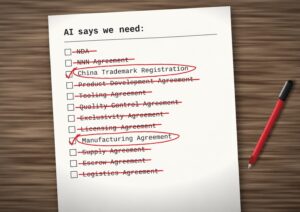
Trademark registrations and NNN agreements protect against different problems. A registration provides rights under trademark law, while an NNN agreement creates contractual obligations governing the manufacturer's use of information and its dealings with the buyer. Companies often need both, but the appropriate protections depend on the products, the relationship, and the rights already secured. Whether additional IP protections are necessary depends on what the company already has and what its manufacturer could do if the relationship deteriorates. We want to know which situation the client is in before the factory has any reason to become uncooperative.
3. What Industry Are You In, and How Dependent Are You on Your Factory?
If you're buying standard consumer products from an industry with excess capacity, you may have several alternative manufacturers. Your position is different if your products require specialized machinery, unusual materials, difficult-to-obtain certifications, or expertise possessed by only a handful of factories. We also consider how long replacing the manufacturer would take and what an interruption would cost, including whether you have enough inventory to keep supplying customers and whether missed deliveries would cost you major accounts or an entire retail season. A company that can move production easily has options unavailable to one dependent on a single specialized manufacturer. Don't assume you can move production to Mexico or Vietnam quickly just because you've found a factory willing to make your products. In an ideal world, you will have considerable overlap of factories so as to be sure that your new factory is truly capable of getting things right.
4. How Financially Healthy Is Your Manufacturer?
If material costs have declined, a reduction can benefit both parties. If the factory cannot pay its suppliers or employees, an attractive price can be an attempt to postpone collapse. We've seen manufacturers promise low prices and then fail to deliver, leaving foreign buyers with supply problems and little realistic chance of recovery. For major manufacturing relationships, we sometimes recommend investigating the manufacturer's finances, ownership, litigation history, and operating capabilities before making new commitments.
5. What Are Your Financial, Employment, and Corporate Exposures in China?
A price negotiation can also expose unresolved problems elsewhere in your China operations. When companies come to us wanting to secure a price reduction (or leave China entirely), we look at outstanding supplier invoices, disputed deposits, quality claims, and other possible financial obligations. If you have a Chinese subsidiary, joint venture, employees, or other personnel in China, we also consider whether those arrangements create additional risks if the manufacturing relationship deteriorates. A company that buys products from an independent Chinese factory faces different risks from one with employees, assets, and ongoing business operations in China. Employment, tax, and corporate compliance issues do not necessarily involve the manufacturer, but they can become important if a pricing disagreement develops into a broader dispute or decision to leave China. We would rather identify those vulnerabilities before negotiations begin.
Before Negotiating Lower Prices, Get Your China Legal House in Order
Price negotiations can expose legal weaknesses that have gone unnoticed for years. Addressing those weaknesses while the factory relationship is still good can prevent expensive problems. Once a manufacturer believes it is losing a major customer, obtaining its cooperation can become much harder. Another client of ours had the right protections in place. Its manufacturing contract clearly established its ownership of its molds. When the company decided to move production, the Chinese factory nevertheless refused to release them. We worked with Chinese litigation counsel to sue the manufacturer and seek an order preserving its assets. Within about five days, the Chinese court froze the factory's bank accounts. The factory released the molds the following day.
Most international disputes don't resolve that quickly, and I'd never promise a similar outcome. But this case shows what a well-drafted, locally enforceable contract can accomplish. We are always happy to try to help a client reduce its China manufacturing costs by 20 percent, but I wouldn't want to discover that pursuing the reduction put its trademarks, molds, inventory, or production at risk. Before asking for lower prices, make sure you know who owns the assets and intellectual property your manufacturing depends on. Some of our best results have come from straightforward negotiations between businesses that wanted to keep working together. Others required substantial preparation, including securing IP, resolving disputes, and developing alternative suppliers before the first pricing discussion.
Chinese factories have plenty of ways to retaliate. As I explain in Why Demand Letters to China Suppliers Often Backfire, they can delay your orders, hold your finished goods or tooling hostage, and even try to use your own trademark against you.
Our $4,500 China Legal Audit
At Harris Sliwoski, we offer a $4,500 China legal audit to help companies prepare to negotiate lower prices with their Chinese manufacturers or move production out of China entirely. The audit focuses on four areas:
- Intellectual property. We review your existing China IP protections, who owns the relevant rights, and any significant gaps that could put your trademarks, designs, technology, or other valuable IP at risk.
- Employment. If you have employees or other personnel in China, we look for employment-related legal issues that could cause problems if you change manufacturers or scale back your China operations.
- Entity structure. If you have a Chinese subsidiary, joint venture, or other China entity, we review its ownership, control, and potential legal vulnerabilities.
- Manufacturing contracts. We review one set of manufacturing contracts with one supplier, looking particularly at provisions that could affect your price negotiations, your ability to switch factories, or your ability to leave China.
The $4,500 fee covers a focused review of existing documents, with the scope agreed upon in advance. We identify significant risks and explain what we recommend doing about them before you begin negotiations. Reviewing each additional set of manufacturing contracts with another supplier costs $1,000, assuming a comparable scope and level of complexity. The audit does not include detailed supplier due diligence or the legal work needed to fix any problems we identify. We will discuss the scope and cost of any additional work with you before proceeding. The goal of these audits is to find and fix problems while you still have options. A missing China trademark registration, an unfavorable ownership arrangement, or a poorly drafted manufacturing agreement might be relatively easy to address while things are going well. Once your relationship with your Chinese factory starts falling apart, those same problems can become far more difficult and expensive to resolve.
How to Negotiate Lower Prices Without Losing Your Chinese Manufacturer
Once a client's legal and commercial position is clear, we can decide how aggressively to negotiate and what approach is most likely to succeed. Before contacting the factory, I also want to know what the company is actually paying for.
Find Out Where Your Money Is Going
A client that began manufacturing in China around 1995 could not afford an $8,000 mold and accepted the factory's proposal to add one dollar to the price of every product instead. Nearly fifteen years later, a new employee discovered the surcharge was still being collected. By then, the company had paid approximately $850,000 in additional charges. It eventually paid another $25,000 to purchase the mold outright, and we drafted a mold ownership agreement that eliminated the continuing surcharge. What began as a seemingly harmless accommodation had turned an $8,000 mold into a nearly one million dollar expense.
Sourcing agents can also add large, sometimes hidden, costs. We've had clients eliminate Chinese sourcing agents and discover their factories would sell directly to them for much less. In one instance, our buyer learned that an agent claiming a 5 percent commission had actually been charging 45 percent and collecting an additional 15 percent from suppliers. If you have a sourcing agent, you should get clear on what you are really paying it before you go to your factory for a lower price.
Give Your Manufacturer a Good Commercial Reason to Reduce Prices
Increased order volumes, more predictable production schedules, lower material costs, or sharing the expense of tariffs can give a manufacturer a commercial reason to cut its prices. The strongest argument can be that the factory has enjoyed a profitable relationship with the buyer for years and should make a concession to preserve it. Some factories agree to deep reductions just to keep a good customer, and others have reduced prices without receiving anything in return. A factory operating at full capacity and turning away business has little reason to cut its prices. Be careful about offering higher purchase volumes, long-term commitments, or other concessions merely to obtain a lower unit price. Those promises create expensive obligations if your business changes or your manufacturer fails to perform.
Don't Sacrifice Product Quality to Get a Lower Price
A client of ours discovered that approximately 30 percent of the electronic devices shipped by its Chinese manufacturer had obvious defects, including cracked screens and scratched casings. The company hired a quality-control firm to inspect future production and negotiated a price reduction covering half the inspection cost. That was more useful than demanding a lower unit price and hoping quality would remain acceptable. Any price reduction should be documented in a way that protects the savings negotiated. A lower quoted price is worth little if the factory can refuse future orders, change delivery obligations, or compromise quality. The right agreement depends on your existing contracts, products, and commercial relationship.
If you're considering negotiating lower prices with your Chinese manufacturer, contact our China legal team before approaching the factory. We can help you identify risks, get your China legal house in order, and pursue the savings without putting your manufacturing operations in jeopardy.