International IP Protection for Startups: What to Protect and Where
Startup companies often come to us wanting the full arsenal of intellectual property protection. They want trademarks in every country where somebody might someday buy their product, patents covering their technology, copyright registrations, design protection, confidentiality agreements, NNN Agreements with their factories, and contracts that keep employees, contractors, manufacturers, distributors, and competitors from taking what belongs to them.
I understand the instinct. For many startups, intellectual property is a large part of the company's value, and in some cases nearly all of it. If you have spent years developing a product, technology, formula, brand, software platform, or design, leaving any of it exposed feels irresponsible.
But startups have another problem: money. Every dollar spent protecting intellectual property is a dollar that cannot be spent on marketing, product development, inventory, hiring, or sales. A founder has to build a successful company.
I often tell startup clients to keep their eye on the prize. Protecting IP matters, at times enormously, but the objective is to build a business people want to buy from. A trademark nobody has heard of is not worth much, and neither is a patent on a product nobody wants.
So I often begin an IP discussion with a question that has nothing to do with the law: how much are you willing to spend? From there, we work backwards. We identify what would hurt the company most if it lost it, where the business makes its money, where it is heading, and which protections give it the most value for what it can afford.
I Stopped Asking Startups Where They Wanted IP Protection
I used to ask startup companies what seemed like an obvious question: in what countries do you want intellectual property protection? I stopped because the answer was so often "all of them." Of course they wanted protection everywhere. Why would anyone voluntarily choose a country where a competitor would be free to take the company name or copy the product? The question separated the desire for protection from what the protection would cost.
Now I ask where the company does 99 percent of its business. If it sells a physical product, I also ask where the product is made. Then I want to know where the company expects to be doing business over the next few years and where it plans to spend money on advertising, distribution, manufacturing, personnel, regulatory approvals, or a market launch.
Some of our larger clients sell their products in more than 100 countries and maintain IP programs across virtually every important market. At their scale, that can make perfect sense. But a tiny skincare company can ship orders to 30 countries without having a business worth protecting equally in all 30.
The $5,000 Country Problem
Suppose your company has about $5,000 a year in sales into a particular country.
For rough planning, I tell clients to assume that obtaining a relatively straightforward trademark in a foreign country will cost around $2,000 once filing fees and legal costs are included. That is a budgeting number, not a quote. Some countries cost less, some considerably more, and the number of classes, filing route, objections, translations, and other issues can change the cost quickly.
If you are selling $5,000 a year into a country, spending roughly 40 percent of one year's gross sales there on a trademark calls for some thought. The filing can still make excellent sense if sales are climbing quickly, a distributor is coming on board, the company manufactures there, or losing the brand would interfere with a broader regional strategy.
If sales have been stuck at $5,000 for several years and management has no plan to change that, I am likely to ask whether the $2,000 would accomplish more somewhere else. I have watched companies enter a discussion convinced they need protection in ten countries, add up the cost, and leave with a list of two or three.
Now change one fact: the same company plans to spend $50,000 advertising in that country next year. I want the trademark issue revisited before the campaign starts. The company is about to spend ten times its current annual sales building recognition for a name it does not control there. A trademark filing that looked marginal six months earlier can suddenly become an obvious business expense. Your IP budget should follow the business, with some protections in place before the spending starts.
Keep Your Eye on the Prize
Many years ago, a clothing company that was just starting to get hot called me about China. It is now very well known, but at the time it was still deciding how aggressively it wanted to expand internationally. There must have been at least five people from the company on the call.
One person said the company should not sell in China because copies of its clothing were already being sold there. Before I could say anything, somebody else jumped in. "That doesn't matter," was essentially the response. The company could make a lot of sales in China, and the fact that copies were already there was all the more reason to make it easy for Chinese consumers to buy the genuine product.
I remember thinking that this was the right way to frame the issue. Copying does not automatically mean a company should abandon a market. Copies can be evidence that consumers already know the product and want it. The more useful question is whether the company can turn that demand into sales while protecting enough of its position to make the market worthwhile.
China is also the sort of country where waiting on trademark protection can be costly. Like most countries, China is a first-to-file trademark jurisdiction, so a company planning a China launch should address its marks before spending heavily to build the market.
The IP strategy should help the company grow while preserving the assets that make that growth valuable.
Before You Sue, Ask What the Copying Is Worth
Over the years, I have probably heard from around 100 companies that wanted to sue somebody for copying their product. They spent the time and money developing something, and somebody else came along with a product that looks almost exactly like it.
I usually ask what damages they have suffered. Most do not know. The companies that offer a number often estimate that the copying has reduced their sales somewhere in the one-to-five-percent range.
Then we discuss what litigation costs, how long it takes, what has to be proved, what a realistic recovery is, whether the defendant can pay a judgment, and how much management time the lawsuit will consume. An injunction can make litigation worthwhile even when damages are modest, and some copycats need to be stopped before the problem spreads. But if the company's best estimate is a two-percent sales decline and the lawsuit will cost as much as the company is likely to recover, suing requires a hard look.
I have had many cases where suing was legally justified but made little business sense. If a company spends $250,000 to win $150,000, the lawsuit may be a legal victory and a business loss.
When the Copycat Takes the Brand
The damages analysis can change dramatically when the infringer copies both the product and the brand. One company came to us after discovering that a copycat was selling essentially the same $20 product under its brand at four for $20. Our client could not compete with that price. Customers searching for its brand were being diverted to a product selling at roughly one-quarter of the price, while the copycat benefited from the reputation our client had spent years and substantial money building.
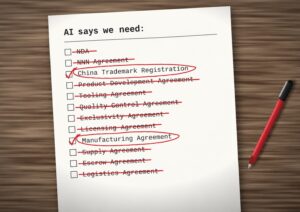
Trademark rights should have given the company considerable leverage. Unfortunately, it had registered its trademark only in the United States. It had no China trademark registration and had not registered the brand in most of the other countries where the copycat was selling.
There were still legal issues we could investigate, but the straightforward trademark-enforcement route the client expected was unavailable.
This is one of the main reasons why I push trademarks toward the front of the line for consumer-product companies. Copying the general idea or appearance of a product can hurt. Putting your name on a cheap copy can intercept customers who were trying to buy from you in the first place.
Trademark Problems Are Much Cheaper Before Launch
International trademark strategy involves more than registering a mark. A company also needs to determine whether it can safely use the name it has chosen. A company once came to us after it had already entered an important foreign market and received a cease-and-desist letter over its name. By the time we became involved, every option carried a cost. The company could continue using the name and accept the litigation risk, leave the market, obtain a license, or change brands.
The company could not get a workable license. Leaving the market made no economic sense, and continuing with the disputed name carried too much risk, so it rebranded. Sales quickly fell by roughly 30 percent and took about a year to recover.
I think about that matter whenever a company regards trademark clearance as an unnecessary legal expense. The company recovered, but it effectively paid twice to build recognition in the same market. The cheaper time to find a trademark conflict is before the packaging is printed, the advertising begins, the distributor is appointed, and customers learn the name.
Companies naturally focus on trademark applications because filing something is tangible. A good clearance search can be just as valuable if it prevents the company from investing heavily in a brand it later has to abandon.
Start With the IP the Company Cannot Afford to Lose
Once the budget is established, the next question is what gets protected first. For a consumer company, the crown jewel is often the brand. For a technology startup, it may be an invention, source code, data, or a proprietary process. A skincare or food company may depend heavily on both a brand and a formula. A jewelry, furniture, footwear, or fashion company may derive much of its value from product appearance.
Different assets call for different tools. Trademarks protect names, logos, and other source identifiers. Patents protect qualifying inventions. Design patents and registered industrial designs protect aspects of product appearance. Copyright protects qualifying original expression, including software code, photographs, artwork, written materials, and graphics. Trade secret law can protect commercially valuable information that remains secret and is treated accordingly. Contracts govern what employees, contractors, manufacturers, distributors, and licensees may do with the company's information and IP.
A single product can involve several of these protections at once. A startup should understand what is available and decide which protections justify the cost.
For many consumer startups, the principal trademark sits near the top of the list. Products change, packaging changes, suppliers change, and product lines disappear. A good brand can survive all of those things. When money is tight, I want to identify the mark whose loss would create the biggest problem. Often that is the main word mark rather than every version of the logo, every slogan, and every individual product name.
Founders also need to understand that forming a company, buying a domain, and securing social-media handles do not replace trademark registration. Owning the .com is useful, but it gives the company no trademark rights in China, Germany, Mexico, Australia, or anywhere else simply because the domain belongs to it.
Build the Country Map Around the Business
The first countries on the map should generally be the places where the company makes most of its money. That is why I ask where it does 99 percent of its business rather than where it has ever made a sale. If 97 percent of revenue comes from the United States, Canada, the European Union, and Australia, with the remaining three percent scattered across twenty countries, those markets should not automatically receive equal IP budgets. Sales do not decide everything, but they are a good starting point.
I also want to know where the company is about to invest. A country where the company is hiring a distributor, entering a large retailer, spending heavily on advertising, obtaining regulatory approval, or opening local operations belongs in a different category from one that produced three website orders last year.
Physical-product companies also need to account for manufacturing. A U.S. company tells me it does not need a China trademark because it has no plans to sell to Chinese consumers. Then I learn that the goods are made in China, the packaging is printed there, the molds are there, and the factory sees the company's name, logo, designs, specifications, prototypes, and future product plans.
China is obviously part of that company's IP world even if local sales are zero. The same analysis applies when manufacturing moves to Vietnam, Mexico, Thailand, India, Turkey, or elsewhere. Manufacturing creates IP exposure that sales figures alone do not capture.
A startup does not need to protect every country it can imagine entering someday. The analysis changes when a hypothetical market becomes a concrete business plan.
EU Trademarks, Madrid Filings, and Local-Language Brands
International filing systems can stretch a limited IP budget, but there is no single worldwide filing that solves everything.
European Union Trademarks
For companies doing business across Europe, the European Union trade mark can be unusually efficient. A single EUTM registration gives the owner rights across all 27 EU member states. A company with large sales in Germany, France, Spain, Italy, the Netherlands, and several other EU markets therefore does not necessarily need a separate national trademark application in each one.
The efficiency comes with tradeoffs because the EUTM is a unitary right. Clearance still matters, particularly when the proposed mark has different meanings across European languages or presents a registrability problem in part of the EU.
The United Kingdom requires separate consideration after Brexit. A startup targeting both the EU and UK therefore needs to account for both systems. For the right company, an EU filing plus a UK filing can cover a large amount of commercially important territory efficiently. If European sales are trivial and there is no expansion plan, the money may belong somewhere else.
Madrid International Trademark Filings
The Madrid System is often described in a way that leaves startups believing there is such a thing as a worldwide trademark. There is no such trademark.
Madrid provides a centralized route for seeking trademark protection across more than 130 countries. Each designated member applies its own domestic law to determine the scope of protection. For a company building a multi-country portfolio, Madrid can simplify filing and administration and make later expansion easier. A company seeking protection in only one or two foreign countries may prefer direct national filings, and objections in designated countries can still require local counsel.
There is another point startups should understand: a Madrid international registration remains dependent on the underlying basic mark for its first five years. If the basic mark fails during that period, the international registration can be affected to the same extent. Madrid makes the most sense after looking at the countries the company needs and how the portfolio is likely to grow.
Do Not Forget the Name People Will Use
International trademark planning should also account for language. A U.S. company may insist that its English-language brand is the only name that matters while local consumers, distributors, factories, or social-media users create their own translation or transliteration. If that version becomes the name people use, it can acquire considerable commercial value.
This is particularly important in markets that do not primarily use the Latin alphabet. A company entering China, Japan, Korea, or an Arabic-language market should think about what consumers are likely to call the brand rather than leaving that decision entirely to the marketplace. If a local-language name is likely to matter, choose it deliberately and consider protecting it early.
Patents Require a Much Harder Budget Conversation
International patent protection can consume a startup's legal budget very quickly. The costs do not stop with drafting and filing. Examination, foreign counsel, translations, prosecution, national or regional phase entry, annuities, maintenance fees, and eventual enforcement can make a broad international patent portfolio extremely expensive.
A valuable technology can justify that expense. A weak patent strategy can leave the company with an impressive collection of documents that does little to improve its commercial position.
Before spending heavily, I want to know whether competitors can design around the patent, whether infringement can be detected, and how long the technology is likely to remain commercially important. Where competitors operate and where the product will be made and sold also matter. Investor, acquirer, or licensee interest can justify patent spending that makes little sense for a right nobody outside the company values.
The PCT Buys Time, Not a Worldwide Patent
A PCT application does not produce a worldwide patent. The Patent Cooperation Treaty provides an international filing mechanism for seeking patent protection in multiple countries, with the process ultimately continuing through national or regional patent offices.
For startups, one of the PCT's biggest benefits is time. An early-stage company may have little idea which foreign markets will matter. By the time expensive national or regional decisions need to be made, it can know far more about customer demand, competitors, financing, distribution, manufacturing, and whether the technology is living up to its promise. That additional information can save a company from spending heavily on patents in countries that turn out not to matter.
Deal With Patents Before Public Disclosure
Startups need to raise the patent question before publicly disclosing important technology. Public disclosure before filing can destroy novelty unless the law that applies provides a grace period, and those rules differ by jurisdiction.
One company contacted us only after it had disclosed a new product online. By the time we became involved, patent and design options that had existed before disclosure were gone in a number of countries. No agreement or legal drafting could recreate those lost rights.
The patent discussion therefore belongs before the trade show, crowdfunding campaign, detailed website launch, publication, or public demonstration. The company can decide after the discussion that a patent is not worth the money. Public disclosure can make that decision before anyone realizes it.
Patent or Trade Secret?
Some technologies present a different choice: patent the invention or keep the valuable information secret. A patent generally requires disclosure in exchange for a limited exclusive right. Trade secret protection depends on keeping the information secret.
If a competitor can buy the finished product, take it apart, and determine how it works, secrecy has obvious weaknesses. If the valuable process happens inside a factory and cannot realistically be reverse engineered from the finished product, trade secret protection can be far more attractive.
Product life also matters. An expensive patent program is harder to justify for technology likely to become obsolete quickly than for a foundational invention expected to drive the company for years.
Design Protection and Copyright Have Their Own Economics
Startups can become so focused on utility patents that they overlook product design. For jewelry, furniture, footwear, consumer electronics, lighting, housewares, packaging, sporting goods, and other visually driven products, competitors can do real damage by copying how the product looks without copying its technical invention.
Design patents and registered industrial designs can address some of that risk. The Hague System provides a centralized international mechanism for seeking design protection across participating countries through a single application.
The economics still control the decision. A furniture company whose best-selling chair remains in its catalog for a decade faces a different design problem from a fast-fashion business releasing hundreds of designs with short commercial lives. The first company may have excellent reasons to protect a handful of important designs broadly. The second can spend a fortune trying to protect products that will be gone from the catalog before the protection pays off.
Copyright works differently. Under the Berne Convention, copyright protection in other member countries generally cannot be made dependent on complying with registration or other formalities. Some jurisdictions, including the United States, nevertheless provide important procedural or enforcement benefits for registration, so strategic filings can still make sense.
For startups, the more immediate copyright problem is often ownership.
Before Protecting IP, Make Sure the Company Owns It
Who wrote the software? Who designed the logo and packaging? Who took the product photographs? Who prepared the engineering drawings? Was it an employee, a founder, an independent contractor, an agency, an overseas developer, or a friend who helped when the company had no money? Startups are often surprisingly loose about those questions during their early years. The problem surfaces later, when an investor or buyer starts asking for proof that the company owns the assets everyone has been valuing.
Paying someone to create something does not automatically resolve every ownership issue. Appropriate employee agreements, contractor agreements, invention assignments, and IP assignments can be some of the highest-value legal work a startup does. A company contemplating its fifth-most-important foreign trademark should first make sure it owns its first-most-important software, brand assets, designs, and inventions.
The same discipline applies to trade secrets. Formulas, manufacturing processes, algorithms, testing procedures, supplier information, pricing models, and customer data lose much of their legal protection if the company does not guard them. If something matters, handle it accordingly. Limit access and use appropriate confidentiality agreements. Suppliers should receive only the information they need, and former employees should lose access promptly. The company should know where its important files are and who can open them. A company that treats supposedly critical information casually for years should not expect the word "confidential" at the top of a document to solve the problem after a dispute starts.
NDAs, NNN Agreements, and Manufacturing Contracts
Contracts are another part of the IP toolkit, but startups sometimes want one agreement to do work it was never designed to do. A standard confidentiality agreement can be perfectly appropriate in some relationships. A prospective investor, software developer, joint-venture partner, distributor, and overseas factory create different risks. The agreement should fit what can go wrong.
International NNN Agreements
For companies manufacturing overseas, we almost always recommend a country-spcific NNN Agreement (not an NDA) before sensitive information changes hands. NNN generally refers to non-disclosure, non-use, and non-circumvention. The distinction matters because a manufacturer does not need to publish your drawings or hand them to a competitor to hurt you. It can use what it learned to make a competing product, benefit another customer, operate through a related company, or try to go around you commercially.
One recurring problem is a company telling us it already has an NNN Agreement, only for us to discover that the mainland factory never signed it. The agreement is with a sourcing agent, trading company, Hong Kong or Singapore entity, or another intermediary, while a different company is receiving the drawings, specifications, and sensitive product information.
The contract protects you against the party bound by it. Before debating the finer points of an NNN Agreement, make sure the right company is signing it.
The document also needs to fit the jurisdiction and transaction. Calling a contract an "NNN Agreement" does not make it effective if it names the wrong party, ignores non-use and circumvention, or offers remedies that accomplish little in the real world.
Manufacturing Agreements
An NNN Agreement does not replace a manufacturing agreement. Once production begins, the relationship becomes much broader: specifications and quality, subcontracting, tooling and improvements, overruns and seconds, and what happens to the company's IP when the relationship ends all need to be addressed.
Companies sometimes spend considerable time protecting the first disclosure of confidential information and then run a multimillion-dollar manufacturing relationship on purchase orders and email. Once large amounts of money and valuable IP are moving through the relationship, the contract should reflect the stakes.
Tooling warrants separate attention because it can become immediate leverage in a factory dispute. A startup pays tens of thousands of dollars to create a mold and naturally assumes the mold belongs to it. The factory may have a different view. The manufacturing agreement should address ownership, possession, permitted use, maintenance, transfer, and what happens at termination. Similar issues arise with CAD files, prototypes, and specialized tooling. In a factory dispute, the most urgent IP question can be whether the company can get its mold out of the factory.
Good Legal Advice Can Mean Buying Less Legal Advice
One manufacturing matter has always stuck with me because it involved the same budget discipline in a different form. A client discovered that its manufacturer had been selling seconds or other unauthorized goods. The client's genuine products carried a no-questions-asked return policy, and the company wanted us to determine whether it was legally required to honor that policy for these unauthorized goods in four different countries.
We could have researched the consumer protection, warranty, and contract law in all four jurisdictions. It would likely have cost tens of thousands of dollars and might still have left some uncertainty. Instead, we talked about the business problem. How many products were likely to come back? What would refunds or repairs cost? What would happen to the brand if consumers bought something carrying the company's name and were then told the company would not stand behind it?
The client decided to refund or repair the products. Our bill was around $2,500. The company solved the customer problem without spending ten times as much to determine exactly where the legal line sat in four countries. Good legal advice can include telling a client that the answer is not worth buying. The same discipline belongs in an IP budget.
Distributors and Licensees Can Create Their Own IP Problems
International expansion often requires local partners, and those relationships need an IP structure of their own.
A strong distributor can build a foreign market far faster than the startup could do by itself. But the distributor may also control local advertising, customer relationships, translated brand names, domains, social-media accounts, and interactions with government agencies.
The agreement should make clear who owns the trademark, who can apply to register it, how the distributor can use it, what happens with local-language marks and digital assets, whether sub-distributors are permitted, and what must happen after termination.
I become especially cautious when a distributor suggests that it should register the company's trademark in its own name because doing so is supposedly easier. A company should understand exactly what it is giving up before letting the party that distributes its products become the registered owner of its brand.
Licensing agreements raise related questions involving territory, quality control, sublicensing, ownership, improvements, enforcement, and post-termination use. The farther the startup expands from direct control of its product and brand, the more important it becomes to establish those rules while the relationship is still good.
Registration Is Only Part of Protection
A startup does not need the worldwide monitoring and anti-counterfeiting apparatus of a multinational. It should, however, have some way to detect major trademark conflicts, counterfeit products, domain abuse, marketplace impersonation, and unauthorized use by distributors or competitors. When infringement appears, use the same economic discipline that went into obtaining the right. The response might be a lawsuit, opposition, takedown request, cease-and-desist letter, customs action, marketplace complaint, negotiation, distributor remedy, or no action at all.
A legal claim is an asset. The company should decide whether pursuing it is worth the cost.
Work Backwards From the Budget
There is no need for an elaborate scoring system to prioritize international IP spending. Start with the countries that generate the most revenue, contain important manufacturing, host key distributors, or are about to receive major investment. The next group consists of credible expansion markets where there is early sales traction, distributor interest, regulatory work, or a concrete plan to enter. Then there are incidental markets where somebody bought the product online but the company has no operations, investment, or expansion plans. Those sales count, but they should not dictate the legal budget.
Business events move countries from one category to another. A large foreign advertising campaign should prompt a trademark review. Moving manufacturing should trigger a look at trademarks, contracts, tooling, and trade secrets in the new country. A new product name should be cleared before thousands of packages are printed. Potentially patentable technology should reach patent counsel before it reaches the public.
Suppose a startup has $15,000 to spend on IP this year. For one company, the best use of the money might be its principal trademarks in the United States, EU, China, and UK. China could rank near the top even with zero Chinese sales because the entire product line is manufactured there. Another company might have little reason to spend money in Europe while Mexico represents a quarter of its revenue. A technology company may need much of the budget to preserve an important patent position. A different business may get more value by cleaning up founder and contractor assignments, protecting trade secrets, and fixing manufacturing contracts.
Next year, the priorities can change. A financing round, new market, manufacturing move, or successful product launch can justify protections that made no economic sense a year earlier. There is no universal startup IP package.
Frequently Asked Questions About International IP Protection for Startups
Do I Need a Trademark in Every Country Where Someone Buys My Product?
Usually not. A few online sales do not make every country an IP priority. Start with the countries where losing the brand would materially affect the business, along with manufacturing locations and markets the company is preparing to enter.
How Much Should a Startup Budget for a Foreign Trademark?
Costs vary widely, but I often use roughly $2,000 per country as an early planning number for a straightforward foreign trademark. The point is to understand the scale: a broad international trademark portfolio can consume tens of thousands of dollars before patents, contracts, designs, and enforcement enter the picture.
Is There a Worldwide Trademark?
No. The Madrid System provides a centralized route for seeking protection across more than 130 countries, but the designated countries and regions still apply their own trademark laws.
Does an EU Trademark Cover the UK?
No. An EUTM covers the 27 EU member states, while the UK has its own trademark system.
Should a Startup Register Its Trademark Where Its Products Are Manufactured?
Often, yes. Manufacturing can make a country important even when the company has no customers there. This is particularly important in first-to-file jurisdictions such as China, where the products, packaging, tooling, and specifications may all be handled locally.
Is There a Worldwide Patent?
No. The PCT provides an international filing route that helps companies pursue patent protection in multiple countries, but the resulting patent rights come through national or regional systems.
Should Every Startup Patent Its Technology?
No. Patent protection needs a business case. It becomes more attractive when competitors cannot easily design around the invention, infringement can be detected, the technology will remain valuable for years, and exclusivity matters to customers, investors, licensees, or potential acquirers.
What Is More Important, Stopping Product Copies or Protecting the Brand?
It depends on the company. For a consumer business, a counterfeit carrying the company's name can be particularly damaging because it diverts customers who were already looking for the genuine brand and can damage the reputation behind future sales.
Does an NDA Protect All of My IP?
No. An NDA addresses confidentiality and, depending on its terms, how information can be used. It does not replace trademark registration, patent protection, copyright ownership, design rights, IP assignments, or the contracts needed to govern manufacturing and distribution.
Is an NNN Agreement Enough for China Manufacturing?
No. An NNN Agreement is an early layer of protection directed at disclosure, use, and circumvention risks. Once production begins, the manufacturing agreement has a much larger job, including quality, specifications, IP ownership, tooling, subcontracting, payment, delivery, remedies, and termination. The factory receiving the sensitive information also needs to be bound by the relevant agreement.
Protect the Business Without Starving It
Startups should take intellectual property seriously without turning IP protection into an end in itself.
A two-percent sales decline from look-alike products calls for a different response from counterfeit goods diverting customers who are searching for your brand. Countries require the same discipline. A market producing $5,000 a year cannot automatically command the same legal budget as one producing $500,000, while manufacturing can make a country important even when local sales are zero.
When a startup tells me it wants IP protection everywhere, I want to know where it does nearly all of its business, where its products are made, where it is going next, what it cannot afford to lose, and how much money it is prepared to spend.
Those answers tell us where the IP dollars should go. The company can then put its remaining resources into what makes all that protection worth having: building the business. If you want help figuring out how best to protect your startup's IP, contact us.