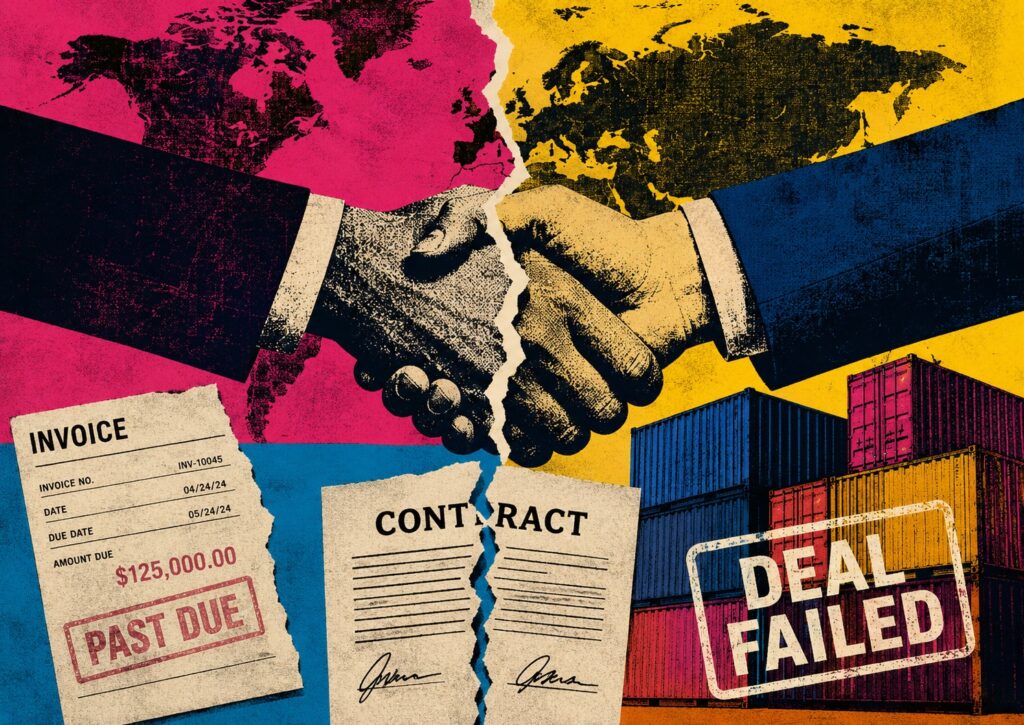
When Your Contract Will Not Save You in a Cross-Border Credit Dispute
A U.S. company recently lost more than $860,000 to a foreign client. It had a signed contract, invoices, and legal remedies. That still was not enough.
The contract was not the real problem. The company extended too much unsecured credit, dealt with the wrong entity, kept performing after the warning signs were already there, and tried to manage a payment dispute with business concessions instead of firm limits. This sequence is more common than most companies think.
The Contract Usually Is Not the First Thing That Goes Wrong
When a foreign client stops paying, companies often begin by asking whether the contract failed them. Sometimes it did. More often, the contract was serviceable enough, and the real damage happened earlier.
The deposit was waived or never requested. The account kept growing after payment slowed. Nobody pinned down the customer’s legal or corporate structure. People talked about compromise without reducing anything to signed terms. The forum clause looked sensible when the deal was signed and much less useful once collection became the real fight. By the time the dispute turns legal, the commercial damage is often already done.
Know Exactly Who Is Asking for Credit
Before extending meaningful credit to a foreign company, you need to know who is actually asking for it. That goes beyond confirming that a company exists. You need to identify the contracting party, confirm where it is registered, understand where it actually operates, determine who controls it, and verify that the signatory is the asset-holding entity rather than a shell or a service-only subsidiary.
In cross-border deals, the company signing the agreement is not always the company with the assets. Sometimes the signatory is only one piece of a larger structure. Revenue may sit with a parent, an affiliate, a marketplace account, or a separate operating company in another jurisdiction. If you do not sort that out before you extend credit, you can end up with a clean contract and a useless recovery target.
This issue comes up often with Chinese counterparties. The entity willing to sign is not always the one holding the assets or generating the revenue. A trading company, a manufacturing company, and a related operating entity may all be connected but legally separate. Many U.S. companies gloss over that because the deal appears straightforward. It rarely is.
Before extending substantial credit, confirm legal identity, ownership, authority, affiliated entities, and asset location. Ask for financial references or basic financial disclosure. Most companies do some version of this with domestic customers. It matters even more when the customer is overseas.
Our law firm regularly prepares due diligence reports on foreign companies for businesses deciding whether to extend credit, enter into a supply relationship, or sign a longer-term services agreement. Those reports are designed to help clients understand who they are dealing with before the exposure builds and before problems start. In at least ten percent of these reports, what we find makes clear that credit should not be extended.
Make Sure the Right Entity Is on the Hook
Once you understand the structure, the next question is whether you are contracting with the company that can actually pay. If the answer is no, fix that before the relationship begins.
If the real assets sit with a parent, a U.S. affiliate, an operating subsidiary, or another owner-controlled entity, that entity should sign the agreement or provide the guarantee. This is one of the most important commercial decisions in a cross-border relationship.
Personal guarantees raise the identical problem. Many companies avoid asking for them because they worry the request will make the deal harder to close. Sometimes it will. That tells you something. A principal who wants the upside of the relationship without personal exposure is shifting the risk to you.
When we are retained to sue an overseas company, the first thing we research is the likelihood of being able to collect if we win. Far too often – I estimate around 25 percent of the time – the low likelihood of ever being able to collect on a judgment leads us to tell the client we do not think the case should continue. You want to know that before you start performing and before the invoices begin to pile up.
Draft the Forum Clause With Collection in Mind
Companies often choose a dispute forum because it feels familiar. I get it. A local court may feel predictable and convenient when the contract is signed. But if the customer is overseas, the real fight may not be where you sue. It may be where you enforce. That is why your dispute-resolution clause should be drafted with collection in mind. Where are the assets? Where do receivables flow? Where does the company actually operate? What forum gives you the best chance of turning a judgment into money?
In A Guide to Dispute Resolution Clauses in International Contracts we explain how to draft these clauses with enforcement in mind. Sometimes a U.S. court is the right answer. Sometimes a foreign court is better. Sometimes international arbitration is better. The point is to choose the option that gives you the most realistic path to collection.
Keep Sales Away From Final Credit Decisions
A lot of avoidable losses start inside the company, not in the contract. The people who benefit from more volume are often the same people deciding whether to keep extending credit. That is a structural conflict. Sales teams are supposed to bring in business. They should not also control how much credit a customer gets or when the account gets frozen.
If you deal with foreign customers, designate one person or one group to control credit decisions. That person or group should have clear authority to approve limits, deny exceptions, and suspend accounts when limits are exceeded. Most importantly, no one whose compensation depends on sales volume should be making credit decisions.
A good credit approval system will not prevent every default, but it will prevent many self-inflicted losses.
A Credit Limit Everyone Can Ignore Is Not a Credit Limit
If your customer is overseas and your performance comes first, unsecured exposure is growing whether you call it credit or not. Deposits matter. Credit caps matter. Suspension triggers matter.
Too many companies waive deposits because they want the business. Then they keep making exceptions because they do not want to disrupt the relationship. By the time they finally freeze the account, the balance has usually spiraled well past where it should have stopped.
In the matter described at the start of this post, the account was not placed on hold until the balance exceeded $850,000. A $250,000 cap with automatic suspension would have limited the exposure to a fraction of that number. The contract allowed immediate suspension on payment default. The creditor simply did not use that right in time. That is backwards, and it is also common.
If the customer’s assets are outside your home jurisdiction, a meaningful deposit should be considered from the outset. The amount will vary by industry, but it should be large enough to provide real protection. Beyond that, there should be a hard credit limit. Once the balance reaches it, performance stops unless someone with real authority approves otherwise.
For larger foreign accounts, some companies should also look at trade credit insurance. That is insurance designed to cover at least part of the loss if a customer does not pay. It is not a substitute for a disciplined process, but it can limit the damage.
Do Not Let Software Defaults Drive Cost
Some of the worst billing disputes begin with a default setting nobody thought to change. Shipping method is an obvious example. If your systems allow client preferences, API inputs, or platform defaults to trigger expensive shipping options automatically, you need controls around that. A foreign client may later claim it never approved those costs, that the system was misconfigured, or that someone said something different on a call. By then, even if your legal position is sound, you still have a serious commercial dispute.
The same problem shows up in fulfillment, storage arrangements, and service-level defaults. If a choice can materially change what the customer owes, it should be spelled out in the contract and backed by internal procedures requiring approval, escalation, or alerts when charges exceed defined thresholds. Being legally right does not erase the commercial damage.
Put Every Real Settlement in Writing
Once a serious payment dispute starts, the instinct is to keep talking, keep the relationship alive, and find a number both sides can live with. That instinct is understandable, and it is also how bad situations get worse.
One side treats a reduced payment figure as a settlement. The other treats it as a partial payment. Emails go back and forth about revised figures, future volume, rerates, and proposed accommodations. Nobody signs anything. Weeks pass. Each side believes the other understands the deal.
If the parties reach any material compromise, document it immediately in a signed amendment, settlement agreement, or payment plan. If it is not signed, it is not settled.
The same point applies to pricing concessions. Do not renegotiate future rates to resolve a past-due balance unless the existing dispute is being resolved at the same time in a binding written agreement. Otherwise you are trading actual cash for theoretical future volume.
A longtime client once called us about a dispute with one of its customers. The client told us the matter had been resolved and asked whether we would draft a settlement agreement to memorialize the deal. A few months later, it called again, this time wanting to sue the customer.
It turned out our client had paid roughly $350,000 of about $500,000 allegedly owed and signed what it believed was a complete settlement. But because the agreement was governed by a jurisdiction that required very specific release language to cover all claims, the customer sued as though no settlement had ever been reached.
Our client wanted us to fight the case aggressively, but after we explained how weak its position was, it agreed to settle again. In the end, it paid close to the full $500,000 its customer originally claimed. Had it paid us roughly $5,000 to draft the settlement agreement in the first place, it likely would have saved around $150,000.
When the Warning Signs Start, Act
In most of these disputes, the warning signs were there long before things blew up. Payments slowed down. New categories of charges suddenly became disputed. The customer asked for more time, then linked payment to future business or future concessions. The balance grew while the conversations continued.
Warning signs should trigger specific action. Tighten terms. Freeze additional exposure. Require payment before further performance. If guarantees were not obtained at the outset, consider whether there is still leverage to demand them now. Assess the value of any inventory or goods you control, understand what your contractual rights actually allow you to do with them, and start planning for enforcement before you need it.
If the balance is already large, your options are more limited. Most of the leverage described here is strongest before the exposure builds, not after.
Use Leverage While It Still Matters
If you hold inventory, goods, documents, or other practical leverage, use it early and intelligently. Too often, companies wait until the dispute is severe before relying on lien rights, suspension rights, or control over goods. By then, the balance may already exceed the realistic recovery value, and the leverage that looked strong on paper may have weakened considerably.
Just last month, a company came to us after spending six months trying to resolve a tariff dispute with its biggest supplier. There was an obvious legal move available, but by then the client had become so dependent on the supplier that using that leverage would likely have shut down its supply chain.
This is especially true with warehoused goods or stored inventory. Those rights can be valuable, but only if you understand what the goods are worth, how quickly that value may deteriorate, what your contractual rights actually allow, and whether using them creates real leverage or simply confirms that the relationship is over.
What This Comes Down To
Large foreign-client losses usually do not result from one dramatic mistake. They come from a series of decisions that each felt defensible at the time. Waive the deposit once. Give the account a little more room. Try one more round of negotiation. Keep shipping while the dispute gets sorted out. That is how companies end up with losses they should have cut off much earlier.
The companies that avoid these losses are not the ones with the fanciest contracts. They are the ones that ask hard questions early, keep credit authority away from sales, stop extending goodwill when the warning signs appear, and structure the relationship around actual recoverability rather than optimism.
The discipline is not complicated. It is just hardest to maintain when the relationship still looks healthy. If your company is extending meaningful credit to foreign customers, review your process before the balance builds, not after.
Harris Sliwoski helps companies assess foreign counterparties, prepare due diligence reports, structure credit terms, and reduce payment risk before an ordinary commercial relationship turns into an expensive collection problem. If you are dealing with a foreign client that is already behind, we can help you assess your options and leverage before more time passes.