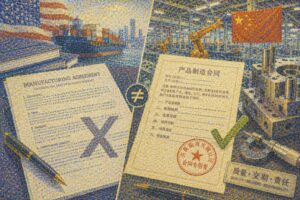
China Supply Chain Restructuring: Legal Traps in Moving, Selling, or Exiting China
A U.S. manufacturer decides to move production from China to Mexico. The company’s technical team starts shipping over production files and the company opens early talks with a Chinese buyer for the plant. The move looks routine. Then the files raise an export-control question nobody flagged, the employee transfers turn into a drawn-out negotiation, the buyer’s lawyers stall over data-room access, and the bank cannot move the payment the way the contract describes. Nothing went wrong on purpose. The company just moved before it understood the rules.
That pattern is playing out across industries right now. Tariffs, rising costs, export controls, geopolitical tension, and board-level pressure are pushing companies to sell a China subsidiary, move production out of China, carve out China assets for a buyer, or relocate to another country while keeping some footprint there.
All of those moves can make sense. The mistake is treating them as ordinary business moves.
Plan the legal and regulatory side of a China restructuring before you pick a buyer, transfer a file, move an employee, or open a data room. That means knowing what’s moving — people, technology, data, assets, or payment — who owns it, and whether China law restricts the move. The companies that get hurt are the ones that find this out from a regulator, a bank, or a buyer’s lawyer instead of from their own counsel.
关键要点
Five things worth keeping in mind from the outset:
- The commercial story matters as much as the legal one. Frame a China exit around what stays — jobs, suppliers, customers — and regulators usually give you fewer reasons to slow it down.
- The highest bid is not always the best deal. A buyer who can’t get the approvals, can’t move the money, or doesn’t understand what it’s agreeing to isn’t worth more than one who can actually close.
- Meaningful carve-outs and regulated sales usually require months of planning, especially when technology, data, employees, tax, or foreign exchange approvals are involved.
- Technology, data, and employee issues should be mapped before diligence begins, because once a buyer or regulator spots the problem, it becomes leverage against the seller.
- Structure can determine whether you actually get paid. Test the payment mechanics with China counsel, tax advisers, and the bank while there’s still time to fix what doesn’t work.
China Will Not Always View the Deal the Way You Do
A foreign company often sees a China divestiture as a straightforward business call: sell the plant, redeploy the capital, move on. Chinese regulators and local officials usually see something more complicated. They are thinking about employment, supplier stability, tax revenue, technology, customer continuity, and whether the deal fits where Beijing wants the economy to go.
That mismatch is where sellers get into trouble. Announce the deal as an exit, and you will likely face more questions, more delay, and more resistance than expected. Frame it instead around continuity — what remains in China, who keeps working, which customers and suppliers remain supported — and you usually give regulators fewer reasons to slow the deal down.
It rarely shows up as a formal rejection. A local labor bureau wants to see the severance plan before it will sign off on a routine filing. A tax office asks for more documentation once it learns the buyer is foreign, and the closing timeline slips by six weeks with no explanation offered. No one ever calls it resistance. It just shows up as extra meetings, more document requests, and conditions that surface late in the process.
None of this guarantees approval, but the commercial story behind a China deal carries real weight, and it’s worth getting right before the first conversation with a buyer or a regulator.
What Can Go Wrong in a China Divestiture?
China deals often look manageable at the term sheet stage, and the real problems tend to surface later. The buyer needs an approval nobody flagged in diligence. The bank has questions about how the payment is actually going to move. Tax clearance drags. Employee transfers turn out to be messier than the buyer assumed. A local government office suddenly takes interest in a deal everyone thought was already on track.
Any one of those can change the economics. A buyer who spots an unresolved problem will often ask for a price cut, a deferred payment, a bigger escrow, a broader indemnity, or a new closing condition — leverage the seller did not have to give up.
Know who the buyer really is, how they intend to pay, what approvals are likely needed, which employees are moving, and whether the structure actually works under Chinese law. A signed letter of intent tells you the parties want a deal. It does not tell you the deal can close.
Choosing the Buyer
Buyer selection is where many China divestitures start drifting off course. A Chinese buyer often has an easier path on the policy side, especially when the deal keeps jobs, production, suppliers, and customers inside China. That does not mean all Chinese buyers look alike, though. A state-owned enterprise may come with local government support and financing, but also more stakeholders, more approvals, and a slower clock. A listed buyer may need to navigate securities-law and stock-exchange requirements. A private buyer may move faster, though financing can be weaker and cross-border experience thinner.
A non-Chinese buyer might offer a better price or a better strategic fit — and a lot more regulatory scrutiny, particularly where the assets involve sensitive technology, important data, or manufacturing China considers strategic.
Don’t grant exclusivity until you know whether the buyer can actually close. Can it get the approvals? Can it pay, and complete the foreign exchange procedures to do it? Does it understand the deal terms it’s agreeing to? A high price from a buyer who can’t close is worth less than a lower price from one who can.
How Long Does a China Sale Take?
Eight to 12 months is a reasonable planning assumption for a meaningful carve-out or regulated sale. Some deals close faster; sensitive or complicated ones take considerably longer.
Timing depends on the buyer, the industry, the assets, the employees, tax, foreign exchange, technology, data, and the approval path — and the variables do not always show up until you are well into the process.
Be careful about promising a closing date before any of that has been tested. A deal that looks simple from headquarters can slow down fast once Chinese banks, tax authorities, local officials, and buyer financing all start weighing in.
Be Careful Before Moving Technology or Know-How Out of China
Plenty of companies want to move technology, technical files, or senior technical employees out of China before selling or scaling back — and often that is the right call. Getting it reviewed first is what separates a clean move from a problem nobody saw coming.
China’s technology import and export rules, plus its newer outbound investment rules, can reach patents, software, technical secrets, drawings, source code, and production methods. A transfer can be restricted, require registration, or need approval — especially for anything that falls within China’s technology export catalogues — and moving the work offshore does not automatically take it outside Chinese regulatory reach if the technology was developed or held through the China entity.
The risky material rarely comes labeled “technology.” It shows up as machine settings, supplier specs, quality records, formulas, or testing data — ordinary-sounding files that happen to be what makes the factory worth buying. The same goes for people: moving an engineer or a plant manager can raise employment, confidentiality, and technology-transfer issues all at once.
Know what it is, who owns it, and whether China law restricts the move. By the time a buyer, regulator, or bank identifies the issue, the seller is usually explaining past decisions instead of choosing the cleanest path forward.
Data Can Slow the Deal
Data shows up in nearly every China restructuring — supplier data, customer data, employee records, technical files, financial records, all of it potentially needing review, transfer, or new storage.
China’s data and cybersecurity laws, including the Personal Information Protection Law, the Data Security Law, and the Cybersecurity Law, govern who can see that data, where it has to sit, and how it can leave the country. Depending on what is involved, that can mean a standard contractual mechanism for cross-border transfers, separate consents, anonymization, localization, or a full security review — and it can change what goes into the data room, who gets to see it, and whether foreign deal teams can review it ahead of closing.
Sort out the data questions ahead of diligence. Pulling back access once it has been granted reads as evasive, even when it is not.
Employees Need to Be Part of the Deal Plan
Employee issues are almost always harder than people expect going in.
The seller has to work out which people keep the China business running and which ones the company needs for its operations elsewhere. Some stay with the business. Some transfer. A few will need to leave — and each of those calls ripples into value, severance, timing, transition services, and how the buyer reads the seller’s confidence in the deal.
China’s employment law has to be built into the plan from the start. Terminations, severance, protected-employee rules, consultation duties, mass layoff procedures, and consent requirements for employee transfers can all move the cost and the calendar — the question is rarely just whether someone can be let go, but whether they must be consulted, compensated, or transferred by agreement first. Employee data needs careful handling during diligence too.
Leave this for the end, and the seller has usually already lost leverage by the time it gets addressed — right when the buyer is getting nervous about everything else. The practical problem is rarely a lawsuit. It’s a production manager who won’t transfer, or a technical team that realizes the deal can’t close without them — and either one can move the price.
Protecting IP During a China Supply Chain Move
A China restructuring is one of the easiest moments for intellectual property to leak.
Employees start worrying about their jobs. Suppliers start worrying about losing the business. Local partners feel cut out of a decision that affects them. Buyers want broad access to technical and commercial information as part of diligence. And competitors are watching all of it. That combination is exactly when trade secrets walk out the door.
Review the contracts that actually govern this well ahead of any announcement — employment agreements, supplier contracts, R&D agreements, joint venture agreements, confidentiality agreements, IP assignments, and termination provisions. Know who owns the IP, who can access it, what can be disclosed, and what has to stay locked down even after the relationship ends.
Litigation is always an option once something leaks, but it is slow, expensive, and the outcome is never certain. Tightening access and contracts before the restructuring starts is the cheaper fix, by a wide margin.
Full Exit or Partial Exit?
Most foreign companies want a clean break from China. Some get one. Most end up with strings attached. A buyer often wants continued supply, technical support, customer support, transition services, or a technology license — and local officials may push for the same kind of continuity if the business matters to local employment or suppliers. Starbucks’s sale of a majority stake in its China retail business to Boyu Capital is a public example of this kind of partial exit: Starbucks kept a minority stake and brand control rather than walking away entirely.
These obligations can be perfectly manageable if they are priced, scoped, and documented early. Negotiated at the end, they become the buyer’s price for closing — take it or walk away from the deal.
Structure Decides How You Get Paid
Structure decides more of this deal than most sellers expect, and it is tightly linked to how — and whether — you actually get paid. An offshore sale gives the foreign seller more flexibility and usually an easier path for the money, assuming the Chinese buyer can get the approvals needed to invest offshore, which is not always a safe assumption. A direct onshore sale is often more comfortable for a Chinese buyer, at the cost of exposing the seller to Chinese tax, foreign exchange, and remittance mechanics on the way out.
Either way, payment mechanics need attention early, not as a last-minute scramble. The parties need to know whether the price is paid onshore or offshore, whether escrow or a guarantor is involved, and how the foreign exchange procedures actually work under SAFE and bank practice — not just what the contract says they should do. A purchase agreement can specify a payment date that the buyer’s bank simply will not honor, or a buyer can agree to deferred payment in good faith and still struggle to move the money offshore when the time comes.
Test the structure and the payment mechanics together, early, with China counsel, tax advisers, the buyer, and the bank that will actually move the money. Excellent price and indemnity terms do not matter much if the payment route does not work — the seller still closes into a receivable it cannot collect.
Governing Law and Dispute Resolution
Don’t treat governing law and dispute resolution as boilerplate — it is not.
If the buyer is a state-owned enterprise, or the deal is heavily onshore, expect pressure for PRC law and a China-seated arbitration forum. With some private buyers, there is more room to land on Hong Kong or Singapore law and arbitration instead.
The right choice depends on the buyer, the structure, the assets, the payment terms, the escrow, the indemnities, and where you might eventually need to enforce a judgment or award. Negotiate it as part of the deal itself — left until the last week, it usually reflects negotiation fatigue rather than strategy.
Questions to Answer Before Restructuring Your China Supply Chain
Companies restructuring out of China — moving people, technology, data, assets, or money — should answer a few basic questions first.
Who is the likely buyer, and can that buyer actually close?
What is actually crossing the border — technology, data, IP — and under what rules?
Which employees stay, which transfer, and which exit?
What approvals, tax steps, or bank procedures could slow the timeline down?
What post-closing support, supply commitments, transition services, or technical assistance is the buyer going to expect?
How does the seller actually get paid, and what is the fallback if payment is delayed?
Answer these before the deal gets moving, and the company stays in control of it. Answer them after, and somebody else usually ends up setting the terms.
A China Restructuring Is Complicated. It Does Not Have to Be Hopeless.
A China restructuring does not behave like an ordinary M&A deal, and it does not behave like a simple factory move either. It sits between the two, which is why companies so often underestimate it. Regulators, local governments, banks, employees, buyers, suppliers, and business partners all have a hand in how this plays out. Miss the pressure points early, and the deal ends up negotiating against the seller instead of the other way around.
The companies that do this well usually make the hard decisions earlier than feels necessary: what can move, what must stay, who gets access, who gets paid where, which employees matter, and what the buyer must prove before exclusivity. When those issues are left for later, they do not disappear. They reappear as buyer leverage, bank delay, employee resistance, tax friction, or regulatory scrutiny. We help clients do that work early, while it’s still their deal to shape.
Common Questions
Does it matter whether the buyer is Chinese or foreign?
Yes. A Chinese buyer often has an easier path with regulators, especially if the deal preserves jobs and production in China — though state-owned enterprises, listed companies, and government-backed funds bring their own approval delays. A foreign buyer can face more scrutiny, particularly where the deal touches sensitive technology, data, or strategic manufacturing.
Can technology or know-how be moved out of China before a sale?
Possibly, but it needs review first. China’s technology-transfer rules, data laws, and national-security concerns can restrict or complicate moving technical materials or sensitive data offshore.
What is the biggest IP risk in a China restructuring?
Trade secret leakage. Employees, suppliers, and competitors can gain access to sensitive information during a period of uncertainty, so tighten access and review contracts well ahead of any announcement.
How long does a China divestiture usually take?
Most meaningful carve-outs take somewhere in the eight-to-12-month range, with complicated or sensitive deals running well past that.
When should legal review start?
As early as possible — ideally before people, technology, or data move, or a payment date gets promised. That is the point where we can still help you build the deal correctly, rather than fix one that is already in trouble.