Por qué las empresas extranjeras no deberían constituir por su cuenta una sociedad de responsabilidad limitada (LLC) en EE. UU.
Your first American customer sends you a $50,000 purchase order. They need your ACH details by Friday. You formed a $699 LLC online and now you cannot open a U.S. bank account, or you cannot open one fast enough to keep the deal. This is not a hypothetical. We see this regularly.
I cannot even tell you how many times we have had to clean up a botched DIY LLC in two weeks.
By “DIY,” we mean forming a U.S. LLC through low-cost online filing services or self-filing without legal or tax planning. These services file a form. They do not design a structure customized for what you need.
A U.S. LLC is not just a form. It is infrastructure. The choices you make at formation will control your taxes, your banking access, your compliance exposure, and how quickly you can grow. DIY formations fail in predictable ways.
Most of those failures can be avoided if you plan for banking, tax posture, and multi-state growth from day one.
Puntos clave
A U.S. LLC is not a $699 task. Early choices can lock in tax, banking, and compliance outcomes for years.
Banking is where DIY formations fail most often. Generic operating agreements and weak know your client (KYC) packages commonly stall accounts.
Multi-state growth arrives quickly. Registration and state tax issues show up sooner than most foreign companies expect.
Professional setup often costs less than fixing DIY mistakes and avoids months of friction.
The DIY pitch versus the real risk
Online formation services typically file a single state form. They do not analyze cross-border tax treatment, ownership chains, treaty posture, banking reality, or industry-specific compliance. Those blind spots are where expensive surprises happen.
The filing itself is rarely the problem. Everything the filing ignores is.
Where DIY U.S. LLC formations break
Tax structure mistakes
Entity classification, ownership structure, and treaty posture determine whether you are taxed once or twice, where you are taxed, and what filings you trigger.
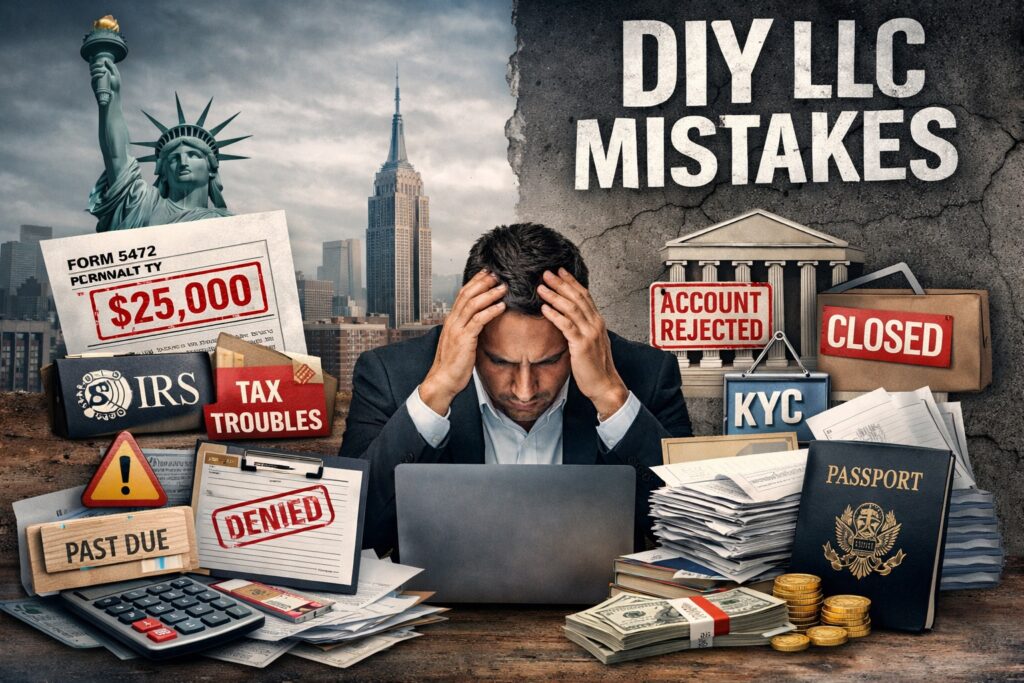
Foreign-owned single-member LLCs that default to disregarded-entity status create a common trap. Even with little or no income, they can have U.S. reporting obligations if there are reportable transactions between the LLC and its foreign owner. The most common example is Form 5472 filed with a pro-forma Form 1120. Missing a required filing can trigger penalties that generally start at $25,000 per year for each required Form 5472, with additional penalties possible if the failure continues after IRS notice.
A typical scenario is straightforward. A German software company forms a single-member LLC online. No one flags the reporting requirements. Two years later, they face $50,000 or more in penalties plus cleanup costs, far exceeding the original “savings.”
Tax consequences begin at formation, not at profitability.
The $25,000 Form 5472 trap
Myth: “My LLC is a disregarded entity, so the IRS disregards it and I do not have to file anything if I do not have profits.”
Reality: “Disregarded” usually means disregarded for certain income tax classification purposes. It does not mean exempt from reporting. If a foreign-owned disregarded LLC has reportable transactions with its foreign owner, Form 5472 with a pro-forma Form 1120 can be required, even in years where the business is not yet profitable. This is one reason DIY structures so often produce expensive surprises.
Banking delays and failed account openings
Banking is where most DIY formations stall.
U.S. banks must identify and verify beneficial owners and control persons, and foreign ownership often increases scrutiny. Banks expect a coherent, bank-ready package that explains who owns the company, who controls it, how money moves, and what the U.S. entity actually does.
Generic operating agreements usually fail here. They often do not clearly establish authority, management control, ownership mechanics, or payment flows. These deficiencies are not fixed at the teller window.
A common outcome is predictable. A foreign company forms an LLC in a “low-cost” state with a template operating agreement, gets rejected by multiple banks, and loses time, deals, or distributors while scrambling to redo documents.
What a bank-ready package should usually include
This is the part DIY filers often do not prepare until a bank tells them “no.” A bank-ready package usually includes the following:
- An operating agreement that clearly establishes ownership, control, and signatory authority
- A beneficial owner and control summary that matches the ownership reality and bank expectations
- EIN documentation and any IRS correspondence needed for onboarding
- Manager and signatory authority documentation, including who can open accounts and move funds
- A short, credible description of U.S. activity and payment flows
- Supporting documents that make the business story easy to underwrite, such as key contracts, invoices, and basic corporate records where appropriate
If you cannot assemble these quickly and cleanly, you should expect delays.
The EIN bottleneck
Foreign owners often discover too late that the EIN process can slow everything down.
The IRS online EIN application is generally limited to applicants whose principal business is located in the United States or U.S. territories. Foreign applicants typically must apply using Form SS-4 by telephone, fax, or mail. Processing times vary and can create meaningful delays, which matters if you need a bank account quickly.
Registered agent missteps
Every LLC needs a registered agent in its formation state. DIY filers often pick the cheapest option without understanding that the registered agent receives legal notices, including service of process.
A low-quality registered agent with poor forwarding practices can mean you miss a complaint deadline or fail to respond to a state notice. Some foreign companies also use a friend’s U.S. address to “help” with banking. This rarely solves banking, can create state registration and tax issues, and can also create inconsistencies in your KYC narrative.
Multi-state and regulatory traps
If you operate outside your formation state, foreign qualification rules can apply. Ignoring them can lead to penalties and weaken your ability to enforce contracts.
Then come regulatory overlays. Data privacy, export controls, food and labeling rules, healthcare, financial services, and other industry-specific regulations can turn a “simple” LLC into a compliance project. Foreign companies often discover these issues only when a bank, customer, or regulator raises them.
Corporate Transparency Act and beneficial ownership reporting
Many foreign founders have heard about the Corporate Transparency Act and beneficial ownership reporting.
The practical takeaway is simple: banks still require robust beneficial ownership and control documentation at account opening, regardless of any government filing requirement. Your KYC package must still work.
Separately, federal beneficial ownership reporting rules and enforcement priorities have changed over time and can continue to evolve. You should confirm current requirements at the time you form an entity or register to do business in a state.
Separate from federal rules, some states have their own transparency or disclosure requirements for LLCs, especially when an entity registers to do business in that state. This is another reason it is rarely “just one form.”
None of this reduces bank scrutiny.
Why your operating agreement is your passport
For foreign-owned LLCs, the operating agreement must do real work.
A cross-border-ready operating agreement typically needs to address remote management authority and signatory control, capital contributions involving international wires and foreign exchange, distributions that account for withholding and home-country tax treatment, transfer restrictions that preserve intended tax classification, and dispute mechanisms you can actually use from abroad.
If your operating agreement is a generic template with no clear authority or ownership narrative, expect banking friction.
The multi-state growth trap
Growth creates nexus. If you succeed, you will add states faster than you expect.
The mistake is choosing a formation state based on marketing and dealing with operations later. Hiring employees, storing inventory, signing contracts, or conducting regular sales activity in another state often triggers registration and state tax obligations. Those obligations do not wait until you feel established.
It is also important to understand what Delaware and Wyoming do and do not do for you. Forming in Delaware or Wyoming rarely solves banking, and it does not eliminate the need to register and comply where you actually operate.
A realistic plan maps likely expansion states early and aligns registrations and tax posture before rushed filings become unavoidable.
DIY online filing versus a strategic setup
DIY online filing usually gives you a state filing and not much else. You often get a generic operating agreement that banks reject, no cross-border tax posture planning, no roadmap for multi-state registration, and no compliance calendar to prevent expensive misses.
A strategic setup is designed to get you banked, compliant, and scalable. It typically includes a bank-ready operating agreement, a clean beneficial ownership and control narrative for KYC, a plan for the EIN process, an approach to Form 5472 and related reporting risks where applicable, and a multi-state plan that matches how you will actually operate.
Here is the comparison in plain terms.
| Feature | DIY online filing | Strategic setup |
|---|---|---|
| Primary goal | Formation filing completed | Banking and compliance-ready setup |
| Operating agreement | Generic template | Bank-ready and cross-border-ready |
| Tax posture | Often not addressed | Designed for cross-border realities |
| EIN planning | Often discovered late | Planned early to avoid delays |
| Multi-state plan | Typically none | Roadmap tied to actual operations |
| Compliance cadence | Ad hoc | Calendar and process from day one |
LLC versus C-corp
DIY formation services let you check a box. They do not help you decide which box to check.
Venture-backed companies often choose C-corps because investors expect that structure. Many other foreign-owned businesses prefer LLCs for flexibility and pass-through treatment that aligns with home-country tax planning. The right answer depends on your tax posture, your investor expectations, and your exit plans. Getting this wrong at formation will usually mean an expensive conversion later.
The real economics
DIY looks cheap at the filing step and expensive everywhere else: banking delays, tax cleanup, penalty exposure, restructuring, and opportunity cost.
Professional formation is predictable. Crisis repair is not, and it is never cheap.
What a proper setup looks like
A proper setup usually starts by choosing an entity type and tax classification aligned with your home-country treatment and business goals. It also includes designing an ownership chain that avoids predictable banking and reporting problems, selecting a formation state based on real operations rather than marketing, drafting a bank-ready operating agreement, securing a reliable registered agent, and planning for the first states you are likely to enter.
A bank-ready package typically includes the operating agreement, beneficial owner and control summaries, EIN documentation, authority resolutions, and a clear description of U.S. activity and payment flows. This is what turns “we will get back to you” into “account approved.”
A good setup also includes an annual compliance calendar and the correct filing posture from the start. For many foreign-owned LLCs, that means identifying whether Form 5472 and a pro-forma Form 1120 apply and putting a process in place so nothing is missed.
A simple reality check
If you need a U.S. bank account quickly, have foreign owners, expect multi-state growth, or operate in a regulated industry, DIY formation is rarely worth the risk. If you are running a low-risk pilot with minimal U.S. activity and no immediate banking needs, DIY might be workable in limited cases, but only after confirming tax and reporting consequences with someone who understands cross-border issues.
United States LLC formation FAQs
¿Puedo constituir una sociedad en Wyoming o Delaware y vender en cualquier lugar sin necesidad de realizar otros trámites?
Puede vender a distancia en otros estados, pero una vez que tenga empleados, inventario, ventas regulares o actividad presencial habitual en un estado, a menudo deberá registrarse allí. Considere la constitución en un solo estado como una solución temporal, no como una estrategia permanente.
¿Necesito una dirección en EE. UU. para constituir una LLC?
No. Se puede constituir una sociedad de responsabilidad limitada (LLC) utilizando una dirección extranjera. No obstante, se necesitará un agente registrado con una dirección física en los Estados Unidos en el estado en el que se constituya la sociedad. Por otra parte, los bancos querrán conocer su actividad en los Estados Unidos y cómo operará la empresa como parte de su proceso de diligencia debida.
¿Puedo ser mi propio agente registrado?
Solo si dispone de una dirección física, no un apartado postal, en el estado de constitución y puede estar disponible durante el horario laboral habitual para recibir notificaciones judiciales y comunicaciones oficiales. Para los propietarios extranjeros, esto rara vez es práctico, por lo que la mayoría recurre a los servicios de un agente registrado profesional.
¿Los bancos siguen exigiendo información sobre los beneficiarios finales?
Sí. Los bancos tienen obligaciones independientes de diligencia debida con respecto a los clientes y exigirán documentación sobre la titularidad real y el control al abrir una cuenta, independientemente de cualquier cambio en los requisitos de información del gobierno.
¿Cuál es la diferencia entre una LLC gestionada por sus miembros y una gestionada por un administrador?
En una LLC gestionada por sus miembros, estos suelen tener autoridad para actuar en nombre de la empresa. En una LLC gestionada por administradores, la autoridad recae en uno o varios administradores designados. En el caso de las LLC de propiedad extranjera, las estructuras gestionadas por administradores suelen aclarar la autoridad bancaria y operativa, especialmente cuando los propietarios se encuentran en el extranjero, pero la elección adecuada depende de quién necesite la autoridad para firmar y de cómo se vaya a gestionar el negocio.
Si mi sociedad de responsabilidad limitada (LLC) de un solo miembro y propiedad extranjera no tiene ingresos, ¿tengo que presentar declaraciones federales?
Posiblemente. Si hay transacciones declarables con el propietario extranjero, incluidas muchas transacciones rutinarias entre empresas, puede ser aplicable el formulario 5472 con un formulario 1120 proforma. Las sanciones por no presentar esta declaración suelen comenzar en 25 000 dólares al año por cada formulario 5472 requerido.
¿Puedo convertir mi LLC en una sociedad anónima de tipo C más adelante si necesito recaudar capital de riesgo?
Sí, pero las conversiones implican trámites legales, fiscales y administrativos, y pueden tener costes reales. Si la financiación de riesgo es una opción realista, suele merecer la pena evaluar una sociedad anónima (C-corp) en el momento de su constitución, en lugar de dar por sentado que se convertirá más adelante.
¿Necesito una cuenta bancaria en EE. UU. o puedo usar una cuenta extranjera?
En algunas situaciones, se puede operar con una cuenta extranjera, pero muchos clientes, procesadores de pagos y socios estadounidenses prefieren o exigen utilizar la banca estadounidense. Si tiene previsto recibir pagos ACH, gestionar nóminas en EE. UU. o pagar a proveedores estadounidenses, a menudo es prácticamente necesario disponer de una cuenta en EE. UU.
¿Puedo utilizar la dirección de un amigo en EE. UU. para realizar operaciones bancarias?
No de forma fiable. Los bancos se centran en la propiedad, el control y la actividad, no en las direcciones postales. Una dirección prestada no soluciona la falta de documentación y puede crear problemas de registro estatal y fiscales que no habías previsto.
¿Cuánto tiempo se tarda en obtener un EIN como propietario extranjero?
Si su actividad principal no se desarrolla en los Estados Unidos ni en territorios estadounidenses, por lo general no podrá utilizar la solicitud de EIN en línea. Las solicitudes por teléfono pueden ser más rápidas, pero solo están disponibles para entidades extranjeras que deseen obtener reconocimiento en los Estados Unidos. Las entidades estadounidenses de propiedad extranjera deben presentar sus solicitudes por fax o correo postal, lo que puede llevar semanas. Planifique el proceso de obtención del EIN antes de comprometerse a facilitar los datos ACH a un cliente estadounidense.
Conclusión
DIY U.S. LLC formation can save a few hundred dollars up front and create five- or six-figure problems later. The failure modes are predictable: tax structures that clash with home-country treatment, operating agreements banks reject, missed filings with $25,000 penalties, and multi-state compliance discovered only when it hurts.
Treat formation as foundational. Get the structure, banking, tax, and compliance plan right at the start and you avoid most of the friction foreign companies face entering the U.S. market.
Ready to do this right?
For a U.S. Market Setup Check, email us three things: your country, your planned U.S. activities for the first 12 months, and whether you need a U.S. bank account before your first invoice. We will respond with a proposed structure, a banking plan, and a U.S. LLC (and/or a C Corporation) quote.