How a Foreign Trademark Application or Registration Can Help You in the United States
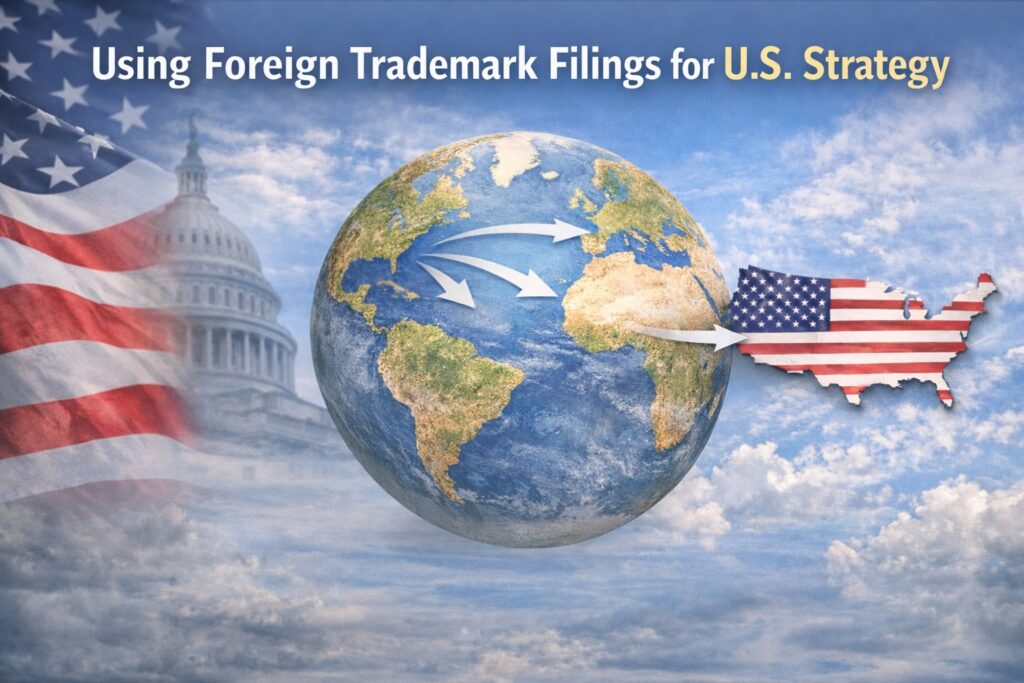
A foreign trademark registration (and even a pending application) can materially strengthen and accelerate U.S. trademark strategy, not just for foreign businesses, but also for American ones that for one reason or another first filed for trademark protection abroad.
For example, a European biotech company files for trademark protection in the EU on March 1st for a new drug brand. Clinical trials will take 18 months before U.S. market entry is possible. Without a foreign filing strategy, a competitor could file in the U.S. during that gap and block the brand. But by filing a U.S. application within six months of the EU filing and later converting to a registration basis once the EU mark registers, the company can secure its U.S. priority date now and complete registration before ever making a U.S. sale.
Used correctly, a foreign filing can let you claim an earlier priority date in the United States and, with a qualifying foreign registration, obtain a U.S. registration without proving U.S. use before the mark registers.
This strategy is most useful when you plan to launch in the U.S. later, when regulatory approvals or compliance steps delay U.S. sales, when distribution or manufacturing timelines make early U.S. use unrealistic, or when you need to defend a brand against copycats while you build the market. In those situations, a well-timed foreign filing can preserve priority and, in the right case, allow U.S. registration before U.S. use.
Section 44(d): Claiming Foreign Priority in the U.S.
Section 44(d) of the U.S. Trademark Act can give you an earlier priority date in the United States, but it does not, by itself, get you a U.S. registration. To actually register, you still need a separate registration basis, which usually means either your foreign application later becomes a foreign registration so you can amend to Section 44(e), or you begin using the mark in U.S. commerce and amend to a Section 1(a) use based filing.
Say you file an EU trademark application on January 1, 2026. An unrelated party then files an application to register the same mark in the United States on January 15. By availing yourself of Section 44(d), you can claim priority over that January 15 application in the United States.
Employing Section 44(d) can be decisive in priority disputes, blocking later-filed U.S. applications, and avoiding intervening filings by competitors.
Key limitations
-
The priority claim applies only to the same mark and the same goods and services as in the foreign application (read on for more on this).
-
Section 44(d) gives you priority, but there must be a valid basis for registration.
Section 44(e): Registering in the U.S. Based on a Foreign Registration
Section 44(e) allows a foreign applicant to obtain a U.S. registration based on an existing foreign registration, without showing use in U.S. commerce at the time of registration. While 44(e) can complement a 44(d), it can also be invoked independently.
For example, taking the example above, say that you decide to seek U.S. protection on August 1. By that point, more than six months have elapsed since the EU application, meaning the U.S. application cannot be filed on a 44(d) basis (and that priority on the basis of the EU application cannot be claimed).
However, if by that date the trademark has been registered in the EU, you can file on a 44(e) basis. While this will not provide any advantages versus any earlier filings, it can still be of immense help, by eliminating the requirement to use the trademark in the United States before it can be registered.
This can be particularly valuable for companies that are expanding into the U.S. market, want protection before launch, or face regulatory or logistical barriers to early U.S. use.
NOTE: While use of the trademark is not required to complete the registration, going forward the use requirements will be the same as for other U.S. registrations. This means that a Declaration of Use must be filed (accompanied by proof of use) between the fifth and sixth anniversaries of registration, and then to renew the registration between the tenth and eleventh anniversaries of registration (and every 10 years henceforth).
The Goods & Services Problem (Where Things Get Painful)
Here is where many otherwise solid applications go off the rails.
The USPTO requires highly specific, USPTO-compliant identifications of goods and services. Many foreign trademark systems do not, instead allowing broad class headings, or more general descriptions than those allowed in the United States.
For example, "computer software" is a perfectly acceptable identification in many countries, but it is not in the United States, where an acceptable identification would be "downloadable credit screening software" or "recorded speech recognition software".
Converting foreign goods and services into USPTO-compliant language can be surprisingly complex and deeply frustrating. This is one of those areas that looks easy—until it isn't.
Also, as a practical matter, if you want to include additional goods and services to those included in the foreign application/registration, 44(d)/(e) won't work. The only way to expand the scope on the U.S. application is to file under a regular basis (actual use (1(a)) or intent-to-use (1(b)).
Other Potential Hitches
It must also be noted that, to avail yourself of 44(d) and 44(e), the U.S. applicant must be the same party that owns the foreign application or registration. This can be an issue if you want ownership of the U.S. trademark to belong an affiliate or subsidiary. In these cases, one option is to keep the same owners during the registration process and then assign the U.S. registration to the desired owner.
Moreover, the mark must be the same. This can be an issue for brands that have refreshed their logo since the time of the foreign filing. In these situations, it might make sense to explore whether an amendment of the foreign record is possible and/or filing a new foreign application before filing the U.S. application.
Documentation and Translation: More Than Just the Certificate
A Section 44(e) application requires submission of a copy of the foreign registration. Foreign registrations that aren't in English must be translated.
Critically, the goods and services must also be translated, even if they do not appear on the face of the registration certificate. This may require translation of a separate document, such as the entry in the relevant country's trademark database.
PRO TIP: If you're a fellow practitioner, note that dates on foreign registration certificates may reflect different calendars, such as the Islamic calendar or the Republic of China calendar used in Taiwan. These dates must be converted to the Gregorian calendar when providing dates to the USPTO.
A Note on Section 66(a) (Madrid Protocol)
The Madrid Protocol (Section 66(a)) also allows foreign registrations to extend to the U.S., but it operates under a different procedural framework and comes with its own risks and constraints.
For more information, see our earlier post, International Trademark Registration: A Step-by-Step Guide to the Madrid System (2025).
En resumen
A foreign trademark application or registration can be a powerful asset in securing U.S. trademark rights—but only if it is used strategically and executed correctly.
Sections 44(d) and 44(e) offer real advantages, but they also demand careful handling, especially when it comes to goods and services and supporting documentation. What looks like administrative detail can quickly become the most difficult—and costly—part of the process.
If you're relying on a foreign filing to support a U.S. trademark application, it pays to get it right the first time.
FAQ: Using Foreign Trademark Filings to Strengthen a U.S. Application
¿Cuál es la diferencia entre la sección 44(d) y la sección 44(e)?
La sección 44(d) le permite reclamar una fecha de prioridad anterior en los Estados Unidos basándose en una solicitud extranjera presentada en los últimos seis meses. La sección 44(e) es una base independiente para el registro que se basa en un registro extranjero existente y puede permitir el registro en los Estados Unidos sin necesidad de demostrar el uso en los Estados Unidos en el momento de la emisión del registro estadounidense.
¿Necesito un registro extranjero para utilizar el artículo 44(d)?
No. La presentación 44(d) se basa en la solicitud extranjera, no en un registro extranjero. Pero la 44(d) por sí sola no es suficiente para obtener el registro. En la mayoría de los casos, se modifica posteriormente a la 44(e) una vez que se emite el registro extranjero, o se modifica a la Sección 1(a) después de comenzar a utilizar la marca en el comercio estadounidense.
¿Qué ocurre si no cumplo el plazo de seis meses para la cláusula 44(d)?
No puede reclamar la prioridad con respecto a la fecha de presentación en el extranjero en virtud del artículo 44(d). Aún puede presentar la solicitud en virtud del artículo 44(e) si ya se ha expedido el registro extranjero, o puede presentar la solicitud en virtud de las bases habituales de los Estados Unidos, como la intención de uso del artículo 1(b).
¿Puede una empresa estadounidense acogerse al artículo 44?
Sí. La sección 44 no se limita a las empresas extranjeras. Un solicitante estadounidense puede acogerse a la sección 44(d) o 44(e) si es titular de una solicitud o registro extranjero que cumpla los requisitos y cumple los requisitos aplicables en virtud del tratado.
¿Puedo ampliar mis productos y servicios estadounidenses más allá de la presentación en el extranjero?
No, si desea basarse en los apartados 44(d) o 44(e) para esos elementos adicionales. La solicitud estadounidense debe incluir los productos y servicios cubiertos por la solicitud o el registro extranjero. Si necesita una cobertura más amplia, normalmente se deben presentar los productos y servicios adicionales en virtud de los apartados 1(a) o 1(b), a menudo en una solicitud estadounidense independiente.
¿Por qué la USPTO rechaza mis productos y servicios cuando la oficina extranjera los aceptó?
Porque la USPTO exige identificaciones más específicas y redactadas con mayor precisión que muchas oficinas de marcas extranjeras. Los términos generales y los encabezados de clase que son aceptables en el extranjero suelen suscitar objeciones en los Estados Unidos. «Software informático» es un ejemplo común que suele ser demasiado vago para la USPTO sin más detalles.
Si obtengo un registro en EE. UU. en virtud del artículo 44(e), ¿tengo que utilizar la marca en EE. UU. en algún momento?
Sí. Puede obtener el registro sin demostrar el uso en EE. UU. en el momento del registro, pero aún así debe mantener el registro mediante las presentaciones de mantenimiento habituales basadas en el uso en EE. UU., incluida una Declaración de uso entre el quinto y el sexto año después del registro y las presentaciones de renovación al décimo año y cada diez años a partir de entonces.
¿Me protege el artículo 44(d) contra alguien que utilice la marca en los Estados Unidos antes de que yo comience a utilizarla?
Puede ser muy útil en disputas sobre prioridad ante la USPTO, ya que puede proporcionarle una fecha de presentación efectiva más temprana. Sin embargo, no es una protección completa contra todos los conflictos del mundo real. Dependiendo de los hechos, el uso real en el mercado y otras doctrinas legales pueden seguir siendo importantes. Si existe un conflicto grave, este es el momento en el que debe buscar asesoramiento rápidamente.
¿Puede el solicitante estadounidense ser una entidad diferente al solicitante extranjero?
Por lo general, no. Para acogerse a los apartados 44(d) o 44(e), el solicitante estadounidense debe ser, por lo general, la misma parte que posee la solicitud o el registro extranjero. Si, en última instancia, desea que una filial diferente sea la titular de los derechos en Estados Unidos, un enfoque habitual consiste en mantener la titularidad alineada durante el proceso de solicitud y registro y, a continuación, registrar una cesión posterior al registro, teniendo cuidado de no crear problemas de cadena de titularidad.
¿Puedo utilizar el artículo 44(d) o 44(e) si mi logotipo ha cambiado después de la presentación en el extranjero?
Solo si la marca es sustancialmente la misma. Las pequeñas actualizaciones no sustantivas pueden ser aceptables, pero los rediseños significativos no suelen serlo. Si la marca ha cambiado, la solución más clara suele ser presentar una nueva solicitud para la marca actualizada, en lugar de intentar adaptar la antigua.
¿Qué documentos necesito realmente para el 44(e)?
Necesitará una copia del registro extranjero y, si no está en inglés, una traducción al inglés. En muchos casos, también necesitará una traducción o una copia de la inscripción en el registro extranjero en la que figuren los productos y servicios, ya que es posible que el certificado por sí solo no incluya una identificación completa.
¿En qué se diferencia la sección 66(a) de la presentación directa en virtud de la sección 44(e)?
La sección 66(a) es la vía del Protocolo de Madrid, en la que se amplía un registro internacional a los Estados Unidos en lugar de presentar una solicitud directa en ese país. Puede ser eficaz para la protección en varios países, pero tiene sus propias normas de procedimiento y puede ser menos flexible para determinados cambios o correcciones. No es automáticamente mejor ni más fácil, sino que se trata simplemente de un sistema diferente con distintas ventajas e inconvenientes.