






China Counterfeits: How to Stop Knockoffs and Protect Your Brand
You find your product on Alibaba at half your price. The seller is using your photographs and brand name, and the product looks almost identical to yours. Then you notice something worse: the seller appears connected to the Chinese factory making your legitimate products.
Start by preserving the evidence, identifying what has been copied and what intellectual property rights you own, and investigating who is behind the sales. From there, decide where you have the most leverage. Depending on the problem, that may mean a marketplace takedown, action against the factory, Customs enforcement, pressure on an importer, litigation, or some combination.
Companies in the strongest position usually laid much of this groundwork before the counterfeit appeared. They registered important trademarks, protected sensitive information before giving it to prospective factories, signed strong manufacturing agreements, and secured IP rights in the markets that matter to their business.
In 2025, China Customs reported detaining 86.42 million items suspected of infringing intellectual property rights and assisting rights holders from 57 countries and regions. Cross-border e-commerce accounted for more detained batches than any other enforcement channel, reflecting how easily counterfeit products can move from Chinese sellers to customers around the world. China Customs Enforcement Data
First Figure Out What Has Actually Been Copied
Businesses use "counterfeit," "knockoff," "fake," and "copy" loosely. For enforcement purposes, those terms can hide important differences.
A competitor can copy the shape of your product without using your trademark. A seller can steal your product photographs while selling something different. Your factory can make unauthorized versions of the genuine product using your tooling and specifications. Each situation can implicate different trademark, copyright, patent, trade secret, or contractual rights.
Alibaba itself separates complaints involving trademark, copyright, patent, and certain other forms of infringement. Alibaba IP Protection Rules
Choose the enforcement route after identifying the right you can actually assert. Companies waste time and money when they begin with the remedy they want rather than the rights and evidence they have.
What to Do When You Find a China Counterfeit
Many companies want to contact the seller or factory immediately and demand that the infringement stop. That can work, but it can also alert the other side before you have preserved the evidence or worked out where the products are coming from.
Preserve the Evidence
Save the listing, screenshots, URL, seller information, and anything that ties the account to another company or marketplace. Do this before contacting the seller or factory because listings disappear, stores change names, and accounts close and reopen under new identities.
Where the stakes justify it, consider buying the product. The item and its packaging can reveal shipping information, manufacturing details, quality differences, and other clues that screenshots will not.
Work Out What IP You Own
Pull together the trademarks, copyrights, patents, design rights, and relevant contracts. Confirm who owns each right, where it is protected, what it covers, and whether the registration remains valid.
This review often exposes problems that should have been fixed earlier: the founder still owns the trademark personally, no China trademark was filed, the patent covers an older product version, or the photographer rather than the company owns the product images. A counterfeiting dispute is a bad time to untangle ownership of the rights you need to enforce.
Investigate the Seller and Supply Chain
The marketplace account may be only the visible end of the problem. Look for connections to your current or former factory, sourcing agent, subcontractors, and importers.
Chinese company records and other investigative sources can reveal ownership, related businesses, litigation, and useful connections among the companies involved. We have repeatedly seen counterfeit investigations lead back into a client's legitimate supply chain. A takedown removes one listing; finding the source can shut down a much larger stream of unauthorized goods.
Decide What Result Matters
A company preparing for a product launch may need listings removed quickly. Another may care much more about stopping its own factory from producing unauthorized units. A third may need to keep counterfeit goods out of the United States even though it has little interest in sales inside China.
Start with the commercial harm and work backward to the enforcement route most likely to stop it. A legally available remedy can still be a poor use of money if it leaves the underlying business problem untouched.
Register Your China Trademark Early
For most branded products, China trademark registration remains one of the most useful parts of a China counterfeit strategy.
China's trademark system generally gives priority to the first applicant. Chinese law provides limited protections for certain prior rights, prior users, and bad-faith registration situations, but foreign use by itself does not put a company in the same position as an early China filing.
For foreign companies, delay can become expensive. Recovering a brand from a bad-faith registrant is usually harder and more uncertain than filing before the dispute begins.
We saw the consequences in a matter involving a Canadian coat manufacturer. A Chinese company had registered the Canadian company's brand and then complained to China Customs, which detained a major shipment of the legitimate company's products. The Canadian company wanted to sue over what it viewed as the theft of its trademark, but its practical options were poor. We eventually negotiated a purchase of the mark, leaving the company to choose between rebranding and paying a six-figure amount to recover its own name. It paid. China Trademark Registration: How to Stop Squatters from Stealing Your Brand
China registration also affects marketplace enforcement. Alibaba states that its domestic Chinese platforms, including Taobao, generally process takedown requests based on China-registered IP rights, while international platforms such as Alibaba.com and AliExpress can accept rights from other jurisdictions. Alibaba IP Protection Rules
A company can therefore need a China trademark even if it never plans to sell to Chinese consumers. Its customers may be in California or Madrid while the factory, seller, listing, and shipment all sit in China.
China's Revised Trademark Law Takes Effect in 2027
China adopted a revised Trademark Law on June 26, 2026. It takes effect January 1, 2027, and existing registrations remain valid. CNIPA on the Revised Trademark Law
Companies making filing or enforcement decisions that extend into 2027 should account for the revised law. For most brand owners, the immediate advice remains the same: file early enough that you are not forced to fight someone else for your own mark later.
Protect Against Counterfeiting by Your Chinese Factory
Many companies picture a counterfeiter as an unrelated factory that reverse-engineers a successful product from an Amazon listing. Your legitimate manufacturer can present a more immediate risk because it already has the production files, tooling, specifications, and supplier network needed to make the product. It may also know your customers and distributors. That access is why factory protection needs to begin before production.
Use an NNN Agreement Before Disclosing Sensitive Information
A China-focused NNN Agreement generally addresses non-disclosure, non-use, and non-circumvention. For counterfeit prevention, the agreement should restrict the Chinese counterparty from using your product information or business relationships for its own benefit and provide workable remedies if it does.
The agreement is most useful before a prospective manufacturer receives the drawings, technical files, prototypes, or other information it would need to copy the product.
The identity of the signing party matters too. If a mainland Chinese factory will receive the sensitive information, you generally want that factory bound. An agreement signed only by a Hong Kong intermediary or trading company does not automatically bind a separate mainland manufacturer.
One of our matters illustrates the risk. The client's contract was with its Hong Kong sourcing company, but the mainland factory manufactured the product and held the CAD files. The factory had never signed the agreement. It later opened a second production line for a competitor, leaving the client with contractual rights against the intermediary but no direct contract with the company engaged in the unauthorized production. The RedNote Contract Lesson for Companies Doing Business in China.
Follow the NNN Agreement with a Manufacturing Agreement
Once you select the manufacturer, a China manufacturing agreement should govern the production relationship. For counterfeit prevention, the critical provisions usually concern product specifications and quality, IP and tooling, subcontracting and unauthorized production, and the remedies available when the factory breaches.
A small electronics company we represented discovered that its Chinese factory was selling the company's products online at substantially lower prices. The client already had a China-specific manufacturing agreement and a registered China trademark. Those rights gave us leverage. We sent a cease-and-desist letter based on the contract and trademark, and the factory stopped the online sales and agreed to comply with the manufacturing agreement. The Growing Threat of Chinese Factory Competition, and How to Fight Back
Manufacturing contracts should deal expressly with unauthorized production and sales because problems extend beyond obvious factory overruns. Rejected goods can enter the market, tooling can be used for another customer's order, and undisclosed subcontractors can start making competing products.
Trademark rights, pre-production protections, and manufacturing contracts work at different points in the relationship. Proprietary and branded products often justify protection at more than one level.
Use China Customs to Stop Counterfeit Exports
Marketplace takedowns address advertisements and sales channels. If infringing goods are leaving China, border enforcement deserves separate consideration.
China Customs protects qualifying trademark, copyright and related rights, and patent rights involving import and export goods protected under Chinese law. Rights holders can record eligible IP with China Customs to facilitate enforcement. China Customs IP Protection
Customs can stop the shipment itself, giving companies another option when takedowns merely disrupt individual sellers. Customs recordation will not make sense for every business, but companies facing recurring counterfeit exports should examine whether border enforcement can stop the goods closer to their source rather than repeatedly removing advertisements after the goods have entered distribution.
Protect Your IP Where the Counterfeit Goods Are Going
Chinese IP rights give you enforcement options in China. Businesses also need protection in markets where counterfeit products are being sold.
For goods entering the United States, owners of registered U.S. trademarks and copyrights can record those rights with U.S. Customs and Border Protection through CBP's e-Recordation system. CBP continues to treat intellectual property enforcement as a priority trade issue. U.S. Customs IP Enforcement
Companies doing substantial business in the European Union, Australia, Mexico, or other important markets should likewise examine the IP protection and border remedies available there. A China registration can help near the factory and exporter, while destination-market rights create additional opportunities to stop counterfeit goods before they reach customers.
How Alibaba Counterfeit Takedowns Work
Alibaba operates an Intellectual Property Protection Platform, commonly called the IPP Platform, for rights holders and authorized representatives. It covers Taobao, Tmall, Tmall Global, 1688.com, Alibaba.com, and AliExpress. Alibaba IPP Instructions
A complainant generally establishes its identity and IP ownership, identifies the infringing listings, and submits evidence supporting the complaint. Once Alibaba verifies the relevant identity and IP documents, they can generally be used for later complaints while the rights remain valid. Counterfeit sellers often return under new accounts, so reusing verified documentation can save time.
Do You Need a China Trademark for an Alibaba Takedown?
It depends on the platform. Alibaba says its Chinese domestic platforms generally rely on China-registered IP rights for takedown requests, while international platforms such as Alibaba.com and AliExpress can accept international IP rights. Alibaba IP Protection Rules
A U.S. trademark registration therefore does not produce the same enforcement position throughout the Alibaba ecosystem. The platform where the infringement appears and the jurisdiction of the underlying IP right both matter.
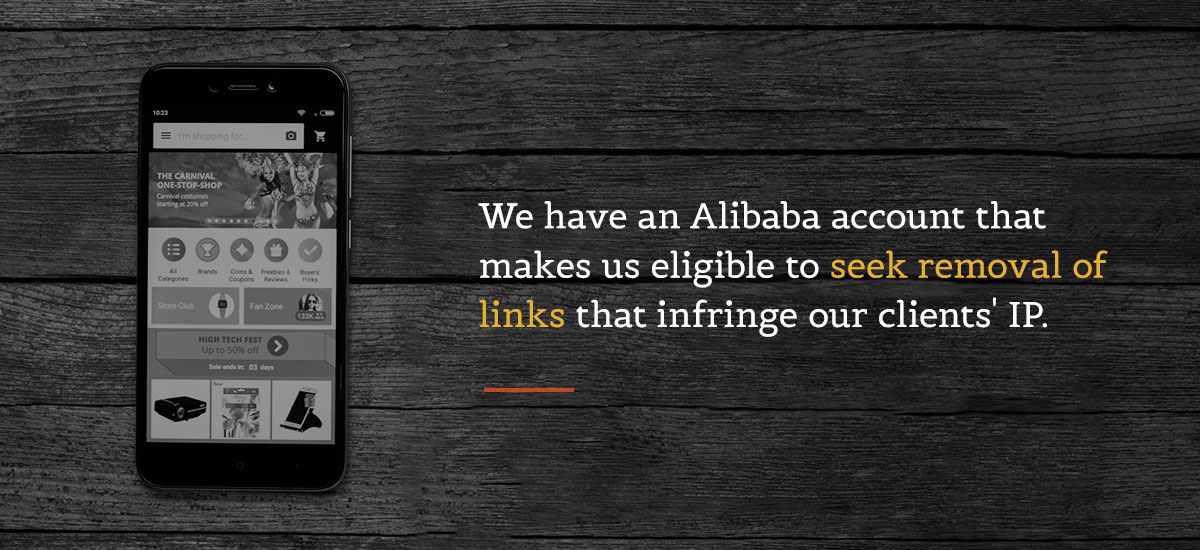
Our law firm has an Alibaba account that makes us eligible to seek removal of links that infringe our clients' IPs. We do this by submitting the following:
- Our client's “business license”
- Any formal IP registration documents
- Sometimes, a POA signed by the client authorizing us to file the complaints on their behalf
- IP registration number(s)
- Title of IP
- Name of the IP owner
- Type of IP
- Country of registration
- Time period during which the IP registration is effective
- Time period during which the IP owner wishes to protect their IP rights
Once Alibaba verifies the provided information, we provide the infringing links. Alibaba almost always removes the listings fairly quickly afterward.
Can You Use an Unregistered Copyright?
Alibaba's current instructions permit a claimant asserting an unregistered copyright to submit a Copyright Claim Statement as evidence of ownership. Alibaba IPP Instructions
This can help when a seller copies product photography, packaging artwork, or other copyrightable material before the owner obtains a formal registration. Formal registration can matter greatly for remedies outside the platform, but its absence does not necessarily prevent an Alibaba takedown.
What If the Seller Challenges the Complaint?
Alibaba permits sellers to submit counter-notices and can review the evidence from both sides before deciding whether a listing stays down. Alibaba IPP Instructions
Treat the complaint as an IP enforcement submission rather than an angry customer-service report. Establish ownership, identify the correct right, and give the platform enough evidence to see the infringement.
If the Listings Keep Returning, Follow the Supply Chain
Alibaba is only one part of the counterfeit market. The same product can surface on Chinese platforms, international marketplaces, social-commerce channels, and independent websites.
When similar listings keep returning after repeated takedowns, investigate whether one manufacturer, wholesaler, or trading company is supplying the sellers. Test purchases, packaging, company records, and shipping information can reveal connections that are invisible from the listing itself.
Look Upstream at the Factory
Your legitimate factory already has the tooling, production instructions, component sources, and quality standards necessary to reproduce the product. Extra production requires far less work than it would for an unrelated counterfeiter, and transferring the production package to a related factory can be easier still.
If your manufacturer is feeding the counterfeit market, the contracts signed before production can become important enforcement tools alongside trademark, copyright, trade secret, or other IP rights.
The objective is not to win a permanent game of whack-a-mole. It is to find the entity feeding the moles.
Look Downstream at the Importer
A U.S. importer or distributor may have inventory, records, and assets within reach of a U.S. court. It may also have enough influence over the Chinese supplier to change what happens upstream.
Depending on the facts, pressure on an importer through a cease-and-desist letter, litigation, Customs action, or marketplace enforcement can disrupt more of the supply chain than another complaint against an overseas seller. Geography should be one factor in choosing a target, along with collectability, available remedies, commercial importance, and the defendant's ability to stop the conduct.
When Does Counterfeit Litigation Make Sense?
Litigation makes sense when the commercial damage, evidence, defendant, and available remedies justify the cost. Before filing, consider what a favorable result would accomplish and whether the defendant has assets or business operations against which relief can realistically be enforced.
Depending on the facts, the available routes can include litigation or administrative enforcement in China, U.S. claims against parties involved in importing or distributing the products, and proceedings before the U.S. International Trade Commission.
Section 337 Can Stop Infringing Imports at the U.S. Border
For substantial U.S. import disputes, Section 337 of the Tariff Act can be useful. Section 337 investigations commonly involve IP claims concerning imported products, and the U.S. International Trade Commission can issue exclusion orders directing U.S. Customs to stop infringing goods at the border. The Commission can also issue cease-and-desist orders in appropriate cases. U.S. International Trade Commission Section 337
Section 337 is a formal federal administrative proceeding with its own substantive and procedural requirements, including domestic-industry requirements for many IP-based claims. Its expense and complexity generally make it suitable only for disputes with enough commercial value to justify the process.
For the right dispute, stopping infringing products before they enter the United States can be worth far more than chasing sellers after the goods have entered the market.
Anger Is Not a Counterfeit Strategy
Companies that discover copied products often want to pursue everyone involved. Enforcement still has to make economic sense.
Years ago, I went into an art gallery in Hanoi and saw a painting I loved for around $4,500. Later that day, I saw copies of the same painting selling for about $50. I bought the original, which still hangs in my office.
The $50 version never tempted me because I wanted the original. The buyer looking for a $50 copy was probably never going to become a $4,500 customer of the gallery.
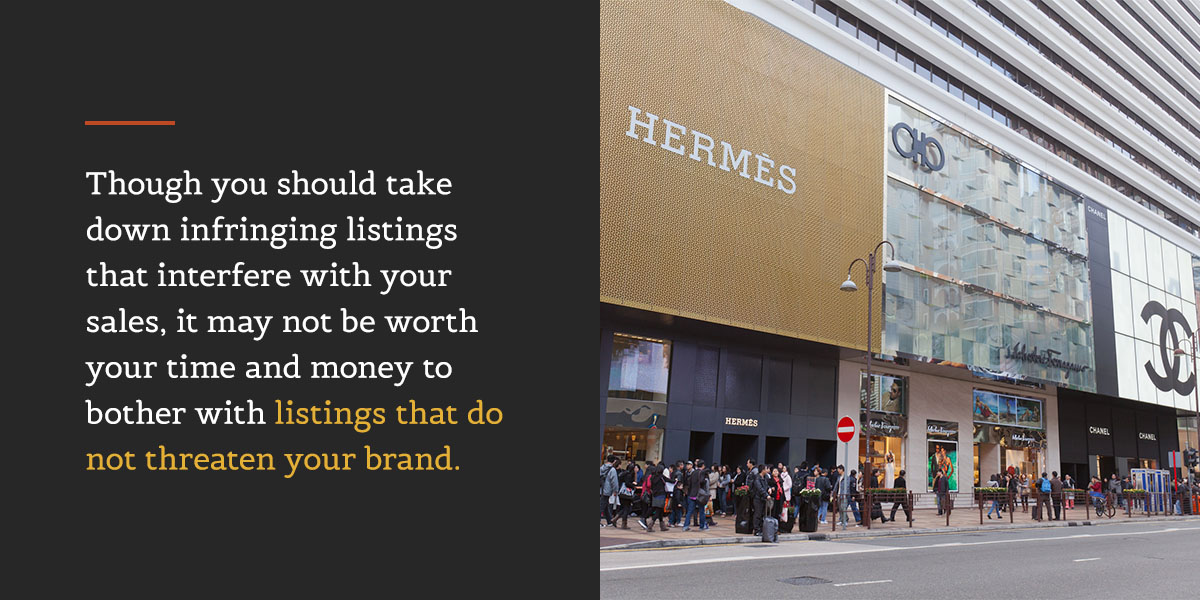
Counterfeits can confuse customers, damage a brand, and undermine important sales channels, but the commercial impact depends heavily on what is being copied, where it is being sold, and who is buying it. Unauthorized production from your own factory being offered to a major distributor deserves a different level of attention from a cheap imitation being sold into a market where you have no customers.
Being right is not the same as having a case worth spending money on.
Common China Counterfeit Questions
Do I Need a China Trademark If I Do Not Sell in China?
Often, yes. Your customers may be in California or Madrid while the factory, seller, and shipment are all in China. A China registration can give you enforcement options close to the source and can also affect your ability to pursue takedowns on Chinese domestic platforms.
The decision should turn on your manufacturing and counterfeit exposure in China, not just where your customers live.
Can I Sue a Chinese Counterfeiter in U.S. Court?
Sometimes, if a U.S. court has jurisdiction and the facts support a U.S. claim. The practical question is whether a U.S. judgment or injunction would accomplish anything.
If direct enforcement against the Chinese defendant offers little practical value, an importer, border remedy, or Section 337 proceeding may provide a better route.
How Much Should I Spend Fighting a China Counterfeit?
Base the budget on the commercial harm and the likelihood that a particular enforcement step will stop it. A recurring factory overrun entering one of your core markets can justify substantial enforcement, while a low-value knockoff aimed at customers you were unlikely to reach may justify very little.
Build the Enforcement File Before You Need It
Counterfeit enforcement is easier when the legal groundwork already exists. Companies manufacturing or sourcing from China should know who owns their important IP, register the trademarks that matter, and put appropriate protections in place before sensitive information, tooling, or production responsibility passes to a factory.
The same preparation should extend beyond China when important sales markets are at risk. Destination-market IP protection, Customs recordation where appropriate, and clean ownership records for trademarks, photographs, designs, and other assets can reduce the time and expense required to act when a counterfeit appears.
When that happens, preserve the evidence and trace the supply chain before spending heavily on enforcement. Ask where your existing rights give you enough leverage to stop the commercial harm. A strategy that reaches the source of the problem will usually accomplish more than one that simply chases the sellers you can see.