







China Manufacturing Risks: When Your Reliable Supplier Stops Being Reliable
Not long ago, a Midwest furniture company wired $800,000 to a Chinese factory it had worked with for nearly 20 years. The furniture never arrived. The factory shut down, its owner disappeared, and the company was left with little realistic prospect of recovering its money. Our international manufacturing lawyers are seeing a troubling increase in problems like this one. More companies are coming to us because their factories have stopped delivering products, demanded unexpected payments, substituted inferior materials, or vanished with their customers' money. We are also seeing more intellectual property disputes and more Chinese manufacturers taking aggressive positions against their foreign customers.
We have represented foreign companies that manufacture in China for decades, and we have warned about these problems on our China Law Blog for nearly as long. Some of the world's best manufacturers are Chinese, and many foreign businesses have built successful, profitable relationships with them. But we now hear much more often from companies whose previously reliable Chinese manufacturers have suddenly become unreliable, sometimes disastrously so, often before the customer realizes how much has changed. I believe much of this is connected to the financial pressure facing Chinese factories, and supplier financial distress worries me more today than it did several years ago. Weak consumer spending, falling property values, industrial overcapacity, and relentless price competition have squeezed profits across significant parts of China's manufacturing economy. Some factories under that pressure now take risks they would once have avoided.
The Problems We Are Seeing with Chinese Manufacturers
Factories Taking Deposits and Failing to Deliver
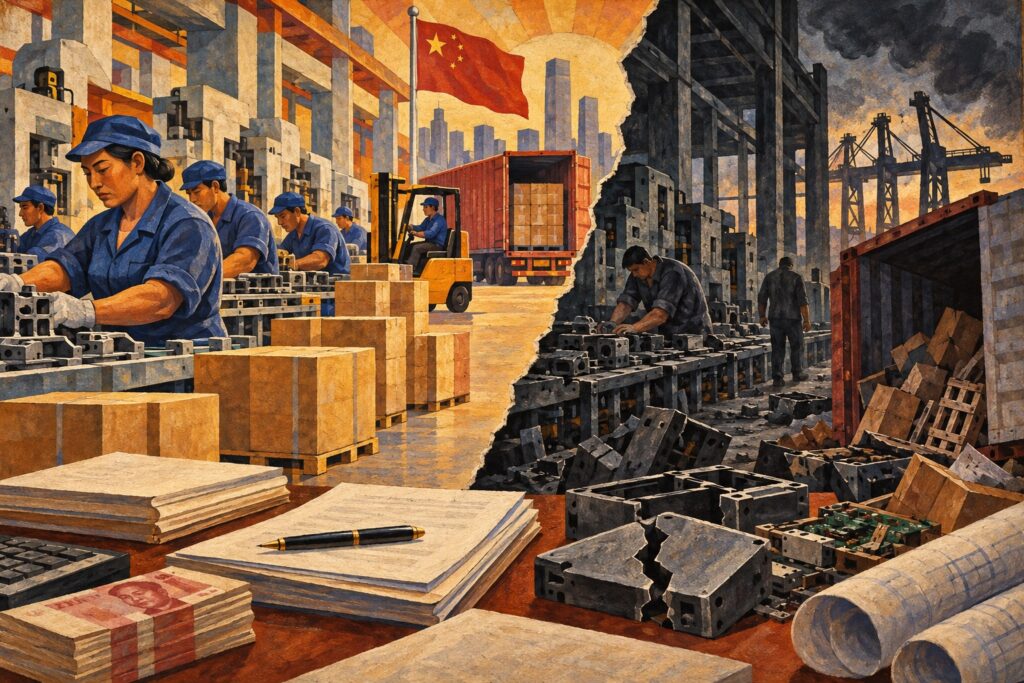
One of the worst problems we see involves companies paying substantial deposits to Chinese manufacturers and receiving no products. A factory runs out of working capital, has trouble paying its own suppliers, or uses a new customer's deposit to cover obligations from earlier orders. Some of these factories shut down before production is finished, and in other cases the factory appears never to have intended to fill the order. Sometimes something does ship, and it is worthless. In our "bricks for fish" case, a buyer drawn in by an attractive price paid a Chinese company for a container of fish. When the container was unloaded in Seattle, the top layers held old, unusable fish, and the rest was broken bricks packed to match the shipment's expected weight. The delay in discovering the bricks gave the seller time to dissolve and disappear, but not before it had cheated several other buyers. We call the broader pattern "bricks for products," in which a factory or trading company takes one last payment before it shuts down or vanishes. We describe its warning signs in The Ultimate Guide to Avoiding International Scams Targeting Businesses.
Foreign buyers increasingly discover a supplier's financial problems only after a shipment is missed, an unexpected payment is demanded, or communications suddenly stop. This is why I get nervous when a company tells me it does not need to investigate its Chinese supplier because it has worked with that supplier for ten years. The furniture company had worked with its factory for nearly twice that long. A factory that was financially healthy three years ago can be struggling today, and years of successful dealings tell you surprisingly little about whether that supplier can meet its obligations now.
Unexpected Price Increases and Demands for More Money
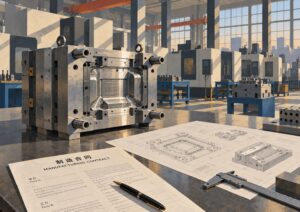
Chinese manufacturers are also taking harder positions on pricing, and they push hardest when they know their foreign customers have limited alternatives. A factory losing money on an order can legitimately try to renegotiate its price. The situation becomes much more serious when the manufacturer has already accepted payment, committed to production, or taken possession of its customer's tooling, and then refuses to perform without more money. In our article, China Manufacturing Contracts: When One Agreement Is Not Enough, we describe an American company whose Chinese manufacturer demanded a 34% price increase. The factory had the customer's molds, its designs, and access to its customer information, and the company's existing contract did not provide sufficiently clear protections or remedies. The manufacturer had the upper hand because the American company needed its products and could not easily move production elsewhere. I see companies get themselves into these situations by letting a Chinese manufacturer control virtually everything needed to make their products, without giving much thought to what happens if the relationship goes bad. Once a factory controls your molds and designs and you have customers waiting for products, your negotiating position can become very weak.
Declining Quality and Unauthorized Material Substitutions
We have long warned companies that manufacturing quality must be established and verified, and financial pressure makes this even more important. A factory trying to protect its margins has a powerful incentive to cut costs, and legitimate efficiency is not the only way to do it. We see manufacturers substitute cheaper materials, change components, reduce testing, or subcontract production without telling their customers. A product can look almost identical to the approved sample and perform very differently because the factory changed an important component or material. The foreign buyer often discovers the problem only after the goods have shipped and been paid for. For products involving electrical safety, batteries, chemicals, food contact, or other regulated categories, these substitutions can create liability far beyond the cost of the defective goods. Foreign buyers need clear specifications, meaningful inspection rights, appropriate testing, and effective contractual remedies for when the factory delivers something different from what was ordered. Relying on a supplier's assurances is especially foolish when that supplier is under pressure to cut costs.
Factories Misusing Their Customers' Intellectual Property
A factory sometimes decides it can make more money selling its foreign customer's products than making them. We have warned about this for years (see Your China Factory as Your Toughest Competitor). Once a manufacturer has its customer's designs, specifications, production methods, and tooling, it is already well positioned to compete with that customer. A struggling manufacturer looking for more revenue has one more reason to exploit those assets. We have seen manufacturers produce unauthorized products, sell competing goods, and use customer information for their own commercial benefit. These disputes get much harder when the foreign buyer has not properly registered its intellectual property in China or set clear contractual limits on how the factory can use its information and tooling.
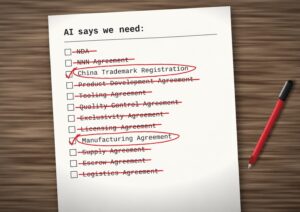
Trademark problems present a related danger. A manufacturer or a related third party that registers a foreign company's mark in China can create serious obstacles to that company's business, including disputes over exports and over use of its own brand. China generally follows a first-to-file trademark system, subject to important protections against certain bad-faith filings. Register your valuable trademarks in China early, preferably before you disclose them to potential manufacturers. Our China Trademark Registration: The Complete Guide for Foreign Companies covers the process, and China NNN Agreement or Trademark Registration? Usually Both explains the difference between trademark registration and contractual protection.
Sinosure Collection Demands
Our firm has handled more than 100 matters involving Sinosure, China's state-owned export credit insurer, and many of them grow out of the factory problems described above. A struggling factory ships defective goods or no goods at all, the foreign buyer refuses to pay in full, and the factory files a claim under its Sinosure policy. If Sinosure pays the factory, it then comes after the buyer. The supplier's claimed debt is not necessarily valid simply because Sinosure or its representatives are pursuing it. We have handled claims involving disputed quality, questionable documentation, and, in some instances, transactions that appeared to have been fabricated. I have seen companies make their Sinosure problems considerably worse by ignoring demands or by admitting liability before examining the underlying transaction. Neither is a good idea. We discuss these problems in Sinosure: The Complete Guide for Foreign Buyers.
China's Economic Problems Are Becoming Your Problems
Back in 2012, I wrote a Wall Street Journal article, China's Slowdown and American Business, on what foreign companies were running into as China's economy weakened. Its subtitle was "Hardly a week goes by without complaints about payment problems or bankrupt debtors." Fourteen years later, I am seeing many of the same problems, along with some new ones.
The current slowdown is particularly dangerous for foreign buyers because it combines weak domestic demand with intense manufacturing competition. Chinese households have watched their property values fall, many worry about their jobs and finances, and consumer spending remains weak. In October 2026, Reuters reported that Chinese retail sales had increased just 1.1% in September, even as exports surged. The International Monetary Fund's February 2026 assessment of China's economy identified weak domestic consumption, the prolonged property slump, and China's limited social safety net as serious structural problems. Chinese manufacturers that depend on domestic sales need orders to keep their factories running and their employees paid. Many of them turn to export markets, where they compete against thousands of other Chinese manufacturers trying to do the same thing.
China's Manufacturing Price Wars
China calls the destructive competition now affecting many of its industries involution. Companies keep lowering prices and expanding production without generating corresponding profits. In manufacturing, this means factories fighting for orders at prices that leave almost no room for rising material costs or unexpected expenses. They keep producing because they need the cash flow, even when the economics make little sense. The China Overcapacities Monitor from the German research institute MERICS documents persistent industrial overinvestment, falling prices, shrinking profit margins, and a growing share of loss-making firms in several important industries.
Some Chinese industries are doing extremely well, however, which is why the national numbers tell you so little about your own supplier. Reuters reported on October 27, 2026 that profits at Chinese industrial companies with annual revenues of at least 20 million yuan rose 15.5% during the first nine months of the year. Electronics manufacturing profits rose 103.8%, while furniture manufacturing profits fell 51.3%. If you buy furniture from China, that second number deserves your attention.
The numbers for smaller factories are worse. According to China's National Bureau of Statistics, the country's overall manufacturing Purchasing Managers' Index reached 50.1 in September 2026, which indicates modest expansion. The indexes for medium-sized and small manufacturers were 49.7 and 48.9, both indicating contraction. Many of the foreign SMEs we represent depend on exactly these smaller manufacturers.
Rising costs are adding to the pressure. In April 2026, Reuters reported on a Chinese plastics manufacturer whose raw-material costs had increased 20%. The company could not pass all of that increase along to its customers, and its profit margins had fallen by half, to about 5% to 6%. A factory operating on margins like that still has employees to pay, materials to buy, equipment to maintain, and suppliers and lenders who expect their money. A late payment from one customer or another jump in material costs can create an immediate cash-flow problem. Some manufacturers respond by becoming more efficient or renegotiating their prices. Others cut corners or delay payments.
Why Smaller Foreign Companies Face the Greatest Danger
The companies I worry about most are the smaller American, European, Canadian, and Australian businesses that depend on one or two Chinese factories for products essential to their survival. Large multinationals usually have more resources to investigate manufacturers, inspect goods, protect intellectual property, negotiate contracts, and qualify alternative suppliers. Smaller businesses often operate on tighter margins and have little room for disruption. I personally know of about half a dozen American and European companies that went bankrupt after being defrauded by Chinese suppliers or stranded by their failure.
Those experiences shape how I approach manufacturing disputes. When a company tells me it is about to send a substantial deposit to a Chinese supplier without adequate due diligence or an effective manufacturing agreement, I think about what happens to the entire business if that supplier fails to perform. Consider a company that depends on one Chinese factory for 80% of its inventory. It has already paid the factory a large deposit, committed to delivery dates, and spent years developing its product. The factory closes, refuses to release the molds, or delivers unusable goods. The company now has customers it cannot supply and a major hole in its cash flow, with no quick way to replace its inventory.
Even if the company has valid legal claims, the expense and delay of litigation can make recovery commercially impractical. A company that needs products and cash to survive cannot afford to spend the next two years pursuing a factory that has no money. By the time some companies contact us, their legal options are limited and their economic options are worse. Many of the precautions that would have reduced their losses were available before the first dollar went to China.
How to Protect Your Company from Today's China Manufacturing Risks
Investigate Your Existing Suppliers, Not Just New Ones
Most companies understand the need to investigate an unfamiliar manufacturer before sending it money. Fewer appreciate the importance of periodically reviewing a supplier they have trusted for years. Verify your manufacturer's current legal status, actual operating location, and financial condition as far as reasonably possible. Look for lawsuits, enforcement proceedings, ownership changes, unusual payment requests, or signs that the factory is having trouble meeting its obligations. Make sure the company signing your contract is the actual Chinese legal entity responsible for manufacturing your products. Foreign buyers are sometimes surprised to learn they contracted with a trading company rather than the factory itself. Pay attention to changes in behavior, too. A formerly reliable supplier that suddenly demands larger deposits, changes bank accounts, misses payments to its subcontractors, or offers a discount on a larger-than-usual order in exchange for faster payment is giving you reasons to investigate.
Reduce the Money You Have at Risk
Limit how much of your money your factory holds at any one time. Avoid unnecessarily large advance payments, and negotiate deposits and production milestones that fit the transaction. Independently verify payment instructions, particularly when a supplier asks you to pay a different account or a different company. A factory offering prices well below its competitors deserves extra scrutiny. It may simply be more efficient, but it may also be desperate for cash, and saving a little on the purchase price is no bargain if you lose your deposit or never receive products you can sell. I would much rather see a client pay a financially healthy factory a little more than save a few percentage points by putting its entire supply chain in the hands of a manufacturer struggling to survive.
Where practical, hold back the final payment until the goods pass an independent inspection and any needed testing. Do not wait until goods reach your home country to discover that the factory changed materials or produced defective products. For regulated or safety-sensitive products, additional compliance testing is often essential. Inspection does not eliminate every quality risk, but it improves your chances of catching problems while you still have real bargaining power. Once you have paid the factory and the goods have left China, resolving a quality dispute generally becomes more difficult and expensive.
Use Contracts That Provide Real Protection
A manufacturing agreement should do a lot more than set price and quantity. It should identify the correct Chinese contracting party and address product specifications, approved materials, quality standards, inspections, delivery deadlines, unauthorized subcontracting, intellectual property, tooling ownership, termination, and remedies for breach. It should also contain a dispute-resolution clause suited to the transaction and to the location of the manufacturer's assets.
Chinese-language drafting, or a carefully prepared bilingual agreement, can make the contract easier to administer and enforce in China. Proper execution and use of the company chop are also valuable safeguards, though neither Chinese-language drafting nor the chop is a universal prerequisite for contract validity. Nearly every China contract we draft is in both Chinese and English, but one language must govern, and both sides need to know which one before they sign. We never draft a contract that makes both languages controlling. For an agreement you will have to enforce against a Chinese manufacturer in a Chinese court, the governing language should be Chinese.
I regularly encounter foreign companies with contracts they believe protect them, only to discover that those contracts provide little practical help when the Chinese manufacturer breaches. A contract is worth far less than most companies think if enforcing it is prohibitively expensive or if it fails to address the problems that actually arise in Chinese manufacturing relationships. Companies disclosing valuable designs, formulas, technical information, or customer relationships should also consider NNN protections before sharing that information. Our article, Do I Need a China NNN Agreement or a China Manufacturing Agreement? Usually Both, explains when you need each and how they fit together.
Think About Enforcement Before You Have a Dispute
Foreign buyers sometimes assume they can sue a Chinese supplier in an American court and recover their losses. They may be able to sue, but collecting a judgment is another matter. Chinese courts can recognize and enforce certain foreign judgments under applicable law and reciprocity principles, including the framework clarified by China's Civil Procedure Law amendments effective in 2024. Recognition is not automatic, and the practical prospects of recovery depend heavily on the circumstances.
We generally prefer Chinese courts for our manufacturing contracts because enforcement against the Chinese company is usually faster and cheaper. We also put contract damages provisions in most of those contracts. A Chinese court can freeze a manufacturer's bank account while the dispute is pending, though not automatically. It takes a separate property-preservation application, and the court can require the applicant to post security. A clear damages provision makes the amount owed easy to establish, which helps support that application, and Chinese manufacturers generally know what a frozen account would mean for them. That makes these provisions one of the best tools we have for getting a factory to honor its contract. When the factory on the other side is running out of cash, speed matters, and an early freeze is worth more than a judgment you spend two years trying to collect. Figure out where your supplier's assets are located, and choose the dispute-resolution mechanism that offers the most effective way to reach them. That decision belongs in your contract negotiations, long before anyone is thinking about litigation.
Executives also need to understand the personal risks of a serious China business dispute. The U.S. State Department's China Travel Advisory warns about exit bans and arbitrary enforcement of laws, including risks associated with commercial disputes. A businessperson involved in a significant dispute should get appropriate advice before traveling to China to confront the supplier.
Protect Your Intellectual Property and Tooling
Make sure your contracts address ownership and permitted use of molds, tooling, designs, specifications, and improvements made during production. They should also spell out how and when the factory must return your property if the relationship ends. I have seen far too many companies assume that because they paid for their molds or designs, their Chinese manufacturer will hand them over whenever asked. That is a dangerous assumption, especially when the factory knows the foreign company cannot make its products anywhere else without those assets. A company that cannot recover its tooling or technical information can find itself unable to move production even with another manufacturer ready to take over.
Have a Plan if Your Factory Fails
Every company that depends heavily on a Chinese manufacturer should know what it would do if that factory stopped operating tomorrow. Start with your tooling and production information. Can you retrieve your molds? Do you have the drawings, specifications, and technical information another manufacturer would need to make your products? Can you get the components and materials needed to move production? Do you have another factory that could take over without months of delay?
I know companies that have spent years developing successful products while leaving virtually everything needed to make them in the hands of one Chinese supplier. Those companies discover how dependent they have become only when that relationship falls apart. For some companies, developing a second source of supply makes sense. That might be another Chinese factory or a manufacturer in Vietnam, Mexico, India, or elsewhere. China remains exceptionally competitive in many industries, and moving production brings its own costs and risks. Weigh those costs against the risk of having no practical alternative if your principal supplier fails.
What I Am Telling Companies That Manufacture in China Right Now
If your company manufactures in China, I would review your supplier's financial condition, your manufacturing contracts, your payment practices, your intellectual property protections, and what you would do if production suddenly stopped. I would do this even if you have worked with the same factory for years and never had a serious problem. In the worst cases, by the time they call us, there is little we can do that makes economic sense. Our international manufacturing lawyers help companies assess their supplier risk and put enforceable manufacturing agreements and intellectual property protections in place. That work is worth doing while your factory is still delivering your products and answering your calls.