Your China Exit Strategy Is Also Your IP Strategy
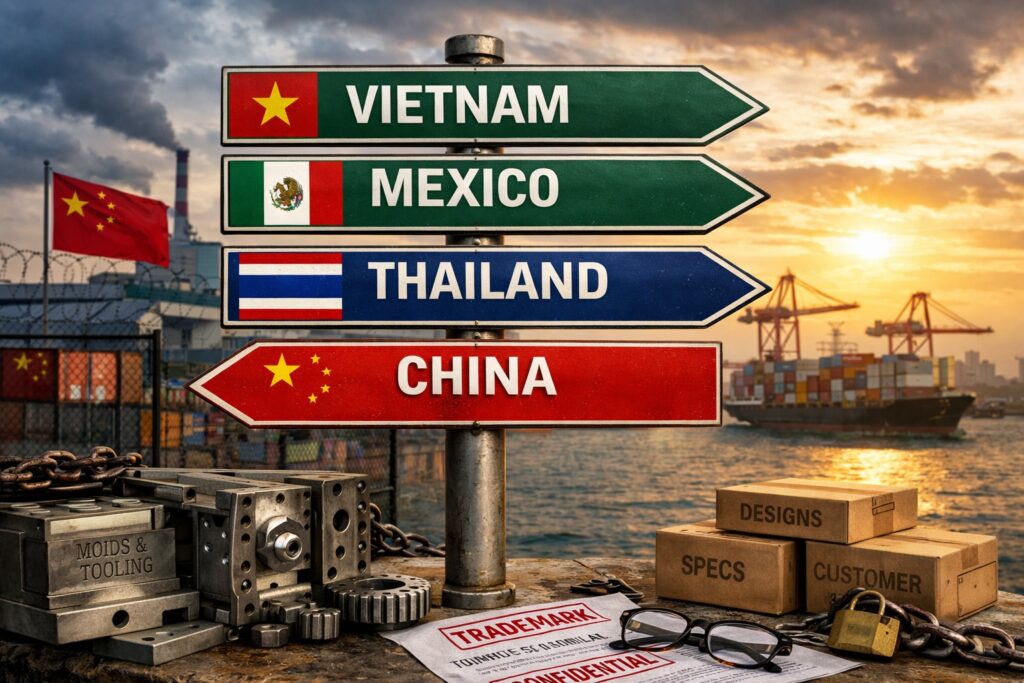
When companies decide to move production out of China, they usually start with the operational questions. They look for factories in Vietnam, Mexico, India, Thailand, or elsewhere. They bring in engineering, procurement, and quality control. They test samples, work through qualification schedules, and map out transition timing. They focus on supply continuity, pricing, and product quality.
Those issues matter, but they are often not what causes the most damage. The real trouble usually begins when the Chinese factory realizes the relationship is ending. What looked like a routine supply chain transition can quickly become a dispute over trademarks, molds and tooling, product know-how, and contract rights. The companies that get hurt most are often not the ones that stayed in China too long. They are the ones that decided to leave and assumed their legal position would take care of itself.
The Questions Companies Ask Too Late
When a company begins planning a China exit, the first questions are almost always operational. Can the new factory meet specifications? How long will qualification take? Will quality stay consistent? Can pricing remain competitive? Can production be moved quickly enough to avoid disruption?
Those are legitimate questions, but they are often not the ones that create the worst legal and commercial problems. The harder questions are also the more consequential ones. Who owns your trademarks in China? Who owns your molds and tooling? What does your factory know about your product, your margins, and your customers? What agreements can you actually enforce once the relationship starts to deteriorate?
Many companies do not seriously ask those questions until the supplier already knows the business is moving. By then, the leverage has shifted, and the factory may see every legal gap as a source of pressure.
Who Owns Your Trademarks in China?
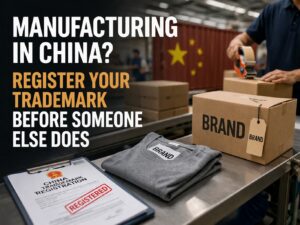
What matters is not whether you registered your trademarks in the United States, Europe, or wherever your headquarters happens to be. What matters is whether you registered them in China.
That distinction matters because China is a first-to-file system. In practical terms, the party that gets the registration first will usually have the stronger legal position in China, regardless of who used the mark first somewhere else. A surprising number of foreign companies manufacture in China for years without registering their core brand names, logos, product names, or Chinese-language marks there. Some assume their home-country filings are enough. Some trust the relationship. Some simply do not get around to filing until it is too late.
Then they decide to move production, and only then do they discover that a supplier, trading company, former distributor, or someone connected to them has already registered the mark, or something close enough to create serious problems. Once that happens, the issue stops being theoretical. It can affect exports, customs, e-commerce, negotiations with replacement suppliers, and the company’s ability to control its own branding in China.
It also often creates problems in the next country. If you are moving to another first-to-file jurisdiction and you have not already cleared and filed there, you may be repeating the same mistake in a new market just as you are trying to exit the old one.
Who Owns Your Molds and Tooling?
Tooling disputes often turn ugly fast because they involve physical assets the factory may already control. A company may have spent substantial money on molds, dies, jigs, fixtures, and other tooling needed to make its product. Those assets may be critical to moving production quickly. Without them, the company may face long delays, the cost of making new tooling, quality variation, or all three.
The problem is that the paperwork is often weak. The manufacturing agreement may not clearly state ownership. It may say little or nothing about return on demand. It may not include deadlines, inspection rights, storage obligations, identification requirements, penalties for non-return, or provisions dealing with subcontractors and custody. So the foreign buyer assumes it owns the tooling because it paid for it.
That assumption often falls apart once the factory knows it is being replaced. Suddenly there are disputes about whether everything was fully paid for, whether the tooling can be moved before open orders are completed, whether release requires additional compensation, or whether the tooling is too integrated into the factory’s operations to be handed over. Once the supplier knows it is losing the business, molds and tooling often become bargaining chips. If the contract language is weak, what looked like a simple ownership issue becomes a fight over physical control. And when production deadlines are approaching, physical control is often what matters most. See The Guide to Molds and Tooling in International Manufacturing.
What Does Your Factory Know, and What Can It Do With That Information?
If a factory has been making your product for years, it probably knows more than most foreign buyers want to admit. It may know your specifications, tolerances, materials, packaging requirements, testing standards, pricing assumptions, sourcing structure, and production methods. In some cases, it may also know your customers, your markets, and where you make your money.
Many Western companies assume a basic NDA solves this problem. Usually it does not. In many cases, it does something worse by creating false confidence. A standard NDA drafted for U.S. or European disputes is often a poor fit for a China manufacturing relationship, especially if it is governed by foreign law, written only in English, and built around remedies that are difficult to use in China. See NDAs Do NOT Work for China but NNN Agreements Do.
A properly drafted China-focused NNN agreement is often much more useful because it is designed to address non-use, non-disclosure, and non-circumvention in a Chinese manufacturing context. But even that should not be oversold. An NNN is not enough by itself. It is one part of a larger protection structure that should also include the right manufacturing agreement, clear tooling provisions, trademark registrations, and solid internal records.
Companies get into trouble when they reduce all of this to one easy conclusion: we had them sign an NDA. That is not much of a strategy. It is usually just a way of discovering too late that your protections were mostly cosmetic.
How These Problems Usually Unfold
The following examples reflect the kinds of real-world situations our law firm has handled, whether helping clients plan a smoother transition out of China or helping companies deal with problems that arose after they moved too quickly.
One company decides to move production from China to Vietnam. It assumes the hard part is finding the new factory. It has U.S. trademark registrations, but nothing in Vietnam. Only after the move is underway does it realize it never cleared or registered its brand there, and someone else has already filed first. Now the company that thought it was solving a supply chain problem is paying lawyers to recover its own brand in the country where it plans to manufacture next. The legal risk did not end when it left China. It followed the company into the new jurisdiction.
Another company pays for custom tooling in China and assumes ownership is clear because the invoices are in order and the commercial relationship seems straightforward. Then it learns the tooling is actually being held by a subcontractor, not by the company taking payment. At that point, payment, legal ownership, and physical possession are three different things. Recovering tooling is hard enough when the factory holding it signed the contract. It becomes much harder when the party with physical control sits outside the main contract chain and the documents say almost nothing about subcontractors, custody, or return obligations.
A third company handles things correctly. Before disclosing sensitive technical information, and before making the transition visible, it puts enforceable China-facing protections in place. Its agreements bind affiliates and subcontractors. Its tooling documents are specific. Its trademark position is checked in both China and the destination country. Just as important, the company is thinking not only about paper rights, but also about timing, forum, evidence, and leverage. It understands that once the supplier learns it is losing the business, every gap in trademark coverage, tooling control, and confidentiality protection can be turned into leverage.
That is usually the dividing line. One company thinks the move itself is the hard part. Another assumes its existing documents are probably enough. A third understands that the legal structure has to be in place before the exit becomes visible.
You Need to Audit China and the New Country Before You Move
This is the part many companies miss. They assume the legal work is mostly about cleaning up loose ends in China before they leave. That is necessary, but it is not enough. A smart exit requires a two-country audit. You need to understand the risks you are leaving behind in China and the risks you may be walking into in the new country.
Start with China. Are your trademarks registered there in the correct name and in the correct classes? Have you protected your Chinese-language marks? Has any supplier, distributor, or related party filed anything adverse? Is your manufacturing agreement actually enforceable in the way you think it is? Are your molds and tooling clearly documented and recoverable? Are subcontractors involved? Would your confidentiality protections hold up if tested? Who has what? Who controls what? What evidence would you need if things start going badly?
Then ask the same set of questions about the destination country. Too many companies treat the next country as a blank slate. It usually is not. If you are moving to Vietnam, Mexico, Thailand, India, or another manufacturing jurisdiction, you need to know whether your trademarks are available and whether you have filed them before your plans become visible. You need to know whether your new manufacturer will use subcontractors, who will physically hold your molds and tooling, what your manufacturing agreement says about ownership and return, whether your confidentiality and non-circumvention protections are enforceable there, and whether local distributors, employees, or counterparties create filing or leakage risks of their own.
This is not just a trademark issue. It is also a contract issue, a tooling-control issue, and often a regulatory issue. Depending on the product and the country, you may also need to think about labeling, product registration, customs treatment, local entity structure, tax exposure, and what legal remedies are realistically available if the new relationship falls apart. Companies get into trouble when they treat legal risk as linear, as though they can fix China first and worry about the new country later. In reality, the risks overlap. A company can leave one weakly protected position and walk directly into another. .
What To Do Before You Tell Your Chinese Factory You Are Leaving
Before you say a word about moving production, find out whether your trademarks in China are actually registered in the right name and whether there are any adverse filings by your supplier, distributor, or anyone connected to them. If you are moving to another first-to-file jurisdiction, such as Mexico or Vietnam, file there too before your plans become visible.
Then review your tooling situation as though it is going to be tested, because it probably will be. Do not stop at whether you paid for the molds. Ask where they are, who physically holds them, whether a subcontractor is involved, whether your contract requires prompt return, and what happens if the factory refuses. If the tooling is not clearly identified, clearly owned, and clearly recoverable on paper, assume it may become a hostage asset.
Then look hard at your confidentiality protections. If what you have is an English-language NDA built for U.S. disputes, it is probably not going to help much against a Chinese factory. If disclosure has not yet happened, fix that now. A China-facing NNN drafted for actual PRC enforcement is far better than discovering after the fact that your confidentiality agreement was mostly a formality.
If the risk profile is high enough, think in advance about whether you may need to move first in China rather than wait to react. That does not mean every exit calls for litigation. It does mean you should not let the supplier choose the battlefield by default. In some cases, the credible threat of filing in the right Chinese court is the fastest way to stop delay, recover leverage, and force the other side to take the matter seriously.
See: Leaving China Manufacturing: The Hidden Risks and How to Protect Your Business
Most Companies Realize This Too Late
Most companies think moving production out of China is a sourcing decision. The ones that get hurt learn too late that it is also a trademark decision, a tooling-control decision, a confidentiality decision, and a contract-enforcement decision. Worse, many of them repeat in the new country the same mistakes they made in China by leaving marks unregistered, using weak agreements, failing to lock down tooling rights, and placing far too much confidence in counterparties they barely know.
By the time a supplier is holding your molds, using your know-how, delaying release of your tooling, or forcing you to buy back rights you should have secured years earlier, the transition is no longer a normal business project. It is a dispute. Production gets delayed. Launch dates slip. Customers get nervous. The replacement factory sits idle. Costs increase. In the worst cases, the company pays twice: once for the failed exit and again to rebuild the legal protections it should have put in place before the move began.
Your leverage is usually strongest before your China factory knows you are leaving and before your plans in the new country become obvious to everyone else. That window does not stay open for long. Once it closes, fixing trademark gaps, tooling problems, and bad contracts becomes slower, more expensive, and much more difficult. Sometimes it does not just make the exit harder. Sometimes it makes the exit fail.