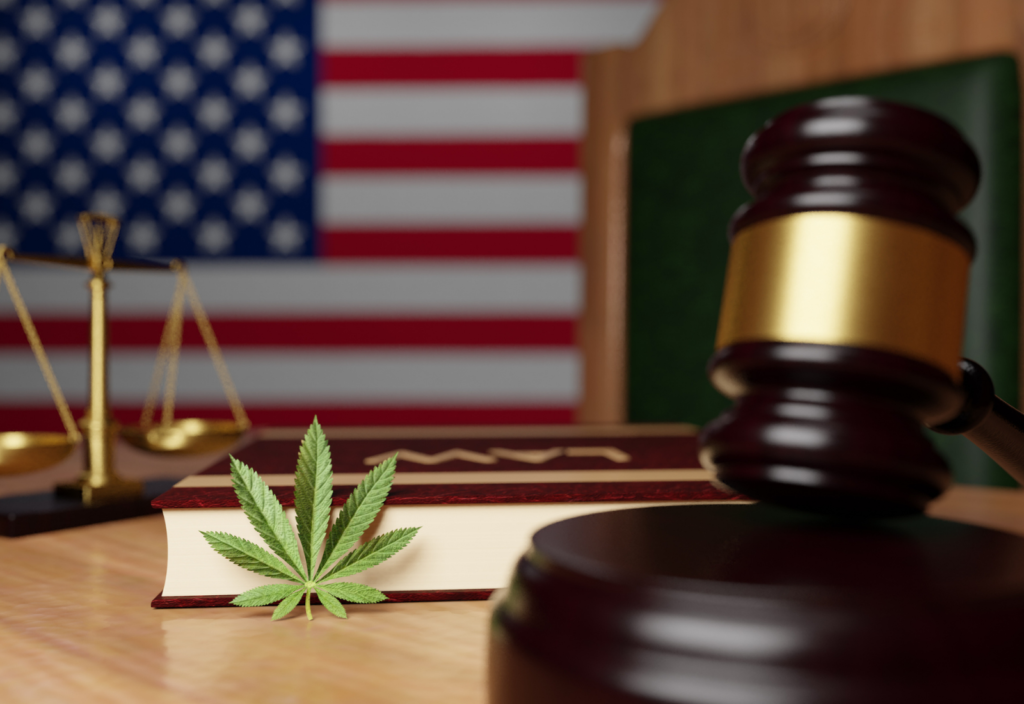
Just last week, the U.S. Court of Appeals for the Ninth Circuit affirmed a lower court's holding that the 2018 Farm Bill legalized delta-8 THC products derived from hemp. In the Ninth Circuit's view, "the plain and unambiguous text of the Farm [Bill] compels the conclusion that the delta-8 THC products before us are lawful." Specifically, "the only statutory metric for distinguishing controlled marijuana from legal hemp is the delta-9 THC concentration level."
The case at issue was an intellectual property dispute that required the courts to consider the legality of delta-8 products. The plaintiff-appellee, AK Futures LLC, brought a copyright and trademark infringement suit against Boyd Street Distro, LLC. In its defense, Boyd Street alleged that AK Futures did not have "protectible trademarks" for its delta-8 products "because delta-8 THC remains illegal under federal law."
In its defense, Boyd Street argued that the Drug Enforcement Administration (DEA) continues to consider delta-8 THC an unlawful substance under its interpretation of the 2018 Farm Bill, "because of its method of manufacture." While disagreeing with Boyd Street's characterization of the DEA stance, the Ninth Circuit clarified that it "need[ed] not consider the agency’s interpretation because [7 U.S.C.] § 1639o is unambiguous and precludes a distinction based on manufacturing method."
Boyd Street also argued that Congress "intended the Farm Act to legalize only industrial hemp, not a potentially psychoactive substance like delta-8 THC." To this, the Ninth Circuit had the following to say:
无论将Δ-8-THC产品合法化的明智性如何,本院不会以自身政策判断取代国会的立法意图。若博伊德街案的裁决正确,且国会确实无意中制造了使含Δ-8-THC电子烟产品合法化的法律漏洞,那么修正此错误的责任应由国会承担。因此,博伊德街案基于立法意图的论点未能成立。
The Ninth Circuit found no compelling argument to support the proposition that delta-8 products are unlawful. This in turn led the court to declare that, being lawful, delta-8 products "may receive trademark protection."
The nexus between delta-8's legality and trademark protection exists because of the lawful use requirement. According to this requirement, use of a mark in commerce must be lawful under federal law in order to form the basis for federal registration under the U.S. Trademark Act (also known as the Lanham Act). Despite the good news for delta-8, cannabis products that are unlawful under the Controlled Substances Act or the Federal Food, Drug, and Cosmetic Act remain ineligible for trademark protection. This includes all products derived from marijuana.
The Ninth Circuit accepted as a given the notion that products illegal under federal law are not entitled to federal trademark protection. Yet, as we noted in Cannabis Trademarks: Is the Lawful Use Requirement Even Lawful, the proposition that the Trademark Act authorizes, let alone requires, such a restriction on trademark registration is shaky. We welcome the court's decision as far as delta-8 goes and applaud it for refusing the invitation to engage in creative statutory interpretation. This refusal is important not just as a matter of principle, but also to flag for federal legislators potential lacunas in the current legal framework for cannabis.
At the same time, we lament the fact that the Ninth Circuit did not take advantage of this opportunity to examine the lawful use requirement, which underpinned Boyd Street's claims. This would have been an ideal opportunity for the court to at the very least consider whether product legality and trademark protection should be linked, a question with implications not just for delta-8 brands, but for the wider cannabis industry.