Doing Business Internationally: Why Your International Lawyer Should Handle Your Domestic Work Too
There are times when you absolutely need a local specialist. A real estate lawyer who knows Oregon title issues, a New York tax lawyer, a California employment litigator. Some legal work is local, and it is a mistake to pretend otherwise. But a lot of companies take that idea way too far. And for a long time, so did we.
We got this wrong
When we first built our international trademark practice, our focus was almost entirely Asia. Clients came to us for China trademarks and then for trademarks in other Asian countries, and we handled those. But when the discussion turned to the United States, we would tell our clients to use their domestic trademark lawyers. If they did not have one, we would refer them to one.
At the time, that seemed sensible. We were busy. Our Asia trademark practice was growing. We saw ourselves as handling the international piece, not the domestic piece. That was a mistake.
As our practice expanded, the flaw in that thinking became harder to ignore. We were handling trademark work in China, Australia, Mexico, Spain, Vietnam, and just about everywhere else except the United States. That made no sense, especially for clients whose U.S. filings were central to the rest of their brand strategy.
If we were already managing a company’s trademarks across multiple countries, why should a different lawyer handle the United States filing under a different set of assumptions? Why carve out the filing that, for many companies, sits closest to the center of the whole brand portfolio?
And this is not theoretical. We have seen companies use one firm for China, Mexico, Portugal, and Canada, and a different lawyer for the United States, only to discover later that the goods and services descriptions do not line up, the ownership structure is inconsistent, and the U.S. filing does not match how the brand is actually being rolled out globally. Then they get to spend money fixing a problem they never should have created.
Once we recognized that, we started seeing the same problem elsewhere.
It was not just trademarks
The same mistake showed up in contract work too. We saw that especially clearly years ago, when a Canadian pharmaceutical company came to us for a complicated China distribution matter.
We spent weeks on it. By the end of that work, we knew the Canadian company’s products. We knew how it wanted distribution handled. We knew what risks it cared about most. We knew where it would compromise and where it would not. We knew which contract provisions mattered to the business people and which ones were mostly background noise.
Then the client asked whether we could help with Brazil. If they had come to us out of the blue and asked only for a Brazil distribution agreement, we would have said no. We would have referred them to Brazilian lawyers. That would have been the right answer.
But that was not the situation anymore. We had already spent weeks learning the client and its business. A new Brazil firm could have known Brazilian distribution law far better than we did, but it still would have had to spend time learning what we had already learned. That learning curve costs money. It affects what gets emphasized, what gets missed, and how quickly the work moves.
So we told the client that we thought the most efficient path was for us to help choose Brazilian counsel and stay heavily involved in the matter. Not because we had suddenly become Brazil lawyers, but because we already understood the client well enough to make the Brazil work better and faster.
Lawyers make that sort of call all the time. Or at least they should.
A lot of clients miss this point. They focus on who knows the local law best, which is a fair question, but it is not the only one. A lawyer who already understands the client’s business, its history, and its risk tolerance will often do better work than one who knows the local law cold but is learning the client from scratch. Throwing that knowledge away every time a matter crosses into a new country is wasteful.
Distribution agreements are no different
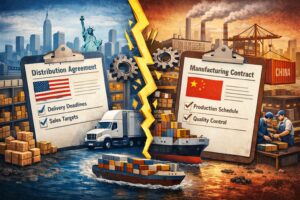
If we are drafting a distribution agreement for Malaysia and another for Japan, there is a good chance we should also be drafting the U.S. version, or at least heavily shaping it. That does not mean the agreements should be identical. They should not be. A U.S. agreement and a Japan agreement are not the same document, and anyone who treats them that way should not be drafting either one. But they should reflect the same company.
They should reflect the same general thinking on exclusivity, trademark control, online sales, reporting, termination, and what happens when the relationship ends. If they do not, the company starts drifting without realizing it. One agreement says one thing about online sales, another says something else about sub-distributors, and a third takes a soft approach to brand control because a different lawyer used a different form.
We saw this play out when a company had distributors in Japan, Malaysia, and the United States, with different lawyers drafting each agreement. The Japan agreement tightly restricted online sales. The Malaysia agreement barely addressed them. The U.S. agreement allowed broad e-commerce sales because the domestic lawyer treated that as a secondary issue, which it wasn’t. Eventually the U.S. distributor started selling online into markets the company had informally promised to protect. At that point, the problem was not just the distributor; the problem was that the company had never reduced a coherent distribution strategy to paper.
Employment agreements raise the same issue
Employment law is another area where clients often split the work in ways that create long-term headaches. Of course you need local employment lawyers in a lot of situations. California is different. France is different. Plenty of places are different. Nobody sensible denies that.
But for an international company, confidentiality, IP ownership, invention assignment, return of company property, access to systems and data — none of those are local questions. They need to reflect how the company actually operates.
The better approach is to build the agreement centrally, with the lawyers who understand how the company actually works, and bring in local counsel to adapt it where local law requires. That usually works a lot better than handing five different firms five different employment agreements and hoping they somehow all reflect the same business.
We saw this when a client with employees in California, Texas, Mexico, and Spain had let separate local counsel draft everything from scratch. One agreement had one invention assignment clause. Another handled confidential information differently. Another took a different approach to affiliate-created work product. That sat quietly until the company had to figure out who owned software code developed by a team spread across multiple countries and entities. That is when everyone learned the documents were never really saying the same thing.
The same logic applies to manufacturing
A company will spend weeks negotiating its Vietnam or China manufacturing agreement on issues like mold ownership, tooling, quality control, inspection rights, subcontracting restrictions, confidentiality, transition obligations, and then use a loose domestic template for its U.S. product development agreement because that relationship feels familiar.
We have seen that end badly. The U.S. manufacturer gets terminated, claims the tooling is its own, and the client discovers its domestic contract never clearly said otherwise. The foreign agreements were more protective than the domestic one and the U.S. manufacturer took advantage of that.
Corporate structure is no different
This problem shows up in corporate structuring too. A business operates through a U.S. parent with foreign subsidiaries in Mexico and Australia. One law firm handles the foreign-side structuring and another handles domestic U.S. corporate work. The foreign firm assumes the U.S. parent owns certain IP and will license it down. The domestic firm has put ownership somewhere else for unrelated reasons. Nobody notices the disconnect until a financing, dispute, tax review, or sale process forces the company to figure out who owns what and why the documents do not line up.
This happens to companies of all sizes. We were once called in to sort out an ownership and structure problem for a Fortune 100 company that did not catch the disconnect until weeks before its deal was set to close.
Litigation works the same way
Sometimes the real work is not identifying the legal claim. It is figuring out how an aggressive lawsuit will affect related supply arrangements, business leverage in other countries, payment relationships, and settlement possibilities.
When that happens, we do not just hand the client a few China lawyer names and disappear.
The China litigators are still essential. They know local procedure, judges, filing rules, and the practical realities of litigating there. But by that point we already know the case inside and out. We know the documents better than anyone. We understand the settlement dynamics, the business stakes, and the reasons the client is willing to push hard in one area and not in another. None of this knowledge stops mattering once the case moves into a Chinese court.
We have had matters where the real work was not just identifying the legal claim. It was figuring out how an aggressive lawsuit would affect related supply arrangements, business leverage in other countries, payment relationships, and settlement possibilities. Once that work has been done, it would be foolish to pretend the strategic lawyers have become irrelevant just because a filing now needs to be made in China.
On the other hand, if the matter is a straightforward $175,000 breach of contract claim, that is usually different. At that point, we will typically give our client the names of Chinese litigators and let them handle it directly. There is no point in adding another layer of legal spend to a small, routine case just so we can remain attached to it.
The bottom line
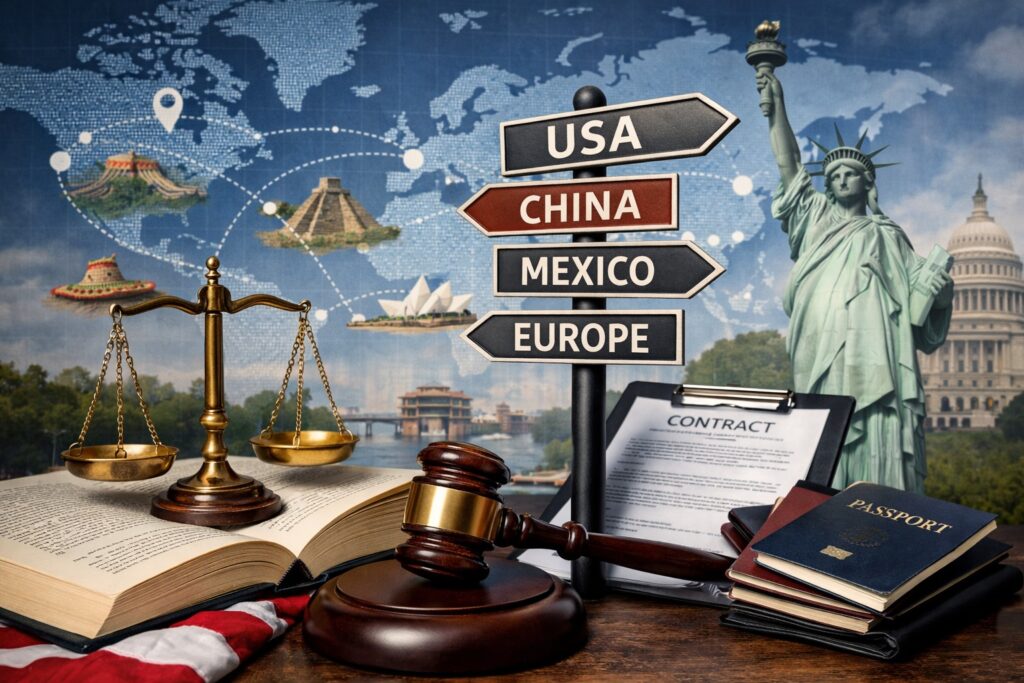
Many companies divide their legal work by geography and end up with pobody notices until something breaks.
The fix is not complicated. If your international lawyers already know your business, keep them in the domestic work too — either doing it themselves or staying close enough to make sure it fits with everything else. And if you have domestic lawyers handling work that connects to what is happening internationally, make sure the two groups are actually talking to each other. That sounds obvious. It rarely happens.
Because the map does not tell you where the value is. The lawyers who already know your business do.