How to Reduce Your International Contract Manufacturing Risks
Small and medium-sized businesses that engage in international OEM manufacturing or outsourcing often fail to take the necessary steps to protect themselves. When problems arise, they frequently have no meaningful legal recourse—because they never built a foundation for it in the first place.
A Five-Step Guide to Safer International Manufacturing
The following five steps will significantly reduce your risks when working with overseas manufacturers and improve your chances of recovering damages if something goes wrong.
1. Secure and Register Your Intellectual Property—Everywhere You Do Business
Start by creating and properly registering your IP in your home country and in every other country where your product will be made or sold. This includes registering your trademarks, logos, slogans, and product names with the appropriate patent and trademark offices. It also includes registering key copyrights and clearly identifying trade secrets and proprietary know-how.
These measures help prevent counterfeit or infringing goods from being produced abroad and imported into your core markets. Without these protections in place, you risk losing control of your brand and product from the outset.
2. Register Your Trademark in the Manufacturing Country
Registering your trademarks in the country where your product is manufactured protects your ability to:
- Export from that country under your own brand
- Block counterfeiters from producing knockoffs
- Prevent third parties (including your own manufacturer) from registering your brand name as their own
Failure to register often results in blocked shipments, trademark hijacking, or inability to enter the local market under your own name.
3. Use Contracts to Protect Know-How and Trade Secrets
Most SMEs lack a deep patent portfolio. Their most valuable intangible assets are often unregistered: proprietary designs, processes, customer lists, or formulas.
Protecting this type of intellectual property requires written agreements. Use an NNN agreement (non-disclosure, non-use, non-circumvention) or embed NNN clauses into a broader manufacturing contract. These provisions help secure your confidential information, limit unfair competition, and reduce the risk of IP leakage.
Without these agreements, enforcement is typically impossible—even in jurisdictions with strong IP laws.
4. Establish Clear Product and Payment Terms—With Teeth
If possible, never make final payment to your manufacturer until you’re confident you will receive the correct products, at the right quality level, on time.
This often means conducting third-party inspections and clearly defining procedures for addressing defective or delayed goods. Your contract should specify exact product standards, delivery timelines, and remedies for non-compliance. And yes, this takes initiative on your part—don’t rely on your manufacturer to safeguard your interests.
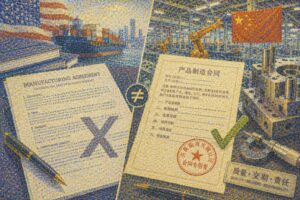
5. Use a Bilingual, Country-Specific Manufacturing Agreement
Too many SMEs rely on basic purchase orders when working with overseas manufacturers. This is a mistake. Purchase orders typically protect the supplier, not the buyer.
You need a formal, country-specific Manufacturing Agreement that addresses:
- IP ownership and use
- Product quality, delivery timelines, and payment terms
- Confidentiality, non-competition, and non-circumvention
- Jurisdiction and dispute resolution
- Language of enforcement
Your contract should be written in your own language and in the official language of the manufacturer’s jurisdiction. This ensures it can be enforced locally if needed.
Conclusion
International manufacturing comes with serious legal and operational risks—but most of them can be prevented. Take proactive steps to secure your IP, define your business terms, and build enforceable protections into your contracts.
What are you seeing out there?