You Have Used Your China Trademark for Years. Can You Prove It?
We have had many clients come to us with some version of the same problem. Their branded products have been made in China for years, but the paperwork was never created with trademark proof in mind. Purchase orders identify products by SKU. Factory invoices say little more than “garments” or “plastic parts.” Photographs are undated. Customs and inspection records sit with the factory. Then someone files a non-use cancellation.
Everyone involved knows the trademark has been used for years. But the evidence file says otherwise.
China makes this an easy trap to fall into because, unlike the United States, it does not require trademark owners to prove use before obtaining a registration or periodically submit proof of continuing use to maintain or renew one. Once three years have passed from the registration announcement, however, the mark can be challenged for three consecutive years of non-use. Proof of use also matters when the trademark owner goes on offense: a company that cannot prove qualifying use can lose its claim for infringement damages even though it owns a valid registration.
China’s lack of a registration-stage use requirement has also encouraged trademark squatters and, at times, overly broad defensive filing. Current Chinese law already permits rejection of bad-faith applications filed without an intent to use. The revised Trademark Law adopted in June 2026, which takes effect January 1, 2027, goes further by targeting applications that lack a genuine use purpose and clearly exceed normal production or business needs. Defensive registrations still have an important place, particularly for companies manufacturing in China, but breadth should serve a real business or defensive purpose. We discuss that strategy in Manufacturing in China but Not Selling There? Your China Trademark Strategy Should Be Defensive, Focused, and Fast.
The Three-Year Rule—and What Changed in 2025
A non-use cancellation can be filed once three years have passed from the trademark’s registration announcement. The relevant period is the three years immediately preceding the filing of the cancellation application. Use that begins after the cancellation is filed cannot cure three preceding years of non-use, though evidence created later can still help establish qualifying use that occurred during the relevant period.
Once CNIPA accepts the application, the trademark owner generally has two months from receipt of the notice to provide evidence of use during the relevant period or explain the non-use. China recognizes force majeure, government policy restrictions, bankruptcy liquidation, and other circumstances not attributable to the registrant as justifiable reasons. A company’s voluntary decision simply to postpone commercial use ordinarily does not fall into those categories.
Until recently, starting one of these proceedings required relatively little from the challenger. That began changing in early 2025, when CNIPA started demanding more preliminary evidence through examination notices. The change was formalized in CNIPA’s May 26, 2025 guidance on three-year non-use cancellations. A cancellation applicant must now provide a factual basis for the claim of non-use. Depending on the circumstances, that can include searches of the registrant’s website, WeChat account and e-commerce activity, information about its business scope and operating status, market research, and investigation of physical business locations. We discussed the practical effect of this change in China Trademarks and Non-Use Cancellations: The Stakes Just Got Higher.
The new requirement makes speculative cancellation filings harder, but it does not rescue a registrant with a bad evidence file. Once CNIPA accepts the case, the trademark owner still needs credible evidence covering the relevant three-year period. A cancellation decision is not necessarily the end of the matter. A trademark owner has 15 days after receiving the cancellation decision to seek review before CNIPA and can challenge an adverse review decision in court.
What CNIPA Wants to See
CNIPA’s own guidance on trademark-use evidence provides a useful framework. The evidence should show the trademark being used, connect it to the goods or services covered by the registration, identify who used it, establish a date within the relevant three-year period, and show use within the territorial reach of China’s Trademark Law.
The registrant does not have to be the person physically using the mark. Use by a licensed or otherwise authorized subsidiary, distributor, manufacturer, or other party can count. But the record should establish the relationship. This becomes especially important when a holding company owns the China trademark while an operating subsidiary or distributor actually conducts the business.
Online activity can also support proof of use. Beginning January 1, 2027, the revised Trademark Law expressly includes trademark use through the Internet and other information networks within the statutory definition of use. Territoriality still matters. A listing aimed solely at customers outside China does not become China trademark use simply because somebody in China can find it online. CNIPA evaluates the evidence as a whole. A sales contract standing alone proves little. The same is true of an interested party’s written statement, an undated product sample, or a screenshot whose timing or authenticity cannot be established. Token transactions created solely to keep a registration alive are also vulnerable.
A sound evidence file is built from records created in the ordinary course of business. Depending on the company, that can include purchase orders or manufacturing agreements identifying the trademark and product, invoices and payment records, dated packaging and labels, shipping and customs documents, inspection or quality-control records, advertising and e-commerce materials, and documents establishing any licensing or other authorized-user relationship. No single piece of paper needs to carry the entire case. The records need to fit together.
Use Evidence Matters in an Infringement Case Too
Non-use cancellation is only one reason to preserve this material. Under Article 64 of China’s current Trademark Law, an accused infringer can respond to a damages claim by asserting that the trademark owner has not used the registered mark. The court can then require the owner to provide evidence of actual use during the preceding three years. If the owner cannot prove that use and cannot prove another loss caused by the infringement, the defendant is not liable for damages.
The revised Trademark Law retains the rule in Article 78 and states the period more precisely: the three years before the infringing conduct. This can turn what looks like a straightforward enforcement case into an evidence problem. A company owns the registration, finds a counterfeiter or other infringer, and assumes the registration establishes everything it needs. It then discovers that its damages case depends on invoices, sales records, packaging, advertising, licensing records, or manufacturing documents nobody thought to preserve.
Export Manufacturing: Get the Evidence Before You Need It
Foreign companies that manufacture in China for export face a particular problem because some of their best evidence often exists inside somebody else’s company. CNIPA has recognized evidence of commissioned manufacturing in Mainland China in non-use proceedings. Export and customs records can also help establish use. Contract manufacturing for export can therefore support a China trademark registration even where the finished goods are not sold to Chinese consumers.
This should be distinguished from the complicated line of Chinese cases concerning OEM manufacturing and trademark infringement. Those cases ask whether export-only manufacturing infringes someone else’s China trademark. A non-use cancellation asks whether the registrant can prove qualifying use of its own mark. The questions overlap factually, but they are not the same legal issue.
For the trademark owner, the problem usually comes down to documentation. A photograph of a branded box has limited value if nobody can establish when it was taken or connect it to a transaction. A manufacturing agreement adds little if it never identifies the trademark. Generic invoices remain generic invoices even if everyone involved remembers what the factory was producing.
Language is rarely the central problem. Foreign-language evidence can require Chinese translation, but a Chinese-language document that never identifies the trademark or relevant goods is still weak evidence. The records need to connect the mark, the goods, the user, the date, and the China-based commercial activity. This is where supplier management becomes part of trademark management. Chinese factories commonly possess production records, invoices, packaging specifications, inspection reports, shipping records, and customs documents that the foreign brand owner does not routinely retain. We have seen clients discover after a factory relationship deteriorated that the former supplier possessed years of records the client now needed for a trademark matter.
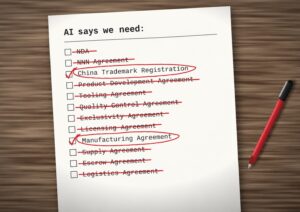
Collect those records while the relationship is working. Once a supplier dispute begins, asking the factory to help you build a trademark evidence file can become considerably more difficult. The same preventive thinking applies to securing the trademark in the first place. Companies manufacturing branded goods in China also need to distinguish the trademark evidence problem from the contractual disclosure problem. An NNN Agreement and a China trademark registration address different risks.
What Changes on January 1, 2027
China adopted its revised Trademark Law on June 26, 2026, and it takes effect January 1, 2027. Earlier drafts generated considerable discussion about requiring every registrant to make periodic proof-of-use filings, somewhat like the United States. The enacted law does not impose that requirement.
It does give CNIPA express authority to initiate cancellation of a trademark that has become generic or has gone unused for three consecutive years without justification. Under the current system, a dormant registration generally remains on the register unless someone challenges it. Beginning in 2027, CNIPA can initiate the process itself. How frequently CNIPA will use that authority will depend on the implementing rules and enforcement practice. Foreign companies with valuable China trademarks should nevertheless treat evidence of use as routine portfolio management rather than something to reconstruct after a cancellation notice arrives.
The revised law also continues China’s broader effort to curb registrations that exist largely on paper. For more on preparing for the new law, see Five Practical Steps Foreign Brands Should Take to Prepare for China’s New Trademark Law.
Non-Use Cancellation Can Clear Someone Else’s Trademark
The three-year rule can also work in your favor. Suppose a pre-filing search turns up an older registration for the same or a confusingly similar mark. If the registration is old enough and the owner does not appear to be using it, a non-use cancellation can clear the obstacle. The 2025 changes mean the challenger now needs to investigate first and submit preliminary evidence, but genuinely dormant registrations remain vulnerable.
The revised Trademark Law also makes an important change for companies using this strategy. Under the law now in force, a one-year blocking period generally follows cancellation, invalidation, or expiration without renewal, during which CNIPA will not approve certain identical or similar third-party applications for the same or similar goods.
Beginning January 1, 2027, Article 49 narrows that rule. The statutory one-year bar applies where the trademark registrant itself applies to cancel the registration. A trademark removed through a successful non-use cancellation will therefore no longer be subject to Article 49’s statutory one-year lock-up. That removes one timing obstacle for a company trying to clear a dormant or squatted mark and secure its own registration. It does not guarantee immediate registration: the new application still has to clear ordinary examination and any other conflicting rights.
The best time to build a China trademark evidence file is while nothing is wrong. Make evidence collection part of ordinary trademark and supplier administration, and a future cancellation notice or infringement case becomes an exercise in producing records rather than trying to reconstruct years of business activity from documents sitting in a former factory’s filing cabinet.