Back to Basics: What Is an H-1B Visa?
H-1B visas are for workers in specialty occupations. An H-1B worker is defined by the Immigration and Nationality Act as a beneficiary who: (i) is temporarily coming to the United States (ii) to perform services in a specialty occupation; (iii) is of distinguished merit and ability; and (iv) for whom the H-1B employer has attested to the Secretary of Labor that it will pay the higher of either the prevailing wage or the actual wage paid to its other workers of similar experience and qualifications in that position.
1. The H-1B visa is for temporary workers and is granted for no more than three years at a time. Furthermore, once an H-1B worker first obtains H-1B visa status, they have a maximum of six years to physically work in the U.S. During that time, the H-1B worker can change employers, but doing so does not extend the six-year limitation on the stay. There is a narrow exception to this six-year period for H-1B workers who are in the process of getting their permanent residence.
2. To be eligible for H-1B status, the H-1B worker must be employed in a specialty occupation. The Code of Federal Regulations defines specialty occupation as “an occupation which requires theoretical and practical application of a body of highly specialized knowledge in fields of human endeavor including, but not limited to, architecture, engineering, mathematics, physical sciences, social sciences, medicine and health, education, business specialties, accounting, law, theology, and the arts, and which requires the attainment of a bachelor’s degree or higher in a specific specialty, or its equivalent, as a minimum for entry into the occupation in the United States.” In other words, the occupation must require highly specialized knowledge that can be attained only in a bachelor’s or higher degree program in a specific specialty.
3. The H-1B worker must demonstrate distinguished merit and ability by virtue of possessing at least a bachelor’s degree or its equivalent in the specific specialty field. To meet this requirement, the H-1B worker must either: (i) have obtained the requisite degree from a U.S. college or university; or (ii) have a foreign degree determined to be equivalent to a degree earned from a U.S. college or university; or (iii) hold an unrestricted state license that authorizes practicing the occupation; or (iv) be recognized as an expert in the specialty field on the basis of education, specialized training, and/or progressively responsible experience. The H-1B worker is required to provide their credentials, including diploma(s), transcript(s), and experience letter(s), to prove that he or she meets the educational requirements for the H-1B visa position. They must also supply certified translations of the required documents if they are in a language other than English.
4. The H-1B employer must obtain certification from the Secretary of Labor of a Labor Condition Application(“LCA”). The LCA serves to safeguard the interests of the American worker by requiring the H-1B employer to attest that it will pay the H-1B worker the higher of either the prevailing wage or the actual wage it pays its employees of similar experience and qualifications in that specialty position. Typically, the prevailing wage is derived from the U.S. Department of Labor’s (USDOL) survey of wages for specific occupations in specific counties or Metropolitan Statistical Areas that are in effect for a one-year period. The H-1B employer electronically files the LCA to identify the specialty occupation, its corresponding wage, and the validity period for which it seeks to employ the H-1B worker. The employer also attests in the LCA to pay the wage and notify its employees of its intent to hire an H-1B worker by posting the LCA for ten consecutive days in two clearly visible locations on the premises where the H-1B worker will perform his or her duties. The H-1B employer can file the H-1B visa petition with the U.S. Citizenship and Immigration Services (USCIS) only after the LCA has been certified by the USDOL and signed by the employer.
How the Change of U.S. Administrations has Impacted the H-1B Visa Landscape
Even before President Biden’s inauguration on January 20, 2021, plaintiffs had challenged Trump administration rules that had significantly increased minimum salary requirements for H-1B visa applicants. Various courts ruled repeatedly in favor of plaintiffs, and one by one, the rules were vacated. During the Biden administration, the legal rulings have continued to unwind rules put in place during the Trump administration, and the process is now pretty much back to where it was at the end of President Obama’s term in office.
H-1B Visa Registration Process and Lottery System
The electronic H-1B registration system introduced in 2020 remains in place, allowing employers to pre-register candidates before the lottery takes place. However, since its introduction, the system has faced growing concerns regarding gaming of the lottery by certain employers. USCIS has observed a significant increase in multiple H-1B registrations for the same beneficiary filed by different employers or related entities. This practice has raised alarms as it appears some employers may be attempting to game the system by artificially inflating the chances of certain candidates being selected in the lottery.
To address these concerns, USCIS introduced new rules in 2023 requiring a more thorough review of registrations to identify duplicate or fraudulent entries. One key development is the emphasis on the concept of a "unique beneficiary," meaning that each H-1B applicant should have a fair and single opportunity to be selected, rather than benefitting from multiple registrations by various affiliated companies. The new review process is aimed at ensuring that no beneficiary gains an unfair advantage through multiple filings, thus maintaining the integrity of the lottery system.
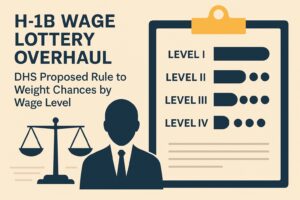
The Biden administration has also been considering broader reforms to the lottery system, including a proposal to replace the random lottery with one that prioritizes higher-paying jobs or occupations in critical workforce shortage areas. However, the implementation of this weighted lottery system has been delayed indefinitely, and for now, the random lottery remains in effect. Despite this, there is growing pressure to reform the system to prevent abuse and prioritize candidates in fields where the U.S. labor market has the greatest need, such as healthcare, engineering, and IT.
In response to the surge in suspicious registrations in 2023, USCIS announced its intention to increase enforcement actions against companies that file multiple petitions for the same beneficiary or otherwise attempt to manipulate the system. Employers should be mindful of these trends and ensure they comply with the intent of the law, as USCIS has signaled that further regulatory updates may be forthcoming to curb lottery manipulation.
New Developments in 2023 and 2024: Adjudication and Enforcement Trends
Since 2023, H-1B adjudication trends have become stricter, especially with respect to third-party placement workers. The Biden administration has emphasized scrutiny of compliance with wage requirements and the employer-employee relationship in cases involving staffing companies or third-party worksites. Employers are advised to provide robust evidence of control over the H-1B worker to avoid Requests for Evidence (RFEs). Furthermore, enforcement actions targeting H-1B fraud have increased, with USCIS collaborating more closely with the Department of Labor (DOL) and Immigration and Customs Enforcement (ICE).
Introduction of E-Filing for H-1B Petitions in 2024
In a move to modernize and streamline the process, USCIS introduced e-filing options for H-1B petitions in 2024, enabling employers to submit their petitions entirely online. This change is expected to reduce paperwork and processing times, and is part of a broader push by USCIS to digitize immigration services. Employers should take note of the new e-filing system and ensure their petitions are prepared for digital submission to avoid delays or rejections.
Pilot Visa Revalidation Program for Certain Foreign Nationals
Additionally, in 2024, the Department of State launched a pilot visa revalidation program for certain H-1B and other work visa holders, allowing them to renew their visas from within the United States rather than traveling abroad. This revalidation program applies to foreign nationals in specific categories who meet certain eligibility criteria and aims to reduce the travel burden for workers needing visa renewals. If successful, this program could expand and become a standard option for H-1B visa holders.
Litigation in Federal Court Regarding the H-1B Program
2023 also saw significant litigation in federal courts concerning the H-1B visa program. Several lawsuits challenged USCIS's interpretation of what qualifies as a specialty occupation, particularly for roles in IT and business consulting. Some of these cases resulted in favorable rulings for petitioners, forcing USCIS to reconsider denials based on overly narrow interpretations of specialty occupation requirements. Employers should stay informed about these legal developments, as the outcomes could affect the approval rates for certain H-1B positions.
For H-1B Employers: Attention to Detail Is Critical
The law puts the burden on the H-1B employer to prove its eligibility when filing a petition. Accordingly, it is essential for the H-1B employer to submit a petition that can withstand both procedural and substantive scrutiny. Procedural scrutiny requires including appropriate and accurately completed forms, attaching the correct filing fees, and submitting the petition to the correct USCIS service center. Substantive scrutiny refers to articulating effective arguments and providing sufficient evidence about why the employer and the worker meet the H-1B eligibility requirements.
The H-1B employer must provide proof of its existence, operations, and financial strength. This includes marketing materials describing the company’s business, leadership, and clients, as well as a valid lease and photographs evidencing its physical premises. The H-1B employer must also typically provide tax returns, wage reports, and contracts demonstrating current and future financial capacity to pay the H-1B wage to the worker for the entire duration of the H-1B visa period.
The evidence that the H-1B worker must supply to the employer includes identity documents such as a passport and a driver’s license. If the worker is in the U.S. in H-1B status for another employer or in another lawful status, he or she must also provide copies of immigration documents authorizing his or her current status, as well as IRS Forms W-2 and pay stubs to prove he or she has maintained that status. Finally, the H-1B worker must also provide a current resume, together with a diploma(s) and transcript(s). If the worker obtained his or her degree(s) outside the U.S., the USCIS will also require a credential evaluation that analyzes and evaluates the educational equivalency to degree(s) earned at U.S. institutions of higher education.
In 2020, the H-1B visa registration process was streamlined in a way that benefits employers, who now can electronically register their candidates in the lottery, then file petitions only for those applicants who are selected. This represents a significant savings of time and money.
Because employers are permitted to file petitions up to six months before the start date (October 1, the first day of the U.S. government’s fiscal year), the first five business days starting on or after April 1 signify the H-1B Cap window. H-1B Cap petitions delivered to the USCIS outside of that window are rejected.
Once the lotteries have been conducted, USCIS begins accepting H-1B visa petitions from those employers whose registrations were selected in the lottery. After sending receipt notices, USCIS typically takes the rest of summer to adjudicate petitions. Adjudication implies approval, denial, or the issuance of a request for further evidence. Depending on when the petition is approved, the worker can begin H-1B employment for the employer on or after October 1.

H-1B Visas for Contract Workers
H-1B employers typically petition for one of two types of work arrangements. Though most employers petition for workers to be employed on their own physical premises, some employers seek authorization for workers to be placed at an end-client pursuant to a legal contract for services between the entities. Such third-party placements have attracted increased USCIS scrutiny during the last decade because of the perception that end-clients use H-1B workers for menial tasks and H-1B employers fail to exercise control over their workers once they are placed on the end-client’s physical premises.
The information technology (IT) field provides real-world examples of third-party work arrangements because of the practice of IT giants soliciting bids from vendors to work on products or fill positions. In some cases, the prime vendor supplies the professional directly to the end-client, but in other cases, the prime vendor subcontracts with a sub-vendor who then supplies the professional to the end-client. In turn, a sub-vendor may subcontract with another sub-vendor, creating a complex chain that may include several layers of vendors between the H-1B employer and the ultimate end-client.
H-1B employers that file petitions for placement of their workers at end-clients should include evidence to demonstrate they will retain the employer-employee relationship with their workers and exercise control over them. The H-1B employers should also include evidence corroborating that their workers will engage in specific work assignments whose specialized requirements have been defined by the end-client, and whose locations have been identified in the certified Labor Condition Applications that were included in the H-1B petitions.
Before agreeing to any third-party engagement, employers who bid to supply resources for end-clients’ projects and then wish to assign H-1B workers to those projects should first consult with an experienced business immigration attorney to understand how these requirements apply to their business, communicate the requirements to all parties involved in the engagement, and obtain assurances from each layer of the vendor chain that requisite evidence will be provided. One certainty in our uncertain world is that a philosophy of proactively providing evidence of eligibility and attention to detail in petition filings will continue to tip the scales favorably.