
A balance scale with stacks of money on one side and a book labeled "The Constitution" on the other, set in front of government buildings at sunset.

Federal Court Strikes Down the $100,000 H-1B Fee: Why the Decision Matters and What Comes Next

On June 8, 2026, the U.S. District Court for the District of Massachusetts issued a significant decision invalidating the Trump Administration’s $100,000 H-1B payment requirement. The court granted summary judgment to a coalition of states, concluding that the Executive Branch exceeded its authority when it imposed the payment through a presidential proclamation rather than through

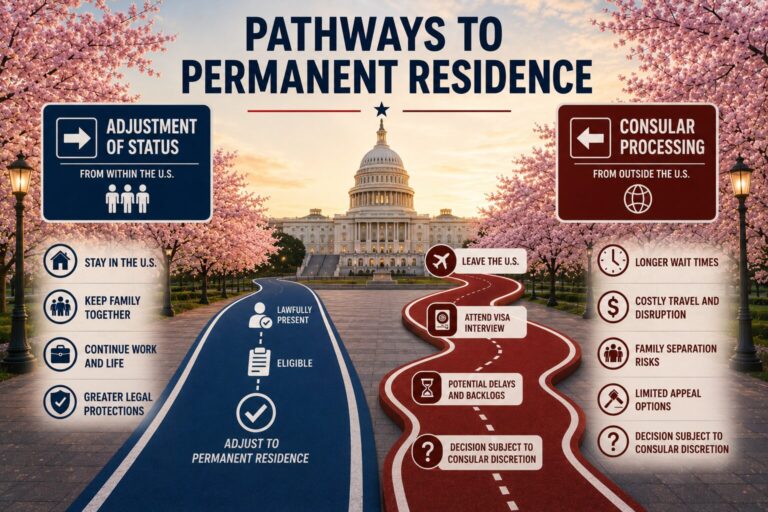
Infographic showing two pathways to permanent residence: Adjustment of Status (from within the U.S.) and Consular Processing (from outside), with pros and cons for each listed. U.S. Capitol in background.

Adjustment of Status Is Not an “Extraordinary” Benefit. It Is How the System Was Built.

The USCIS Adjustment of Status Memorandum Since USCIS published Policy Memorandum PM-602-0199 on May 21, 2026, immigration lawyers, employers, universities, and foreign nationals have spent the last several days trying to assess the practical and legal implications of what may become one of the most consequential immigration policy shifts in decades. The initial reaction understandably

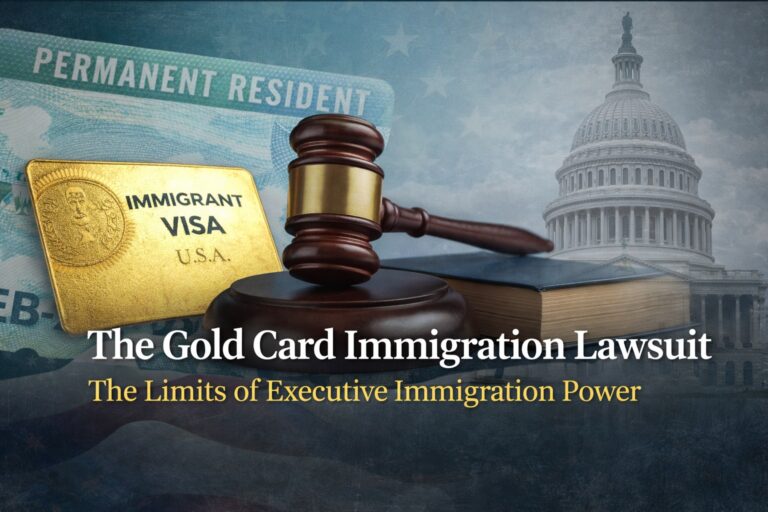
A gavel, immigrant visa, and book are shown in front of the U.S. Capitol and a green card with the text: "The Gold Card Immigration Lawsuit—The Limits of Executive Immigration Power.

When Money Supersedes Merit: The Gold Card Lawsuit and the Limits of Executive Immigration Power

The Gold Card Lawsuit and the Limits of Executive Immigration Power The federal lawsuit challenging the Gold Card immigration program brings legal structure to what had previously been an open policy question: how far the executive branch can go in reshaping employment-based immigration without Congress. The case, American Association of University Professors v. U.S. Department

Illustration of two groups of people, one standing and walking in a cityscape affected by tech layoffs, and another seated and talking in front of houses, suggesting community support amidst urban challenges.

Tech Layoffs, Talent Realignment, and the Opportunity for Startups, Workers, and Investors

The past year has brought dramatic changes to the technology sector. Major companies have announced large-scale layoffs while at the same time making unprecedented investments in artificial intelligence and automation. This combination raises difficult questions. Why are companies cutting tens of thousands of jobs while simultaneously committing billions to new technologies? Part of the answer

A gavel rests on an H-1B visa document and application form in front of a U.S. courthouse building, symbolizing the impact of an H-1B lawsuit.

H-1B Lawsuit Challenges Trump’s $100,000 Visa Fee: What Employers Need to Know

A $100,000 fee to hire an H-1B worker. Two days’ notice. No exemptions for hospitals losing doctors or universities mid-research project. On September 19, 2025, President Trump issued a proclamation conditioning the entry of H-1B workers on their employers paying a six-figure fee, effective September 21. Hospitals scrambled to retain staff, tech companies froze hiring,

Infographic showing H-1B wage lottery overhaul, with a scale, a person in a suit, and a clipboard listing four wage levels with weighted chances.

The New H-1B Lottery Proposal: What Employers Need to Know

H-1B Lottery Overhaul: What Employers Need to Know About the New Wage-Based System The H-1B lottery has always been a source of uncertainty. Every year, employers prepare registrations and hope that the odds break their way. Until now, the system has been a simple draw: one chance per beneficiary, regardless of the job, the salary,

A magnifying glass rests on top of a USCIS immigration form, with large, semi-transparent question marks and a globe graphic overlaid on the image.

The $100,000 H-1B Fee: What the USCIS Proclamation Really Means

The $100,000 H-1B Fee: What the USCIS Proclamation Really Means When the White House rolled out its proclamation under INA § 212(f), it sounded like a wall was about to come down. The text tied the $100,000 requirement to entry into the United States. Employers rushed to interpret what that meant, workers abroad wondered if

Subscribe To Our Blog

Explore the latest legal news and insight regarding China, cannabis, international law, immigration, dispute resolution and Web3.