
Dan Harris

Dan Harris is a founding member of Harris Sliwoski, an international law firm where he mostly represents companies doing business in emerging market countries. Most of his time is spent helping American and European companies navigate foreign countries by working with the international lawyers at his firm in setting up companies overseas (WFOEs, Subsidiaries, Rep Offices and Joint Ventures), drafting international contracts, protecting IP, and overseeing M&A transactions.

In addition, Dan writes and speaks extensively on international law, with a focus on protecting foreign businesses in their overseas operations. He is also a prolific and widely-followed blogger, writing as the co-author of the award-winning China Law Blog.

International litigation versus international arbitration

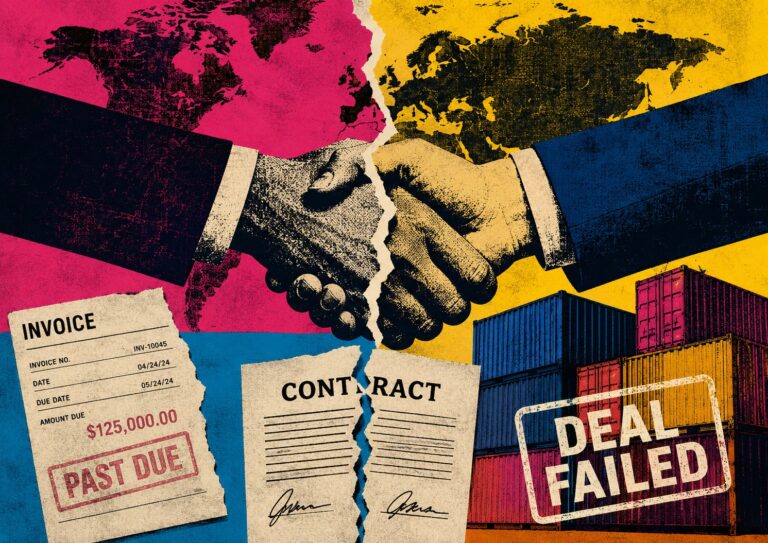
Is Arbitration Always the Answer? A Guide to Global (and China) Dispute Risks

Why International Arbitration Is the Cornerstone of Modern Global Risk Management The Global Business Reality: Cross-Border Disputes Destroy Deals Imagine a multinational manufacturer that spends almost five years caught in a foreign court system trying to recover a 2.5 million-dollar debt. By the time the case has crawled through local procedure and appeals, the company

White text on a blue background reads “The Pros and Cons of Manufacturing Integrators” with icons of gears, a robot arm, and tools in the background.

High End Manufacturing Integrators: The Pros and Cons for Companies That Cannot Afford Mistakes

High End Manufacturing Integrators: The Pros and Cons for Companies That Cannot Afford Mistakes Why Companies Are Turning to Manufacturing Integrators Companies that build sophisticated products tend to face the same pattern of problems. Overseas factories offer attractive pricing, but their incentives rarely match yours. Their priority is volume and machine utilization. Your priorities are

A red contract document with the text: "Why sign a new contract in China instead of adding an amendment?" in large white letters.

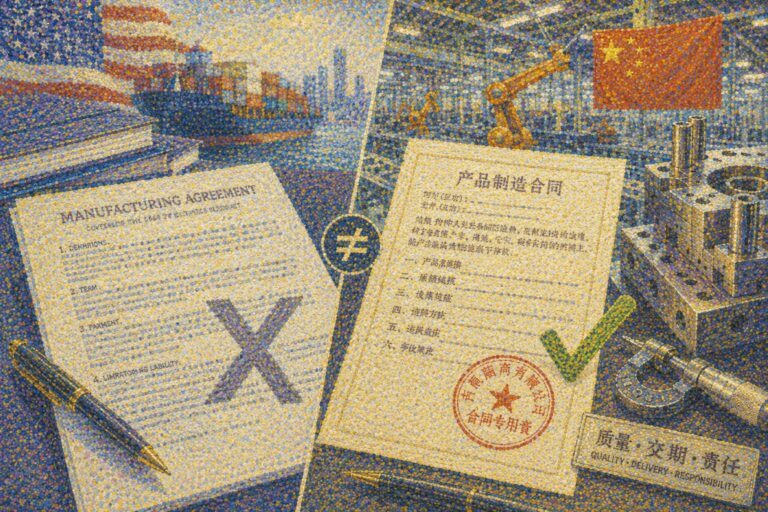
Why It’s Better to Sign a New Contract in China Than to Add an Amendment

Why It’s Usually Better to Sign a New Contract in China Than to Add an Amendment When working with Chinese manufacturers or other counterparties, foreign companies often ask our China business lawyers whether they can amend an existing contract instead of signing a new one. On paper, an amendment sounds efficient. In practice, it usually

Infographic on China technology licensing, featuring a map of China with digital circuits, and icons for security, regulations, safety, and restricted cloud access.

China Technology Licensing: A Comprehensive Guide

Technology licensing lets you sell into China without a physical presence. Here is a 2025 playbook for diligence, export controls, IP protection, payment verification, and negotiating tactics that actually work.

A slide showing China's new 2025 AUCL law, its impact on executives, and digital abuse, with a map of China and key points listed beside it.

China’s 2025 Competition Law Creates Executive Liability and Extraterritorial Reach

China’s 2025 Competition Law Creates Executive Liability and Extraterritorial Reach On October 15, 2025, China’s revised Anti-Unfair Competition Law (AUCL) will take effect, ushering in the most significant overhaul of China’s market regulation in nearly a decade. I began my legal career doing antitrust work at Kirkland & Ellis, so when China first rolled out

Red graphic with Chinese flag elements, a warning sign, and bold text reading: "China Manufacturing Risks in 2025: Why They're Worse Than Ever.

China Manufacturing Risks in 2025: Why They’re Worse Than Ever

China Manufacturing Risks in 2025: Why They’re Worse Than Ever The New Reality of Manufacturing in China Twelve months ago, a U.S. company wired $800,000 to a trusted Chinese supplier it had worked with for years. The factory never shipped a single product. Instead, it shut its doors, the owner disappeared, leaving the American company