Washington Bench Trial or Jury Trial? How the Choice Can Change Your Entire Case
Most litigants treat the jury demand as a routine filing, one more box to check during the pleading stage. In Washington, that can be a costly mistake. The choice between a bench trial and a jury trial affects how the case is built, how witnesses are prepared, how legal issues are presented, and how settlement leverage develops. It is not an administrative detail. It is a strategic decision that should be made early, before it hardens into assumptions that are difficult to undo.
Washington’s constitution preserves the right to a civil jury trial, and the Superior Court Civil Rules govern how that right is demanded, waived, or replaced by a trial to the court. If you are litigating a business dispute in Washington, this is not something to sort out at the end of the pleadings or the week before trial setting.
The Jury Right in Washington: What It Means and How to Use It
Washington’s constitution states that the right of trial by jury remains inviolate, while also allowing waiver of a jury in civil cases with the parties’ consent. Under Civil Rule 38, a party must demand a jury trial in writing, file that demand, and pay the required jury fee by the time the case is called to be set for trial. If no party demands a 12-person jury by then, the case is tried to a 6-person jury, and five of those six jurors can reach a verdict. Under Civil Rule 39, once a jury trial is properly demanded, the case remains a jury case unless the parties stipulate to a bench trial or the court determines that no jury right exists for the issue in question.
Do not assume a bench trial is the natural default for a more technical case. It is not. In superior court, a jury trial exists if the issue is triable of right and the demand is properly made. Waiving that right can be smart. Waiving it without a plan is not.
What the Choice Actually Changes
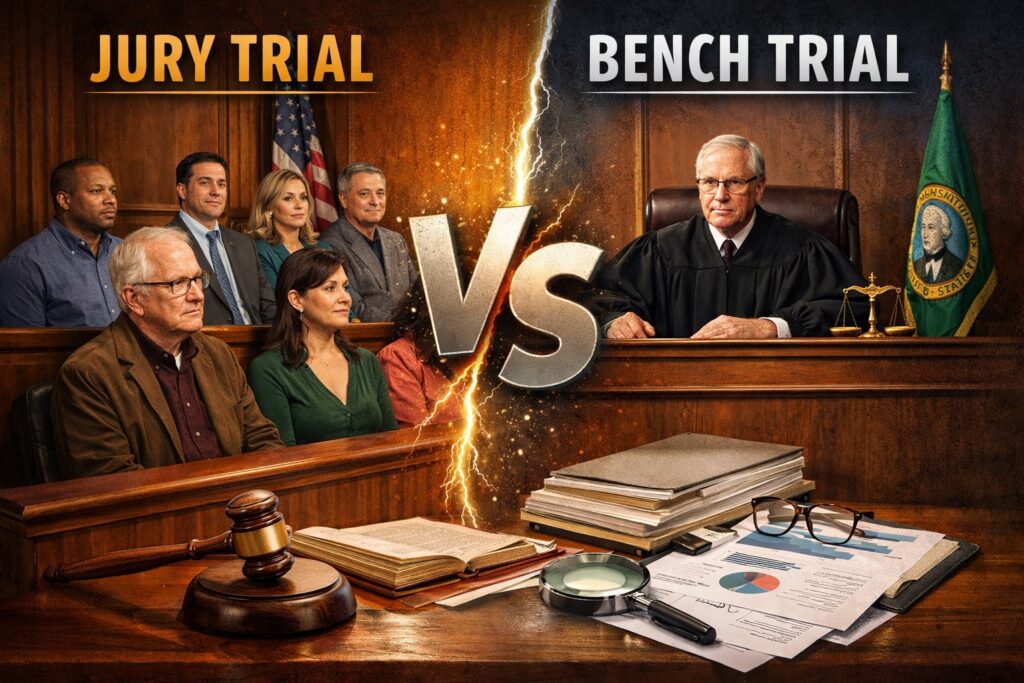
In a jury trial, lay jurors decide the facts. In a bench trial, the judge does. That difference affects far more than the identity of the factfinder.
A jury trial forces lawyers to translate the case into clear themes, credible witnesses, and a story ordinary people can follow. A bench trial allows a more technical presentation, but it also places the entire case before a single decision-maker who is likely to care less about presentation and more about whether the proof lines up with the legal elements.
Washington judges decide legal issues throughout the case regardless of trial format. In a bench trial, there is no fresh look. The same judge who heard your motions and shaped the record may also become your factfinder. You need to decide whether that familiarity is an asset or a liability.
When a Jury Trial May Help
A jury trial can be the better choice when the case turns on credibility, fairness, common-sense inferences, or conduct that ordinary people will understand immediately. Some business disputes look technical on paper but are simple at their core. A broken promise. A cover-up. A manipulated record. A self-serving explanation after the fact. Jurors often cut through the noise faster than lawyers expect.
That does not mean a party should pick a jury because the law is weak and sympathy is strong. That is a good way to lose. It does mean some cases benefit from being decided by people who are not trained to think in narrow legal categories. They may respond more directly to evasiveness, overcomplication, or obvious unfairness.
A jury trial may also make sense where the other side’s witnesses are unlikeable, overly polished, or rehearsed. Jurors do not need to love your witness. They do need to believe your witness more than the other side’s.
When a Bench Trial May Be Better
A bench trial can be the smarter choice when the case is driven by documents, statutory interpretation, accounting detail, regulatory structure, or industry-specific facts that would take too long to explain cleanly to lay jurors. Some Washington business cases are won not by emotional force but by careful assembly of documents, timelines, and internal inconsistencies. That kind of case can play better to a judge.
If your case depends on a dense paper trail, a detailed audit, or a narrow statutory argument, a bench trial is probably the better choice. A bench trial may also make sense where the jury appeal cuts the wrong way. A legally strong defense can look cold in front of a jury. A technically weak plaintiff story can still sound appealing if it is framed as simple mistreatment. Sometimes the better move is to put the case in front of a judge who is more likely to separate what the law requires from what feels unfair.
Bench trials also change how lawyers try the case, often in ways clients do not anticipate. Witnesses can be examined more tightly. The court may tolerate a more direct path through the documents. The parties may spend less time performing for the room and more time building the record. That can matter a great deal in a hard commercial case.
Your Trial Strategy Changes Once You Know Who Will Decide the Facts
Lawyers who prepare a bench trial the way they would prepare a jury trial waste time. Lawyers who prepare a jury trial as if they are submitting a trial brief lose jurors.
In a jury trial, the work starts with simplification. The legal theory has to be translated into themes that can survive witness testimony, cross-examination, and deliberations. Exhibits need to be selected with clarity in mind, not just admissibility. Expert witnesses need to teach without sounding condescending. Openings and closings need to connect the documents to a coherent story.
Bench trials are also more interactive, and that changes the emphasis. The judge is not waiting for a story to land. The judge is deciding whether the evidence satisfies the governing standard. That means organizing the evidence around legal elements, not narrative arc, and making sure every exhibit has a clear evidentiary purpose. Judges in bench trials ask questions, interrupt to focus the record, and sometimes signal early where they think the case turns.
Witness Preparation Is Different, Not Less Important
Lawyers sometimes assume judges are immune to bad witness performance. They are not. Witness presentation matters in bench trials too. It just matters differently.
In a jury trial, a witness has to be understandable, credible, and disciplined. The witness cannot hide behind jargon or long-winded answers. Jurors punish evasiveness quickly. Experts, especially, must turn difficult material into plain English.
In a bench trial, the witness can usually be more technical, but technical does not mean careless. Judges may tolerate more jargon, but they have little patience for corporate speak, hedging, and gamesmanship. A judge is also more likely to drill down on precision, internal consistency, and whether the witness actually knows what the documents say. A bench-trial witness who overstates or gets cute with the record can lose a judge just as quickly as a jury witness can lose jurors.
Leverage and Settlement Risk
The bench-versus-jury decision does not just affect trial. It affects settlement leverage.
A party with a clean jury story may have more settlement power than its summary judgment briefing alone would suggest. A party with a highly technical statutory defense may gain leverage by making clear that the case is better suited to a judge than a jury. Trial format changes risk, and changed risk changes numbers.
If you wait until trial setting to think seriously about jury demand, waiver, or trial posture, you are late. Under Civil Rule 38, jury-demand timing matters, and under Civil Rule 39, the path from jury case to bench trial depends on stipulation or a court ruling that no jury right exists. Those are not details to sort out after mediation fails.
What Washington Businesses Should Ask Before Waiving a Jury
Before waiving a jury in Washington state court, a business should ask a few blunt questions.
Is this case really about documents and legal standards, or is it about whether the decision-maker will believe one side over the other?
Will the core theory sound cleaner to a judge or to six or twelve ordinary people?
Does the case depend on specialized concepts that will take days to teach, or does it reduce to a simple story once the noise is stripped away?
Will your best witness look careful and credible, or stiff and overlawyered?
Will the other side benefit more from emotional framing than from doctrinal discipline?
Those questions go directly to who should decide the case.
Final Thoughts
The bench-versus-jury decision touches everything: how facts are framed, how law is presented, how witnesses are prepared, and what settlement risk looks like.
Sometimes a jury is the better choice because the case turns on credibility, fairness, and common-sense judgment. Sometimes a bench trial is the smarter move because the case lives or dies on technical proof, legal structure, and disciplined use of the record.
Do not drift into the decision. Trial format is not an afterthought.
At Harris Sliwoski, we help businesses evaluate Washington litigation strategy before those choices harden into problems. If your case may turn on whether a judge or a jury decides the facts, that issue should be analyzed at the start, so the case is built for the audience that will actually decide it.