Why Importers Should Control Freight and Customs From Day One*
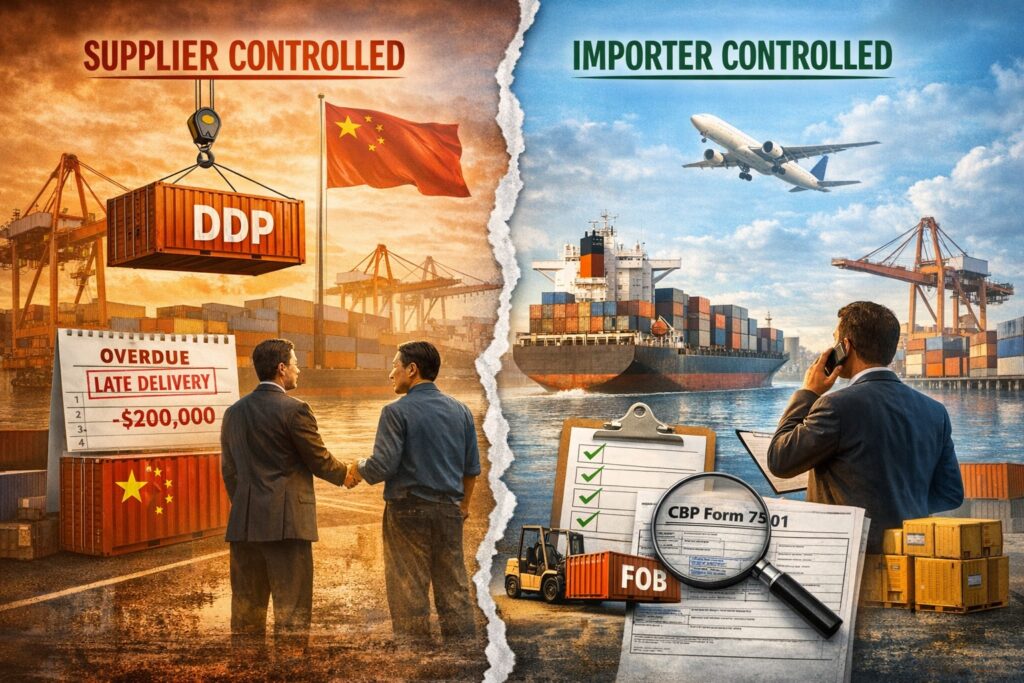
Wally’s Widgets had a breakthrough product, a solid Chinese manufacturer, and a $2.8 million retail order. He also had a $200,000 late-delivery penalty clause and no experience importing from China.
When the factory offered to handle shipping and customs under DDP terms – delivered duty paid, one all-in price – Wally agreed. From his perspective, this felt easier to Wally’s Widgets. No forwarder to hire. No customs paperwork to manage. Just place the order and wait.
It turned out to be the most expensive decision he made.
The structural problem with supplier-controlled freight
Most experienced importers buy on FOB or FCA terms and control freight themselves. They selected the freight forwarder. They decide which carrier to use. They decide whether a shipment needs the fastest sailing or the lowest rate.
This isn’t about distrust. It’s about control.
DDP shifts that control to the supplier. And that creates a built-in conflict: the supplier’s margin versus your delivery date.
When freight rates rise, the supplier must decide whether to absorb the increase or wait for the market to soften. Because freight costs are baked into a fixed DDP price, waiting is often the cheaper choice for them.
From the importer’s side, the updates sound familiar. “No space this week.” “Carrier rolled the container.” “Port congestion.” During peak season, those explanations can be partly true. The problem is you can’t step in and fix it because you don’t control the booking.
We’ve watched this happen more times than we’d like to count.
What happened to Wally
The factory built a freight allowance into its DDP pricing – $5,000 per container – to Norfolk. If it booked freight for less, it kept the difference.
Then the market shifted.
In mid-July, rates jumped. The best available rate was $5,500 per container – $500 above the allowance. On seven containers, that meant $3,500 coming straight out of the factory’s margin.
For Wally, $3,500 was small compared to a $200,000 penalty clause and the risk of damaging a key retail account. He would’ve paid more without hesitation to protect the sailing date.
But he wasn’t in control of the booking.
The factory waited. It hoped rates would ease. Updates were vague. Wally had no direct contact with the carrier or forwarder, so he couldn’t tell whether space was unavailable or simply too expensive.
By the time the shipment sailed, the delivery window had closed. The goods arrived late. The retailer enforced the penalty.
If Wally had controlled freight, his forwarder would’ve laid out the options when rates increased: pay more and sail on schedule or wait and accept the risk. He would’ve made the call based on his business priorities.
Instead, the decision was made for him.
The other risks we see when suppliers control freight
You lose visibility into your costs
When you control freight, you see options. Different ocean carriers. Different transit times. Different service levels. You decide when to pay for reliability and when to cut cost.
When the supplier controls freight, you usually see one result and one price. Freight disappears inside an all-in number. Over time, that lack of transparency makes it harder to manage landed cost strategically.
Where tariff shortcuts get expensive
We’ve seen product lines that stopped working because tariffs pushed costs too high. Then the supplier comes back with a revised DDP quote that somehow lowers the landed cost dramatically. The factory price hasn’t changed. Freight looks about the same. But the total cost drops measurably.
When that happens, something in the customs declaration likely changed.
Freight rates fluctuate. Duty rates don’t unless classification, valuation, or origin changes. If a supplier says they can “handle tariffs differently” without a clear explanation, the likely issue is inaccurate or manipulated entry data – misclassification, undervaluation, or origin adjustments that won’t hold up under review.
CBP enforcement is data driven. The importer of record is generally responsible for the accuracy of the entry data, not the overseas factory.
If a shipment gets flagged, it’s your inventory that sits. It’s your customer that waits. Incoterms define commercial responsibilities. They don’t eliminate customs scrutiny.
Cheap DDP pricing that can’t be explained clearly should raise questions.
The tariff refund question
After the Supreme Court’s February 20, 2026, decision holding that IEEPA didn’t authorize certain tariffs, many importers began looking at refund options. If refunds become available, the companies best positioned to pursue them will be those with clear entry records and direct access to their customs documentation.
If you outsourced the entire import process under DDP and never saw the entry paperwork, you may end up arguing about who can claim the refund. Without the original entry records, you’re negotiating blindly.
When DDP can make sense
We understand why importers take DDP deals. When you’re new and the factory offers to handle everything, it genuinely seems easier. DDP isn’t automatically wrong, and in some situations it works.
If the supplier has a legitimate U.S. presence, established compliance procedures, and is transparent about how entries are filed, DDP can be workable.
Transparency is the key.
If you aren’t receiving entry summaries (CBP Form 7501) and supporting documentation, you can’t verify how your goods were classified, valued, or who is listed as importer of record. That should concern you.
Even smaller importers can ask questions. Request FOB or FCA pricing. Compare it to the DDP quote. Talk to an independent freight forwarder and get a benchmark rate. The goal isn’t to create friction with your supplier. It’s to understand what’s behind the number.
Warning signs importers should not ignore
The pattern we usually see starts with a DDP quote that’s mysteriously cheap. Then come vague answers about how that number was achieved, followed by delays no one can clearly explain.
Watch for Incoterm inertia. If a supplier resists a move to FOB or FCA without a clear logistics reason, margin may be buried in the freight or the customs process.
None of this alone proves anything improper. But together, they signal misaligned incentives.
Practical first steps
Taking control doesn’t require a logistics department.
Speak with a freight forwarder that handles your trade lane regularly. Evaluate them on communication and problem-solving, not just price. Confirm who’ll handle customs brokerage and what documentation you’ll receive.
Ask your supplier for FOB or FCA pricing alongside DDP. Compare the numbers. If the DDP price is dramatically lower and no one can clearly explain why, dig deeper.
Build a realistic lead-time plan that includes production, port handling, transit, and clearance. Share it internally. Treat logistics as part of your business planning, not as an afterthought.
The real cost of convenience
DDP sounds simple. One price. One contact.
In practice, it often means less visibility and less control.
Wally didn’t choose the wrong factory. He gave up control of freight and customs because it felt easier at the start. When conditions changed, he had no way to intervene.
Shipping terms aren’t minor details. They determine who makes decisions when something goes wrong.
Wally learned that lesson for $200,000. You don’t have to.
* This post was written by Andy Heller. Andy is a 36 year freight forwarding veteran, and President of Inspire International Forwarding, LLC.