










Surreal illustration contrasting an asset purchase, shown as equipment and documents, with a stock purchase, depicted as a company building and certificates.

Buying a Business in the U.S., Part 7: Asset Purchase vs. Stock Purchase

When buying a U.S. business, one of the first decisions is whether to purchase the company’s assets or its ownership interests. That choice affects what you acquire, which liabilities remain with the business, what happens to its contracts and licenses, and how the transaction is taxed. It also affects the price a buyer is willing


A man and woman in suits sit at a table flanking a diagram of a factory, representing the process of buying a business in the United States by managing shipments, production, and growth.

Buying a Business in the U.S., Part 6: Purchase Price Adjustments

When a buyer and seller agree on a purchase price for an acquisition, the sticker price on a term sheet is rarely the payment that ultimately changes hands. Between signing the deal and closing (and often, even after closing), a series of contractual adjustments will dictate what the seller actually receives, and when. In U.S.

A man and a woman in business attire sitting at a conference table talking.

How to Choose a Corporate Lawyer

How to Choose a Corporate Lawyer for Your Business Too many companies hire their first corporate lawyer the way they choose a dentist. Someone recommends a name, the first meeting goes well, and nobody asks another question until something goes wrong. Then the company discovers that its lawyer has never handled a matter like the

Four people sit around a table covered with documents, reading and reviewing papers as they conduct M&A Due Diligence in a well-lit office with large windows and artwork on the walls.

Buying a Business in the U.S., Part 5: Due Diligence

Due diligence is the part of an acquisition where a buyer gets to look under the hood of a seller business. In this exercise, the buyer figures out—or tries to figure out—whether the business on offer is the business it would own after closing. Diligence can extend over a period of weeks or months, and

Surreal scene of faceless figures at a table signing a Letter of Intent, surrounded by melting clocks, scales, charts, and large pens—a symbolic depiction of buying a business in the U.S.—with a contract on a pedestal in the background.

Buying a Business in the U.S., Part 4: Letters of Intent (LOIs)

Buying a Business in the U.S., Part 4: Letters of Intent (LOIs) In business purchase negotiations, parties often execute an early‑stage document called a letter of intent (“LOI”). You may also see it called a term sheet or even a memorandum of understanding (“MOU”). The label matters less than the document’s language and the parties’

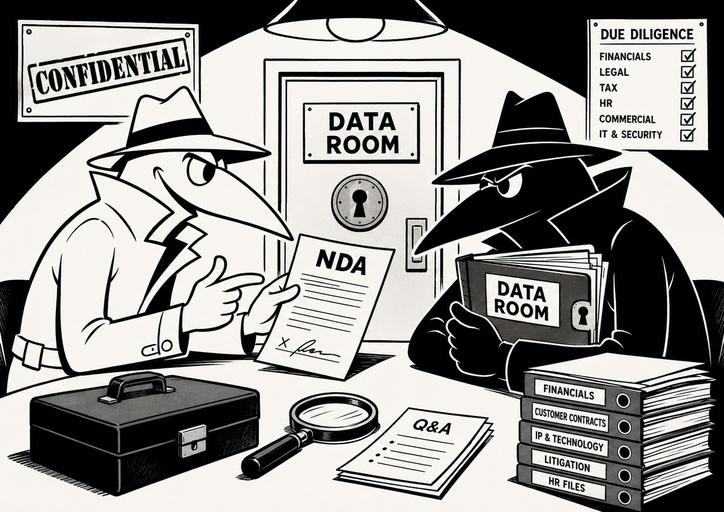
Two people in trench coats and hats exchange documents labeled “NDA” and “Data Room” in an office filled with files, a briefcase, a magnifying glass, and a checklist on the wall.

Buying a Business in the U.S., Part 3: Nondisclosure Agreements

I recently wrote about how to find businesses for sale, and how to price them. Today I’ll discuss the very first contract typically signed by a buyer and seller in the life cycle of a small or closely-held business acquisition: the non-disclosure agreement (NDA). In nearly all deals outside of the straight “investment” or VC

A man in a dark coat stands on a rocky peak, holding papers, and looks out over a misty, mountainous landscape under a cloudy sky.

Should Your Business Sue? Seven Questions to Ask Before Filing a Lawsuit

Should Your Business Sue? Seven Questions to Ask Before Filing a Lawsuit A strong legal claim can still be a bad lawsuit. A customer refuses to pay, a partner diverts business to a side venture, or a former employee leaves with confidential information. Any of these may support a claim, but that does not settle

A lawyer addresses the judge and jury in a crowded courtroom, with a witness on the stand and a court reporter typing.

United States Litigation for Business Owners: The 101

Business Litigation: What It Costs, How Long It Takes, and When It Makes Sense At some point in a serious business dispute, someone says, “Maybe we should sue.” The suggestion usually comes after months of frustration. A customer has stopped paying. A partner walked out with the client list and half the staff. A supplier

Subscribe To Our Blog

Explore the latest legal news and insight regarding China, cannabis, international law, immigration, dispute resolution and Web3.