EU Expansion and the EUTM: Will Your EU Trademark Automatically Cover New Member States?
The European Union Trade Mark (EUTM) is one of the most efficient trademark tools available for companies doing business in Europe. Filed through the European Union Intellectual Property Office (EUIPO), a single EUTM registration provides trademark protection across every EU Member State through one application, one fee structure, and one renewal cycle.
EU enlargement could make that coverage even broader. But enlargement is not just “free extra territory.” It can also create brand risk in places you were not actively thinking about.
You sign a distributor in Serbia. During rollout, you discover the distributor filed your mark locally months earlier. Now you are negotiating to buy back your own name before you can sell under it.
Which Countries Might Join the EU Next?
As of January 30, 2026, the European Commission’s enlargement pages identify candidate countries and potential candidates including Albania, Bosnia and Herzegovina, Georgia, Moldova, Montenegro, North Macedonia, Serbia, Türkiye, Ukraine, and Kosovo.
Treat this section as a snapshot, not a prediction.
Does an Existing EUTM Automatically Extend to New EU Member States?
In most cases, yes.
An EUTM is a unitary right created by EU regulation. When a country accedes to the EU, EU law becomes applicable in that territory under the accession treaty and related implementing measures. That typically causes EUTM territorial coverage to expand to the new Member State as of the accession date.
EUTMs apply wherever EU trademark law applies. When a country becomes a Member State, EU trademark law starts applying there, and the EUTM’s territory expands with it.
The Risk Most Brand Owners Miss: Pre-Existing National Rights in the New Member State
Coverage is usually the easy part. Enforcement is where problems show up.
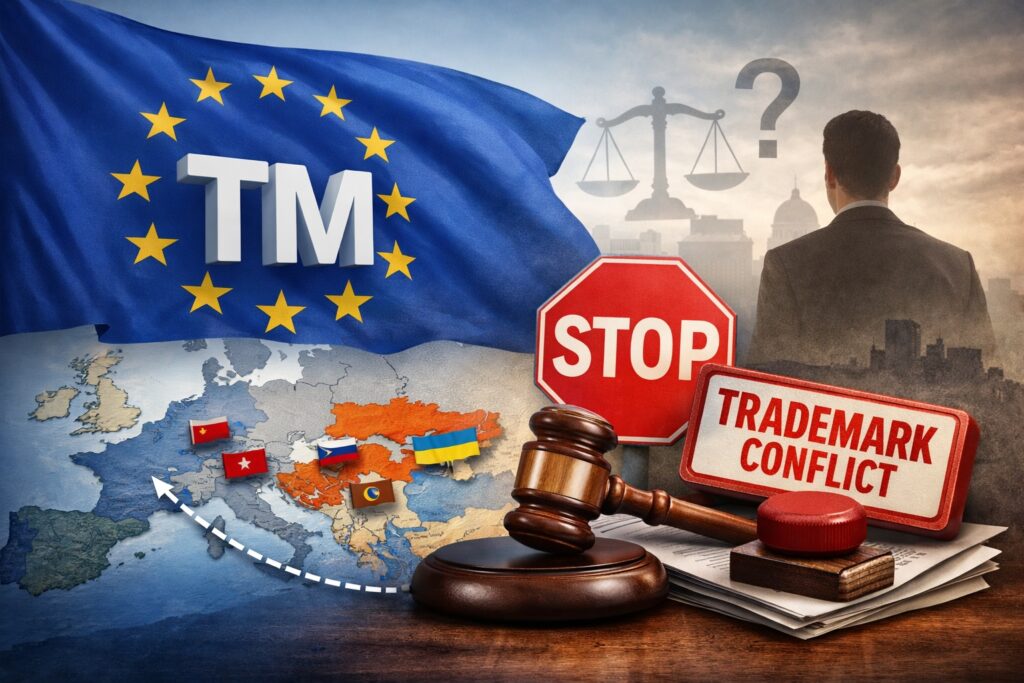
In many candidate countries, local companies or opportunistic filers may already hold national trademark registrations that conflict with your mark. Enlargement rules recognize that reality and build in a critical geographic carve-out.
Earlier national rights in the acceding country can allow the local rightsholder to prohibit your use in that country after accession. But those earlier local rights do not automatically invalidate your EUTM across the rest of the EU. Enlargement can create a local enforcement barrier without destroying your EU-wide registration.
You may be able to cancel the local registration, but that takes time, evidence, and a strategy. You may have EU-level rights on paper but limited practical ability to stop a local rightsholder until the conflict is resolved. You may end up negotiating coexistence, purchasing the conflicting mark, licensing, or rebranding in that market.
Enlargement Does Not Create New Language-Based Refusals for Existing EUTMs
Enlargement can raise a different concern: whether a mark becomes “descriptive” or otherwise objectionable in a new EU language.
Under current EU trademark rules, enlargement generally does not create new absolute-ground vulnerabilities for existing EUTMs that arise only because a new Member State joined. An existing EUTM cannot be attacked simply because a term is descriptive or otherwise objectionable only in the new Member State’s language.
This is a meaningful protection, but it is not a shield against every validity theory. It addresses absolute-ground issues that arise solely because of accession, not problems such as bad faith, genericide, or other grounds unrelated to enlargement.
What About Non-Use If You Are Not Selling in the New Country Yet?
If you are not using the mark in Montenegro yet, can someone cancel it for non-use as soon as Montenegro joins?
No. Accession does not create a special “new Member State” grace period, and it does not suddenly make a healthy EUTM vulnerable. The practical question stays the same as before enlargement: if non-use becomes an issue, can you show genuine use in the EU during the relevant period?
EU trademark law does not require country-by-country use, but it does require genuine use in the Union as the law interprets it. If you have genuine EU use, enlargement does not create a new non-use problem. If you do not, enlargement does not fix the one you already have.
Why Brexit Still Matters
Brexit is the simplest reminder that EUTM territory tracks EU membership. When the UK left the EU, EUTMs did not continue to provide UK coverage, and separate UK mechanisms were used to preserve rights.
The EUTM’s geographic reach changes with EU membership, and those changes are handled through treaties and implementing rules.
What Companies Should Do Now
If you are selling into, manufacturing in, licensing into, or appointing distributors in a candidate country, treat enlargement as a reason to get ahead of trademark risk.
- Match your trademark strategy to your commercial roadmap. If a candidate country is a likely market in the next 12 to 36 months, assume trademark friction is part of entry.
- Run clearance and conflict checks now in the markets that matter. The key question is not whether an EUTM will cover the country someday. The key question is who already owns something confusingly similar there today.
- Consider national filings in high-risk markets when there is a real business rationale. In some situations, a national filing can reduce squatter risk and improve leverage if a conflict arises later.
- Monitor accession developments so you are not surprised by timing. Montenegro is widely viewed as a frontrunner, and the EU continues to report tangible progress in its negotiations.
Conclusion
EU enlargement can expand the territorial reach of existing EUTMs. In many cases, EUTM protection extends to a new Member State automatically from the accession date because the EUTM is an EU-created unitary right that applies wherever EU trademark law applies.
If a candidate market matters to your business, do the conflict work early. Cleaning up a trademark problem is almost always cheaper before the market becomes strategically important.
FAQ: EU Enlargement and the EUTM
Do I need to file a new trademark if a new country joins the EU?
Usually no. In most cases, your existing EUTM extends to the new Member State as of the accession date without a new filing.
Can my EUTM be cancelled just because my mark is descriptive in the new country’s language?
Under current EU trademark rules, generally not on that basis alone. Enlargement typically does not create new absolute-ground vulnerabilities for existing EUTMs that arise only because a new Member State joined.
Will my EUTM automatically be enforceable in the new Member State?
Often yes, but enforcement can be more complicated than coverage. Earlier national rights and transitional rules can affect what you can stop, how quickly you can stop it, and what remedies are realistic.
What if someone already owns a similar national trademark in the acceding country?
This is the most common commercial problem. A local party may hold an earlier national registration that conflicts with your mark. They may be able to stop your use in that country, but they generally cannot take down your EUTM across the rest of the EU on that basis.
If I have not used my mark in the new Member State yet, can it be cancelled for non-use immediately after accession?
No. Accession does not create a special “new Member State” grace period. The practical question remains whether you can show genuine use in the EU during the relevant period when use becomes an issue.
Should I file national trademarks now in candidate countries?
Sometimes. If a candidate country is a real current or near-term market, national filings can reduce squatter risk and improve your position.
For example, life sciences companies often file early because regulatory approval timelines make market entry predictable, and trademark conflicts can delay a launch. Consumer brands expanding through distributors may face similar pressure, since local partners sometimes register marks before the brand does.
The right answer depends on your industry risk, your distribution model, and what the local trademark register looks like today.
Does EU enlargement change the cost or renewal requirements for an EUTM?
No. An EUTM remains a single registration with one renewal cycle and one set of fees. Enlargement increases geographic reach but does not add renewal payments.
The European Union Trade Mark (“EUTM”) is one of the most powerful intellectual property rights available in the world. Administered by the European Union Intellectual Property Office (EUIPO), an EUTM provides its owner with trademark protection across all EU member states through a single registration. Rather than filing and maintaining separate national registrations in up to 27 countries, a brand owner can secure rights in the entire EU with one application, one set of fees, and one renewal cycle. This harmonized system has been a cornerstone of IP strategy for companies operating across the EU.
But while the EU currently has 27 member states, its future borders may not stop there. Expansion has been a defining characteristic of the Union since its earliest days, when (its predecessor, the European Economic Community) was founded by just six members.
Which Countries Might Join the EU Next?
The most likely candidates to join the EU in the foreseeable future are Albania, Bosnia, Moldova, Montenegro, North Macedonia, Serbia, and Ukraine, all of which have been officially granted candidate status by the EU.
Of these official candidates, Montenegro is furthest along the process, with the country hoping to complete all required preliminary negotiations this year, a goal that the European Commission considers “doable.”
Serbia has completed a small part of the required negotiations, but the bulk of them still remain ahead.
In addition, Kosovo has applied for EU membership. However, not all EU countries yet recognize Kosovo’s independence, a prerequisite for admission.
Georgia has also submitted an application for membership, though it is currently suspended.
Finally, Turkey is a long-standing candidate, which has completed close to half of the required negotiations. However, negotiations have been frozen since 2016.
What Would Enlargement Mean for the EUTM System?
One of the EUTM’s central features is that it applies simultaneously across all EU member states. If a new member joins the EU, the natural question for rightsholders is:
Does an existing EUTM automatically extend to cover the newcomer?
The short answer is: yes — under current practice. The underlying basis for EUTMs is the EU’s legal framework, which is rooted in EU law and treaty provisions. When a country becomes a member of the EU, its incorporation into that legal framework means EU regulations — including those governing EUTMs — take effect within that territory. While there is no specific precedent case on the automatic expansion of an EUTM to a new member, the principle is analogous to how EUTMs have historically adapted to changes in the EU’s composition.
For example, past enlargements — such as Croatia’s accession in 2013 — were treated such that EU law, including IP regulations, became fully applicable on the accession date. An EUTM owner thus enjoyed protection in Croatia from the moment it became an EU member without needing to file a national Croatian trademark. This pattern suggests that future entrants will similarly be covered by existing EUTMs once they accede.
In practice, newcomers typically undergo a transitional phase in which they align their national laws with the full body of EU law. Once accession is complete, EU regulations — and the EUTM regime — take effect seamlessly.
Practical Considerations for Rights Holders
Even with enlargement on the horizon, many brand owners may still wonder whether it’s worth investing in EUTMs today. The answer remains a resounding yes:
-
Cost and administrative efficiency: A single EUTM continues to be far more economical than a bundle of national filings across the EU’s 27 current members.
-
Market coverage: With enlargement, a single EUTM could cover even more territory without additional filings.
-
Legal certainty: The EUTM regime offers predictability and uniform enforcement mechanisms across all member states, which is generally superior to navigating a patchwork of national systems — even where national filings remain strategic supplements.
In other words, even before enlargement, the EUTM system offers significant value to trademark owners seeking broad protection in Europe.
Conclusion
EU enlargement is more than a geopolitical or economic story — it’s a dynamic event with direct implications for intellectual property strategy. As candidates proceed along the path toward membership, the geographic reach of the EUTM system stands to grow in tandem. Based on how past accessions have been handled, existing EUTM rights will likely carry over automatically to cover new member states once they accede.
For businesses and brands investing in European markets, that potential expansion only reinforces the attractiveness of EUTMs: they are already a great deal, and they may become an even better one as the Union grows.